A Ugandan importer once reached out to us after a shipment from China left him with a bill he never saw coming. He had agreed to buy goods under CIF terms, assuming that meant the seller was handling everything up to his warehouse door. It did not. By the time customs clearance fees, destination handling charges, and local delivery costs hit, his “landed cost” was nearly 30% higher than he had budgeted.
The culprit? A misunderstood Incoterm.
If you buy or sell goods internationally, the Incoterm you put in your contract is not just a technicality. It defines who pays what, who handles customs, and the precise moment risk shifts from the seller to you. Get it wrong and you absorb costs you did not plan for, face disputes with your supplier, or worse, watch your cargo sit at a port because nobody arranged clearance.
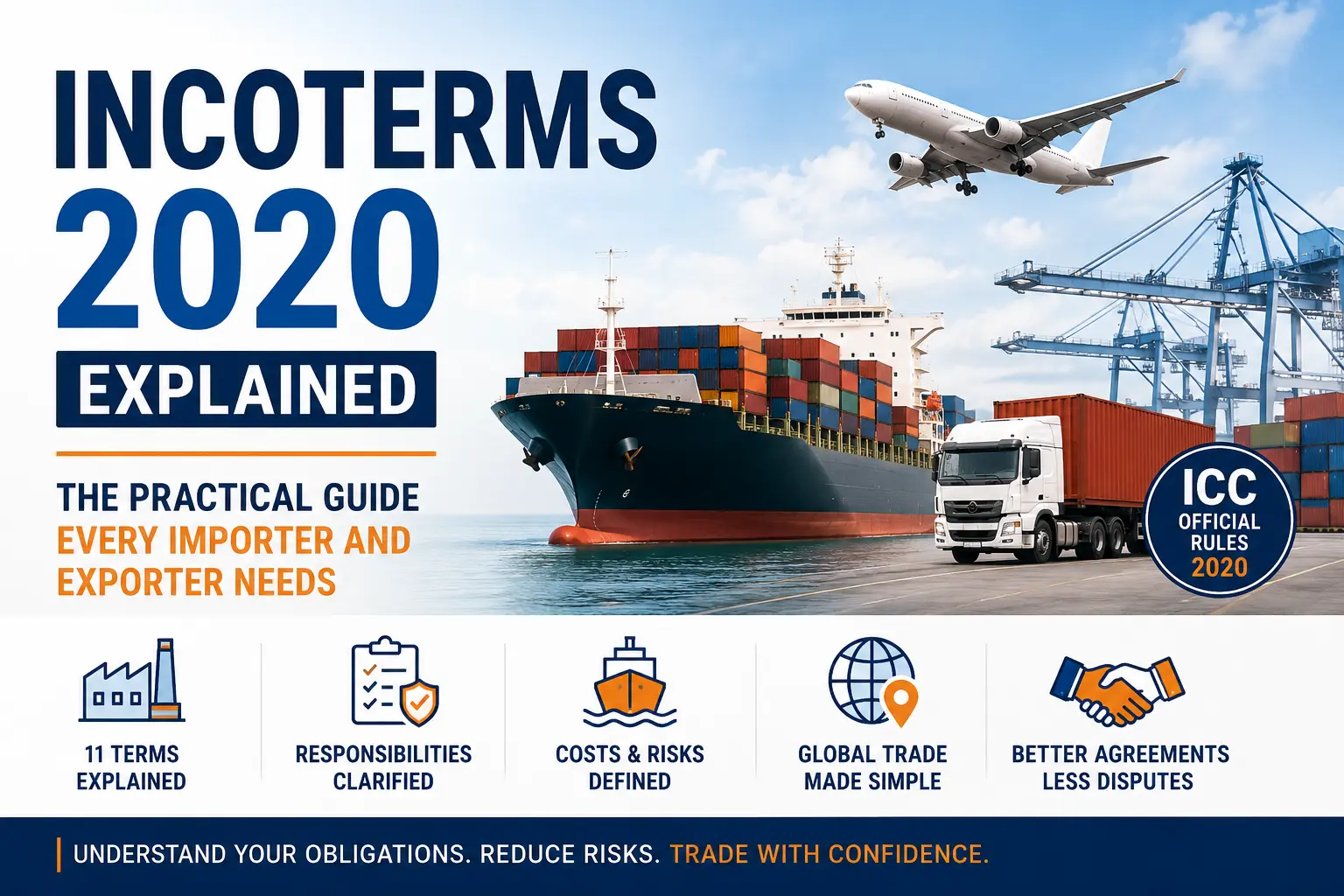
This guide covers all 11 Incoterms 2020 rules in plain English, the key changes from 2010, how to choose the right term for your trade, and the most expensive mistakes traders make. Whether you are a US importer buying electronics from Japan, a Ugandan business sourcing goods by sea, or a small e-commerce seller trying to understand what FOB actually means on an Alibaba listing, this is the resource you need.
Our team at UFI Shipping works with importers and exporters across multiple markets every day through our freight forwarding services, and the questions we get about Incoterms are constant. Here is everything we know, laid out clearly.
What Are Incoterms 2020?
Incoterms 2020 are a set of 11 standardized trade terms published by the International Chamber of Commerce (ICC) that define the responsibilities of buyers and sellers in international commercial transactions. Each term spells out who arranges transport, who pays for insurance, who handles customs, and exactly where risk transfers from seller to buyer.
They were updated from Incoterms 2010 to Incoterms 2020 to reflect how modern global trade actually works, including changes to container shipping practices, insurance requirements, and security obligations. The ICC periodically reviews and updates Incoterms, so it is always worth confirming with your freight forwarder that you are working from the current edition.
Every trader in every market needs to understand them. In the USA, Japan, Uganda, and every other trading nation, the Incoterm you choose shapes your costs, your liability, and your legal position if something goes wrong. The ICC estimates that Incoterms are used in hundreds of millions of contracts globally each year. Using the wrong one, or misreading one, is one of the most common and preventable causes of trade disputes.
The 11 Incoterms 2020 Rules Explained
The 11 Incoterms 2020 rules split into two groups. Seven terms apply to any mode of transport: road, rail, air, or sea. Four terms apply only to sea freight and inland waterway transport. Picking a term from the wrong group for your shipment is already one of the most common mistakes traders make, so understanding this distinction matters before anything else.
EXW: Ex Works
EXW means the seller’s job is done the moment the goods are available at their premises (factory, warehouse, or another named place). The buyer takes on all responsibility from that point, including loading the goods onto the transport.
Who pays what: The buyer handles everything, including export customs clearance in the seller’s country, all freight, insurance, and import clearance at the destination.
Risk transfers: At the seller’s premises, when goods are made available.
Real-world example: A Japanese textile manufacturer offers EXW Osaka. A US buyer would need to arrange a local agent in Japan to handle export customs, book the container, ship it across the Pacific, and clear customs in the USA. Every cost and every risk sits with the buyer from the factory gate.
Best suited for: Buyers who have strong logistics networks in the seller’s country and can manage export procedures themselves.
Common mistake: Many buyers, especially smaller importers from Uganda or smaller US businesses, agree to EXW thinking it simply means “pick up from the factory.” They then discover they have no way to handle export customs in a foreign country and no local contacts to manage loading. EXW is often the wrong choice for international buyers without local logistics support at origin.
FCA: Free Carrier
Under FCA, the seller delivers the goods to a named carrier or another nominated person at a named place. If that place is the seller’s premises, the seller is responsible for loading. Everywhere else, the seller does not need to load.
Who pays what: The seller handles export customs clearance and delivery to the named carrier. The buyer takes on freight, insurance, and import clearance from that point.
Risk transfers: When goods are delivered to the named carrier at the named place.
Real-world example: A Japanese electronics exporter ships FCA Tokyo (freight station). Once goods are with the freight forwarder at the named terminal, risk passes to the US buyer, who then arranges ocean freight and import clearance in Los Angeles.
Best suited for: Containerized shipments, air freight, and any modern multimodal transport.
Common mistake: Not being specific enough about the named place. “FCA Japan” is meaningless. “FCA Freight Station, Tokyo” gives both parties clarity on exactly where and when risk transfers.
CPT: Carriage Paid To
CPT means the seller pays for carriage to a named destination. However, and this catches many buyers off guard, risk transfers to the buyer when the seller hands the goods to the first carrier, not when the goods arrive at the destination.
Who pays what: Seller pays for transport to the named destination. Buyer assumes risk from handover to the first carrier and handles insurance and import clearance.
Risk transfers: When goods are handed to the first carrier.
Real-world example: A Chinese manufacturer ships CPT Kampala. The seller pays for transport all the way to Kampala, Uganda, but if the container is damaged at sea, the risk is on the Ugandan importer because risk transferred when the goods were handed to the shipping line in China.
Best suited for: Land freight, air freight, or multimodal shipments where the seller wants to control the main transport leg.
Common mistake: Buyers assume CPT means risk travels with the goods all the way to the destination. It does not. Buyers must arrange their own cargo insurance to cover the main carriage.
CIP: Carriage and Insurance Paid To
CIP is CPT with one important addition: the seller must also arrange and pay for cargo insurance. Under Incoterms 2020, CIP requires a higher level of insurance coverage than before (Institute Cargo Clauses A, the most comprehensive level).
Who pays what: Seller pays freight and insurance to the named destination. Risk still transfers to the buyer at handover to the first carrier, same as CPT.
Risk transfers: When goods are handed to the first carrier.
Real-world example: A US retailer importing specialty goods from Japan under CIP New York benefits from knowing the seller has arranged comprehensive insurance. Even so, risk in transit after handover to the carrier sits with the US buyer.
Best suited for: High-value cargo, manufactured goods, and shipments where the buyer wants seller-arranged insurance.
Common mistake: Confusing CIP with DDP. CIP does not include import clearance. The buyer still handles customs at destination.
DAP: Delivered at Place
DAP means the seller delivers goods to a named place in the buyer’s country, ready for unloading. The seller handles all carriage and bears risk all the way to that point. Import customs clearance and duties remain the buyer’s responsibility.
Who pays what: Seller pays all transport costs and bears risk to the named destination. Buyer handles import duties and taxes.
Risk transfers: When goods arrive at the named destination, ready for unloading.
Real-world example: A European supplier ships DAP Nairobi to a Ugandan importer. The goods arrive at the importer’s warehouse, and the importer then handles Uganda Revenue Authority clearance and pays any applicable duties.
Best suited for: Buyers who have a customs broker or established import process in their own country.
Common mistake: Ugandan importers, and importers in many developing markets, sometimes forget that DAP leaves them responsible for often complex or expensive local clearance. Budget for import duties before agreeing to DAP.
DPU: Delivered at Place Unloaded
DPU is the only Incoterm where the seller is responsible for unloading at the destination. The seller bears risk all the way until the goods are unloaded at the named place.
Who pays what: Seller covers all costs and risk including unloading at destination. Buyer handles import clearance and duties.
Risk transfers: Once goods are unloaded at the named destination.
Real-world example: A US auto parts importer receiving a shipment from Japan at their warehouse under DPU means the seller (or their agent) must unload the goods at the US warehouse. Risk does not transfer until unloading is complete.
Best suited for: Situations where the buyer lacks unloading equipment or capacity at the delivery point.
Common mistake: Sellers underestimate the cost of arranging unloading in a foreign country. This term can be expensive for sellers who have not planned for destination unloading costs.
DDP: Delivered Duty Paid
DDP is the maximum obligation for the seller. The seller delivers goods to the named place in the buyer’s country, fully cleared through import customs, with all duties and taxes paid. The buyer simply receives the goods.
Who pays what: The seller covers everything, including export clearance, international freight, insurance, import duties, and taxes in the buyer’s country.
Risk transfers: When goods are delivered to the named place, ready for unloading.
Real-world example: An Alibaba supplier in China offering DDP to a US Amazon FBA seller means the Chinese supplier handles customs clearance and pays US import duties. The US seller’s goods arrive at the Amazon fulfillment center ready to go.
Best suited for: E-commerce sellers, inexperienced importers, and buyers who want a completely landed cost with no surprises.
Common mistake: Sellers not fully understanding their tax obligations in the buyer’s country. DDP requires the seller to be registered or have an agent for customs purposes in the destination country. Not all sellers can legally offer DDP in every market.
FAS: Free Alongside Ship
FAS applies to sea freight only. The seller delivers goods alongside the nominated vessel at the named port of shipment. Risk transfers at that point.
Who pays what: Seller delivers goods to the port and places them alongside the ship. Buyer handles loading, ocean freight, insurance, and import clearance.
Risk transfers: When goods are placed alongside the vessel at the named port.
Real-world example: A bulk grain exporter in the USA sells FAS Houston. The buyer’s shipping line loads the cargo. Risk is on the buyer from the moment the grain is placed on the quayside.
Best suited for: Bulk cargo, commodities, or situations where the buyer controls the vessel and loading operations.
Common mistake: Using FAS for containerized cargo. If goods are in a container terminal before loading, the container is not “alongside the vessel” in the traditional sense. Use FCA for containerized shipments instead.
FOB: Free on Board
FOB is the most recognized, most used, and most misunderstood Incoterm in global trade. Under FOB, the seller delivers goods on board the nominated vessel at the named port of shipment. Risk transfers at that point.
Who pays what: Seller handles export clearance and delivery on board the vessel. Buyer pays for ocean freight, insurance, and import clearance.
Risk transfers: When goods are on board the vessel at the port of shipment.
Real-world example: A Japanese electronics manufacturer selling FOB Yokohama to a US importer means risk passes when the goods are loaded onto the vessel in Yokohama. The US buyer arranges and pays for the ocean freight to Los Angeles and handles US customs.
Best suited for: Bulk cargo, breakbulk, or situations where the buyer genuinely controls the main carriage from the loading port.
Common mistake: Using FOB for containerized shipments. In modern container shipping, the seller typically hands goods to a container terminal long before the vessel loads. The container may sit at the terminal for days. Using FOB means there is a gap where neither the standard FOB conditions nor the practical reality of the terminal apply clearly. For containers, FCA is the technically correct term. This is one of the most important practical issues Incoterms 2020 addressed, and we cover it in detail in the next section.
CFR: Cost and Freight
Under CFR, the seller pays for transport to the named destination port. Like FOB, risk transfers when goods are on board the vessel, not at the destination.
Who pays what: Seller pays freight to destination port. Buyer assumes risk from loading and handles insurance and import clearance.
Risk transfers: When goods are loaded on board the vessel at the port of shipment.
Real-world example: A Chinese manufacturer ships CFR Mombasa to a Ugandan importer. The freight cost to Mombasa is in the seller’s price. But if the ship encounters a storm and goods are damaged, the Ugandan importer bears that loss because risk transferred at loading in China.
Best suited for: Bulk or breakbulk sea freight where the buyer wants to see a freight-included price but can arrange their own insurance.
Common mistake: Buyers forgetting to arrange cargo insurance. Risk transfers early under CFR, and no insurance is mandated for the seller.
CIF: Cost, Insurance, and Freight
CIF is CFR with the addition of seller-arranged insurance. The seller pays freight and must provide minimum insurance coverage (Institute Cargo Clauses C under Incoterms 2020) to the named destination port.
Who pays what: Seller pays freight and arranges minimum insurance. Buyer assumes risk from loading and handles import clearance and destination charges.
Risk transfers: When goods are loaded on board the vessel at the port of shipment.
Real-world example: A textile exporter in Japan ships CIF Los Angeles. The US buyer gets a price that includes ocean freight and basic insurance. But once goods are on the vessel in Japan, risk is the buyer’s. The insurance the seller provides is the minimum required, not necessarily full value coverage.
Best suited for: Buyers who want freight costs in the quoted price and are comfortable managing import clearance.
Common mistake: Assuming CIF means the seller bears all risk to your port. It does not. Risk transfers at loading, before the ship even leaves the origin port. Also, the insurance under CIF is minimum coverage (Clauses C), which may not cover all perils. Many experienced buyers top up with their own all-risk policy.
Incoterms 2020 Comparison Chart
| Term | Transport Mode | Risk Transfers | Seller Pays | Buyer Pays | Best For |
|---|---|---|---|---|---|
| EXW | Any | At seller’s premises | Nothing (goods available) | Everything | Local pickup, experienced buyers |
| FCA | Any | At named carrier/place | Export clearance + delivery to carrier | Freight, insurance, import clearance | Containers, air, multimodal |
| CPT | Any | At first carrier | Freight to destination | Insurance, import clearance | Multimodal, seller controls freight |
| CIP | Any | At first carrier | Freight + insurance (Clauses A) to destination | Import clearance | High-value goods, multimodal |
| DAP | Any | At named destination | All freight and carriage | Import duties and clearance | Buyer handles own customs |
| DPU | Any | At destination (unloaded) | All freight + unloading | Import duties and clearance | Buyer has no unloading capacity |
| DDP | Any | At named destination | Everything including duties | Nothing (receive goods) | E-commerce, inexperienced importers |
| FAS | Sea/Inland waterway | Alongside vessel at origin port | Delivery to port | Loading, freight, insurance, import | Bulk/commodity, buyer controls vessel |
| FOB | Sea/Inland waterway | On board vessel at origin port | Export clearance + loading on vessel | Freight, insurance, import clearance | Bulk, breakbulk sea freight |
| CFR | Sea/Inland waterway | On board vessel at origin port | Freight to destination port | Insurance, import clearance | Bulk sea freight, buyer arranges insurance |
| CIF | Sea/Inland waterway | On board vessel at origin port | Freight + minimum insurance | Import clearance, destination charges | Sea freight, buyer wants freight-included price |
Key Takeaway: The seven “any mode” terms (EXW through DDP) work for containerized, air, and multimodal shipments. The four sea-only terms (FAS, FOB, CFR, CIF) apply to sea and inland waterway freight only. For containerized shipments, FCA, CPT, CIP, and DAP are generally more appropriate than FOB, CFR, or CIF.
Key Changes from Incoterms 2010 to Incoterms 2020
The 2020 update was not just a rebrand. Several changes have real, practical implications for how your contracts should be written.
DAT Renamed to DPU
Delivered at Terminal (DAT) became Delivered at Place Unloaded (DPU). The name change reflects a substantive point: delivery does not have to happen at a “terminal.” It can happen at any named place, including a buyer’s warehouse or a construction site, as long as the seller unloads the goods there. This gives traders more flexibility in naming the delivery point.
FCA Updated for Bill of Lading and Letter of Credit
This is the change that matters most for anyone using Letters of Credit (LCs) in their trade financing. Before 2020, traders using containerized shipments faced a practical problem. Banks require an On-Board Bill of Lading (stamped by the shipping line) to release payment under an LC. But under FCA terms, risk transfers when goods are handed to the carrier at the terminal, often days before the ship loads. Shipping lines would not issue an On-Board Bill of Lading until the ship actually departed, which meant the seller could not get paid under the LC until after they had already lost control of the goods.
Incoterms 2020 solved this. Under the new FCA rules, the buyer and seller can agree that the buyer will instruct its bank or the carrier to issue an On-Board Bill of Lading to the seller once the goods are loaded. This allows the seller to present compliant documents under an LC while also using the technically correct FCA term for containerized shipments. If you are financing international trade with Letters of Credit, this change alone is worth understanding in detail.
CIP Insurance Now Requires Higher Coverage
Under Incoterms 2010, both CIP and CIF required the same minimum insurance: Institute Cargo Clauses C (the most limited coverage). Incoterms 2020 changed this for CIP specifically. CIP now requires Institute Cargo Clauses A coverage, which is the most comprehensive level. CIF still requires only Clauses C minimum. If you are shipping high-value or fragile goods, CIP now offers significantly better default insurance protection than CIF.
New Security-Related Obligations
Incoterms 2020 explicitly addresses security-related requirements, including information sharing needed for export and import security filings. Both buyers and sellers now have clearer obligations to provide documentation and information needed for security screenings. For US importers dealing with CBP requirements, Japanese exporters managing export controls, and Ugandan traders dealing with port security processes, this clarity helps define who arranges what at each stage.
Own Transport Allowed Under FCA and D Rules
Incoterms 2020 explicitly recognizes that sometimes the seller or buyer uses their own transport rather than a hired carrier. The FCA and the D-group terms (DAP, DPU, DDP) now clearly account for this scenario. This matters for companies with in-house logistics, particularly for last-mile delivery arrangements.
Key Takeaway: The three most impactful changes are the FCA Bill of Lading fix (crucial for LC users), the higher CIP insurance standard (important for high-value goods), and the DPU flexibility (useful for non-terminal delivery points). If you have contracts written under Incoterms 2010, review whether these changes affect your terms before renewing those agreements.
How to Choose the Right Incoterm for Your Business
This is where most guides fall short. Listing what each Incoterm means is the easy part. Knowing which one to pick for your specific trade situation is where real value lies.
Before choosing an Incoterm, ask yourself these five questions.
1. Do you have control over freight arrangements? If you have established relationships with freight forwarders and carriers, you may want terms that give you that control (FOB, FCA, CPT as a buyer). If you do not, you may be better off letting the seller handle freight (CFR, CIF, DDP).
2. Where does risk need to transfer? Think about where you can realistically respond if something goes wrong. If you cannot manage a cargo claim at a foreign origin port, you do not want risk transferring there.
3. Are you importing into a country with complex customs processes? Markets like Uganda require navigating the Uganda Revenue Authority, pre-shipment inspections, and local port handling. An inexperienced importer may find that DAP or DDP gives them time to organize clearance without bearing transport risk simultaneously.
4. Are you using a Letter of Credit? If yes, use FCA with the new 2020 Bill of Lading provision rather than FOB for containerized cargo. This protects your ability to present compliant documents to the bank.
5. What mode of transport are you using? Sea freight in bulk? FOB or CIF may work. Containerized ocean freight? Use FCA, CPT, or CIP. Air freight? Stick to FCA, CPT, or CIP. Never use FOB, CFR, or CIF for air or multimodal shipments.
If You Are a US Importer Buying from Asia (Japan, China)
For containerized shipments from Japan or China, FCA at the named freight station in Asia is often the cleanest option. You control the freight, you choose your carrier, and risk transfers at a clear, documented point. If you want an all-in price from the supplier and you trust their freight arrangements, CIP to your named US port gives you comprehensive insurance too.
Avoid FOB for containers unless your supplier explicitly ships breakbulk. Many US importers still use FOB because it appears on supplier quotes, but the technical issues with FOB and containers mean you may have gaps in your risk coverage.
If You Are a Ugandan Importer Dealing with Sea Freight
Ugandan importers typically import via Mombasa (Kenya) or Dar es Salaam (Tanzania) before inland clearance. CIF to the destination port is common and gives you a landed sea freight price with basic insurance included. However, remember that CIF insurance is minimum only. Consider topping up with your own policy, especially for high-value goods.
If you have a reliable customs broker in Uganda but no freight experience at origin, CFR to Mombasa or Dar es Salaam lets you see the freight cost while leaving origin logistics to the seller. DAP Kampala works well if the seller has local delivery capability, but factor in your import duty obligations carefully.
If You Are a Japanese Exporter Selling to Global Buyers
Japanese exporters often default to FOB or CIF because these are the terms most buyers know. FOB Yokohama or CIF to the buyer’s destination port is commercially familiar. However, for containerized exports, FCA at the Tokyo or Osaka freight station is the technically correct alternative to FOB and avoids the container terminal gap problem.
For buyers who want everything handled, DDP can be a competitive offering, but only if you have customs clearance capability in the buyer’s country. DAP or DPU is often a better middle ground.
If You Are a Small Business with No Freight Expertise
Choose DDP if the seller offers it and the price is competitive. DDP means no surprises: one landed cost, no customs headaches, no separate freight invoices. The tradeoff is that you pay more up front and you trust the seller’s logistics efficiency.
If DDP is not available, working with a freight forwarder like UFI Shipping takes most of the complexity off your plate. Under FCA or CIF terms, your forwarder handles the ocean freight booking, customs clearance, and delivery, turning a complicated international shipment into a managed process.
Key Takeaway: There is no universally “best” Incoterm. The right choice depends on your freight experience, your trade finance method, your mode of transport, and how much risk you are willing to hold. When in doubt, consult your freight forwarder before signing the contract.
Most Common Incoterms 2020 Mistakes (and How to Avoid Them)
These mistakes cost traders real money. Every single one is avoidable.
Mistake 1: Using EXW for international trade when you have no export experience
What happens: You sign an EXW contract with a Chinese factory, then realize you have no agent in China to handle export customs clearance, arrange inland transport to the port, or book space on the vessel. Delays and demurrage charges pile up.
Cost consequence: Demurrage at Chinese ports can run hundreds of dollars per day. Arranging last-minute export agents adds cost and time pressure.
How to avoid it: If you cannot manage export logistics in the seller’s country, use FCA at minimum. The seller handles export clearance, you handle everything from the carrier onward.
Mistake 2: Confusing FOB and FCA for containerized shipments
What happens: You use FOB for a containerized shipment. The seller delivers the container to the terminal. The container sits for three days before the vessel loads. During that time, the container is damaged by another vehicle in the terminal. Neither FOB’s risk transfer point (on board the vessel) nor any clear FCA handover covers this gap cleanly.
Cost consequence: A disputed cargo claim, potential loss with no clear party responsible, and insurance complications.
How to avoid it: Use FCA for all containerized shipments. Name the specific freight station or terminal as the delivery point.
Mistake 3: Not specifying the named place clearly in the contract
What happens: The contract says “FOB China” or “DAP Uganda.” These are not specific enough. Which port in China? Which location in Uganda? Disputes arise over transport costs and risk transfer points.
Cost consequence: Legal disputes, unpaid invoices, and logistics paralysis while both parties argue over the contract.
How to avoid it: Always name the specific port, freight station, terminal, or address. “FOB Qingdao Container Port” and “DAP Buyer’s Warehouse, Plot 12, Industrial Area, Kampala” give both parties zero room for ambiguity.
Mistake 4: Assuming DDP covers all import duties
What happens: A buyer agrees to DDP and assumes all costs are covered. The seller delivers goods but the buyer still faces local handling charges, inspection fees, or port dues that the seller considered outside of DDP scope.
Cost consequence: Unexpected charges at destination, relationship friction with the supplier, and budget overruns.
How to avoid it: Agree explicitly in the contract which charges are included in DDP. Confirm whether local port handling, inspection fees, or security charges are the seller’s or buyer’s responsibility.
Mistake 5: Not aligning the Incoterm with your insurance policy
What happens: A US importer agrees to FCA terms. Risk transfers at the carrier in Japan. The importer’s cargo insurance policy only kicks in from the US port of arrival. There is a gap in coverage across the entire ocean voyage.
Cost consequence: A cargo claim for goods damaged at sea with no valid insurance to claim against.
How to avoid it: Before signing any contract, tell your insurance broker exactly which Incoterm you are using. Make sure your policy covers the goods from the point where risk transfers to you.
Mistake 6: Using sea-only terms (FOB, CIF) for air or multimodal shipments
What happens: A buyer agrees to CIF for an air shipment. CIF is a sea-only term. There is no defined risk transfer point for air freight under CIF, creating legal ambiguity if something goes wrong.
Cost consequence: Insurance claims can be rejected, and legal disputes can arise over which party held risk during transit.
How to avoid it: For air freight, always use FCA, CPT, or CIP. Check the transport mode before selecting any Incoterm.
Incoterms 2020 and Insurance: What You Must Know
Insurance is where Incoterms get most misunderstood. Understanding who is obligated to insure the goods, and at what coverage level, can save you from discovering a major gap after a loss.
Only two Incoterms require the seller to arrange insurance: CIP and CIF. Under every other term, including EXW, FCA, FOB, and DAP, neither party is obligated by the Incoterm itself to insure the cargo. Both parties are free to insure, but only CIP and CIF mandate seller-arranged cover.
Here is the key difference between CIP and CIF insurance under Incoterms 2020. CIP requires Institute Cargo Clauses A, which is “all-risks” comprehensive cover. CIF only requires Institute Cargo Clauses C, which is the most restricted level and excludes many common perils including theft, contamination, and damage from poor packing. If you are importing high-value goods, CIF insurance may not protect you adequately. CIP gives significantly better protection.
If you are buying under EXW, FCA, or FOB terms, risk passes to you at a point before goods arrive at your destination. You need your own cargo insurance to cover transit from that point. Do not assume the seller’s business insurance covers your goods once risk has transferred.
A practical step: before finalizing any Incoterm in a contract, share it with your freight forwarder and your insurance broker. Your forwarder, such as the team at UFI Shipping, can confirm what coverage you need based on the exact term and trade route.
Incoterms 2020 for E-Commerce and Small Business
E-commerce has changed who needs to understand Incoterms. It is no longer only large trading companies and commodity importers. Shopify store owners sourcing products from Asia, Amazon FBA sellers importing from China, and small businesses in Uganda ordering goods from Europe all need to make Incoterm decisions, often without a dedicated trade team to advise them.
The term you will see most often in e-commerce and Alibaba supplier listings is DDP or FOB. DDP is increasingly popular for cross-border e-commerce because it gives buyers a true landed cost. The seller handles everything, including customs clearance and duties, and delivers to the buyer’s warehouse or fulfillment center. For an Amazon FBA seller in the USA, DDP to the Amazon warehouse means no customs surprises, no separate duty invoices, and no logistics coordination on your end.
FOB appears constantly on Alibaba listings. It means the supplier is quoting you a price that covers getting the goods on the vessel at the Chinese port. Everything after that: ocean freight, insurance, US customs, and delivery to your warehouse, is your responsibility. Many first-time importers see “FOB” as a simple “ex-factory” price and then get a shock when the freight forwarder’s invoice arrives.
Practical checklist for small business owners choosing an Incoterm:
- Confirm the mode of transport (sea, air, courier) before selecting any term.
- Check whether your supplier can legally and practically handle export customs in their country.
- Ask your supplier what terms they normally use and why.
- Contact a freight forwarder before signing any large contract. Even a brief consultation can save significant cost.
- Match your insurance policy to the Incoterm’s risk transfer point.
- Always name the specific place, port, or terminal in the contract, not just the country.
Incoterms 2020 Chart and Quick Reference
A well-designed Incoterms 2020 chart should show all 11 terms laid out along a horizontal supply chain timeline, from the seller’s factory all the way to the buyer’s warehouse. The key visual element is the risk transfer arrow, which shifts from left (seller’s responsibility) to right (buyer’s responsibility) at different points depending on the term.
Suggested chart elements:
The horizontal axis should show the key stages of a typical international shipment: Seller’s Premises, Export Clearance, Origin Port/Terminal, On Board Vessel, Transit, Destination Port, Import Clearance, and Buyer’s Premises.
Each Incoterm should be plotted with two color-coded indicators: the point where the seller’s cost obligation ends (they stop paying) and the point where risk transfers (the buyer assumes liability for loss or damage). Note that for CIF, CFR, CIP, and CPT, these two points are different: the seller keeps paying for freight to the destination, but risk transfers much earlier.
The chart should also flag which terms apply to sea freight only (FAS, FOB, CFR, CIF) versus any mode of transport (the remaining seven).
Downloadable Reference: A one-page Incoterms 2020 PDF quick reference card, listing each term, mode of transport, risk transfer point, seller obligations, and buyer obligations, is a useful tool to share with suppliers and colleagues. You can request one from our team when you speak with UFI Shipping about your next shipment.
Frequently Asked Questions About Incoterms 2020
What is the difference between FOB and CIF in Incoterms 2020?
Under FOB (Free on Board), the buyer pays for ocean freight and insurance from the port of shipment. Under CIF (Cost, Insurance, and Freight), the seller pays for ocean freight and arranges minimum insurance to the destination port. Both terms transfer risk to the buyer when goods are loaded on the vessel, so the buyer bears transit risk under both. The difference is who pays the freight and who arranges insurance.
Which Incoterm is best for a buyer?
DDP (Delivered Duty Paid) gives buyers the most protection and the simplest landed cost. The seller handles everything including customs clearance and duties. However, buyers using DDP give up control over freight choice and timing. CIP is also buyer-friendly because the seller arranges comprehensive insurance.
Which Incoterm is best for a seller?
EXW (Ex Works) gives sellers the least obligation. Once goods are available at the seller’s premises, all responsibility transfers to the buyer. However, EXW can make the seller’s offering less attractive commercially. FCA is a practical alternative that still gives sellers limited post-factory obligations.
What replaced DAT in Incoterms 2020?
DAT (Delivered at Terminal) was replaced by DPU (Delivered at Place Unloaded). The change reflects that delivery with unloading can happen at any named place, not only at a formal terminal. The seller’s obligation to unload at the named destination remained the same.
Can Incoterms 2020 be used for domestic trade?
Technically yes. Incoterms are designed for international trade but can be incorporated into domestic contracts. However, for purely domestic transactions, local commercial law and domestic trade terms often provide more relevant frameworks. Incoterms work best in their intended context: cross-border trade.
What is the most commonly used Incoterm?
FOB (Free on Board) remains the most frequently used term globally, particularly in commodity and manufacturing trade. CIF is also widely used. However, for containerized shipments, FCA is technically more appropriate than FOB, and usage of FCA is growing as traders become more aware of this distinction.
Does Incoterms 2020 apply to sea freight only?
No. Seven of the 11 Incoterms 2020 rules apply to any mode of transport, including air, road, rail, and sea. Only four terms (FAS, FOB, CFR, CIF) are restricted to sea and inland waterway transport. Using sea-only terms for air or multimodal shipments is a common and potentially costly mistake.
What is the main difference between Incoterms 2020 and Incoterms 2010?
The key changes are: DAT was renamed DPU and expanded beyond terminal delivery; FCA was updated to allow an On-Board Bill of Lading for Letter of Credit transactions; CIP now requires higher insurance coverage (Clauses A vs the previous Clauses C); and both editions added clearer security-related obligations. The overall structure of 11 terms remains the same.
Which Incoterm gives the buyer the most control?
EXW gives buyers the most operational control, since the buyer manages all logistics from the seller’s premises onward, including export clearance. For buyers who have strong logistics networks in the seller’s country, EXW can be advantageous. For buyers without that capability, FCA or FOB provides a balance of control without requiring the buyer to manage foreign export procedures.
Which Incoterm is safest for an importer?
DDP is the safest for importers in terms of cost certainty and customs risk, since the seller handles everything. CIP is also very safe because the seller is obligated to provide comprehensive cargo insurance. DAP is safer than FCA or FOB for importers who want goods delivered to their country before risk transfers, but still want to manage their own customs clearance.
Getting Your Incoterms Right Protects Your Business
Choosing the right Incoterm is not a paperwork formality. It is a decision that directly affects your costs, your liability, and your ability to recover if something goes wrong in transit. The trader who understands these 11 terms walks into every contract negotiation with more confidence, better cost control, and fewer unpleasant surprises.
At UFI Shipping, we help importers and exporters across the USA, Japan, Uganda, and beyond navigate exactly these decisions. Choosing the right term, aligning it with your insurance, and structuring your contracts properly is part of what good freight forwarding looks like in practice.
Not sure which Incoterm applies to your next shipment? Our team can help you work through it. Get in touch with UFI Shipping today and let’s make sure your next trade contract is built on solid ground.