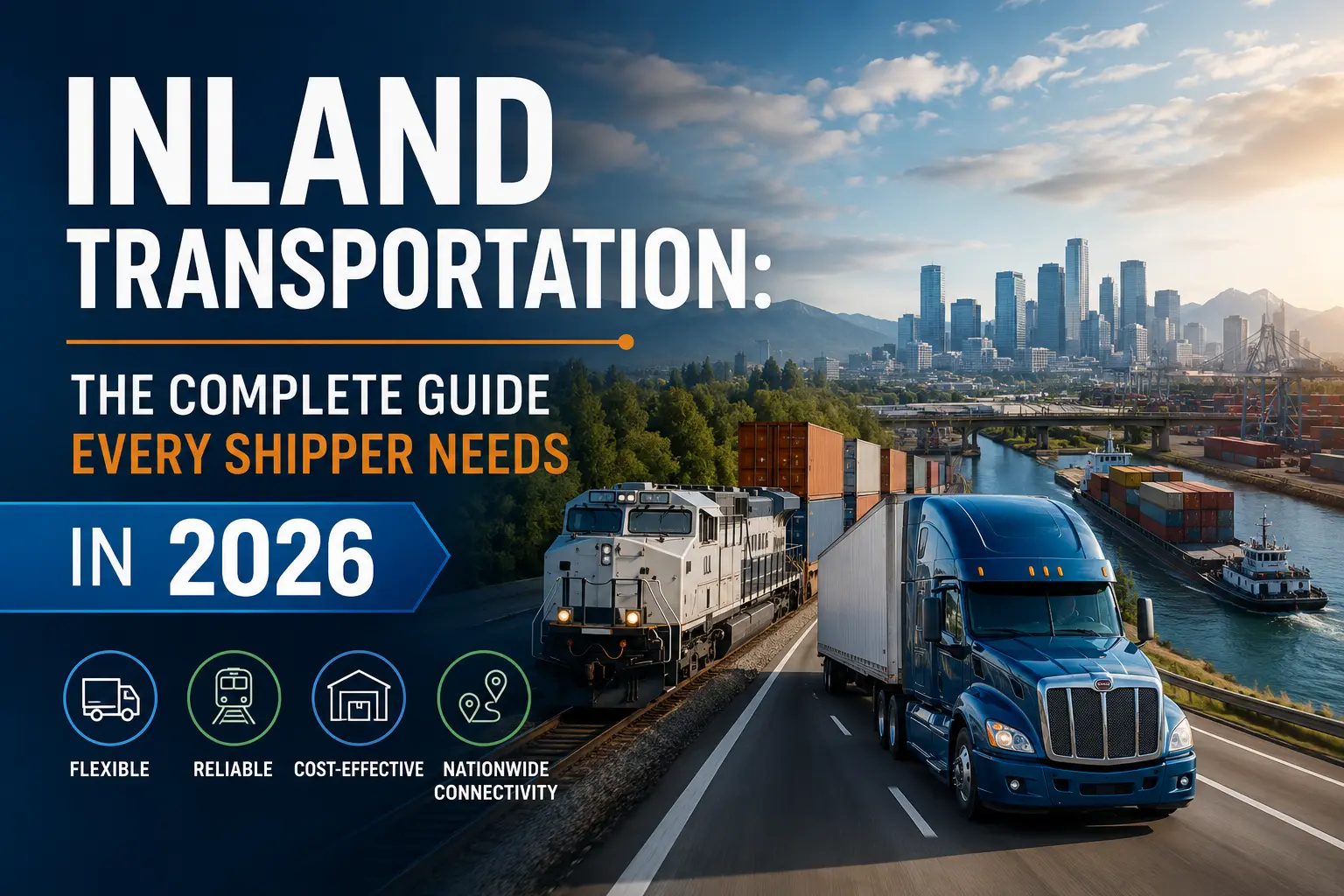
When your cargo arrives at the port, the job is only half done. The real test begins on land — trucks, trains, barges, and drayage moving your goods from the port gate to the warehouse shelf, factory floor, or customer doorstep. That journey is inland transportation, and for most importers and exporters, it is where delays happen, costs spiral, and supply chains either prove their worth or fall apart.
This guide covers everything you need to understand inland transportation clearly — what it is, how each mode works, what it costs, how to pick the right option, and what mistakes can quietly bleed your logistics budget dry.
What Is Inland Transportation?
Inland transportation refers to the movement of goods over land or navigable waterways within a country’s borders. It is the critical connector between international shipping and final delivery, bridging seaports, airports, distribution centers, manufacturing plants, and end customers.
Think of international shipping as a relay race. Ocean freight handles the long ocean leg, but inland transportation carries the baton from the port to the finish line. Without it, containers stack up at terminals, factories run out of parts, and customers wait.
It is worth knowing that the term covers two distinct phases in a typical shipment:
Pre-carriage — moving cargo from the shipper’s location to the port of loading. On-carriage — moving cargo from the port of discharge to the final destination.
Both phases rely on the same modes: road, rail, inland waterway, and in some cases, short-haul air. Getting these phases right is what separates a smooth supply chain from a costly, chaotic one.
Modes of Inland Transportation: How Each One Works
Road Transportation (Trucking)
Road freight is the backbone of inland logistics worldwide. Trucks can reach virtually any destination with road access — something no other mode can match. Whether it is a full container load (FCL) on a 40-foot flatbed heading to an inland container depot, or a smaller LTL (less-than-truckload) consignment sharing space with other cargo, road transport offers flexibility that rail and waterway simply cannot.
The tradeoff is cost over distance. Trucks are efficient for short to medium hauls, typically up to 500 miles (roughly 800 km). Beyond that, cost per ton-mile rises significantly compared to rail.
Key considerations for road transport:
- Door-to-door service with no transshipment
- Suitable for time-sensitive cargo
- Vulnerable to fuel price fluctuations, traffic congestion, and driver availability
- Weight and dimension restrictions apply on public roads (this matters for oversized industrial or automotive cargo)
Drayage: The First and Last Mile at the Port
Drayage deserves its own mention because it is frequently misunderstood. Drayage is the short-distance trucking that moves containers between the port terminal and a nearby rail depot, warehouse, or container freight station (CFS). It is typically under 50 miles.
If you are importing through a major port — say, moving containers out of the terminal to a local distribution center or to a rail ramp for an onward long-haul move — drayage is what makes that happen. It sits at the intersection of ocean freight and inland logistics, and delays here can trigger costly port storage fees (detention and demurrage).
For importers using UFI Shipping’s inland transportation services, drayage coordination is typically part of the end-to-end inland transport solution, which helps avoid the siloed handoffs that cause delays.
Rail Transportation
Rail shines for long-distance, high-volume cargo. Moving coal, grain, automobiles, chemicals, and intermodal containers hundreds or thousands of miles inland, rail is substantially cheaper per ton than trucking over those distances.
Intermodal rail — where shipping containers are moved directly from ocean vessels onto rail flatcars without unpacking — has transformed this mode. It connects ports to inland distribution hubs efficiently, especially in large continental markets like the US, China, and Europe.
The limitation is fixed infrastructure. Rail only goes where tracks exist. This means a drayage truck (or short-haul truck move) is almost always needed at both ends of a rail journey, making pure rail rarely the complete answer.
Inland Waterway Transportation (Barge)
Barges moving along rivers, canals, and lakes carry enormous volumes of bulk cargo at very low cost per ton. Agricultural products, construction materials, petroleum, and chemicals move by barge where navigable waterways exist.
The environmental case for inland waterway transport is strong: barges produce significantly lower CO₂ emissions per ton-kilometer than trucks. For bulk commodities that are not time-sensitive and originate or terminate near a river or canal, barges offer an economical and sustainable option.
The obvious constraint is geography. Waterway transport is only viable in regions with the right infrastructure — the Rhine-Main-Danube corridor in Europe, the Mississippi River system in the US, or specific river networks in Asia.
Pipelines
Pipelines are a specialized mode, carrying oil, natural gas, liquid chemicals, and water over fixed routes. They are the most cost-effective mode for what they carry, but serve a narrow range of industries. Not relevant for most shippers of manufactured goods or consumer products.
Haulage Types: Carrier Haulage vs. Merchant Haulage
This distinction matters when you are booking international shipments and deciding who controls the inland leg.
Carrier haulage means the ocean carrier (shipping line) arranges and takes responsibility for the inland transport — both pre-carriage to the port and on-carriage from the port. The carrier selects the trucker, and any damage or delay during that inland move is the carrier’s liability.
Merchant haulage means you, the shipper or consignee, arrange and control the inland transport independently. You choose the trucking company, bear the cost directly, and take on the associated liability. This gives more control and often more flexibility, but also more responsibility.
Many experienced importers prefer merchant haulage for the destination on-carriage, as it allows them to work with carriers they trust and negotiate their own rates.
What Does Inland Transportation Cost?
Cost is the question most guides avoid answering. Here is a practical breakdown.
Cost Factors That Affect Every Inland Shipment
| Factor | How It Affects Cost |
|---|---|
| Distance | Longer distance = higher fuel and driver costs |
| Mode | Rail cheaper per ton over long distances; road cheaper for short distances |
| Cargo weight and volume | Heavier/larger = higher cost; dimensional weight applies to air |
| Cargo type | Hazmat, refrigerated, or oversized cargo incurs surcharges |
| Fuel prices | Fuel surcharges (FSC) fluctuate with oil markets |
| Seasonal demand | Peak season (Q4) drives up truck rates significantly |
| Route and infrastructure | Tolls, port congestion charges, rural routes cost more |
| Insurance and cargo liability | Higher-value cargo needs more coverage |
Rough Cost Benchmarks (2026)
These ranges reflect general market conditions and vary significantly by country, carrier, and cargo specifics.
| Mode | Estimated Cost Per Ton-Mile (USD) | Best For |
|---|---|---|
| Full Truckload (FTL) | $0.05 – $0.12 | Short-medium haul, time-sensitive cargo |
| LTL (partial truck) | $0.12 – $0.25 | Small shipments, flexible routing |
| Intermodal Rail | $0.02 – $0.05 | Long-distance, high-volume cargo |
| Inland Barge | $0.01 – $0.03 | Bulk commodities near waterways |
| Drayage | $150 – $600 per container move | Port-to-depot/warehouse short haul |
Note that inland logistics costs represent a substantial share of total supply chain expenses. According to the 2026 freight market outlook, inland logistics remains a significant driver of total supply chain costs, with disruptions — congestion, equipment shortages, documentation holdups — often doing more damage to reliability than the ocean voyage itself.
How to Choose the Right Mode of Inland Transportation
This is the decision most shippers actually need help with. Here is a practical framework.
Step 1: How far is the cargo moving?
Under 500 km — trucking is almost always the right answer unless you are moving bulk commodities in large volumes. Over 500 km — rail becomes worth evaluating seriously.
Step 2: How time-sensitive is the shipment?
Urgent or just-in-time manufacturing cargo usually means trucking, or at minimum, intermodal with tight scheduling. If flexibility on delivery windows exists, rail and barge become viable.
Step 3: What is the cargo type and volume?
Bulk dry or liquid cargo (grain, coal, chemicals) near a waterway: barge first. High-value finished goods or electronics: secured trucking or air. Full container loads moving across a continent: intermodal rail.
Step 4: What is the infrastructure at origin and destination?
If the destination has a rail ramp or an inland port nearby, intermodal becomes practical. If it is a remote rural location, road is the only real option.
Step 5: What is the carbon footprint requirement?
Increasingly, large importers have sustainability commitments. Rail emits roughly 75-80% less CO₂ per ton-kilometer than trucking; barges even less. If your buyers or regulators require it, this becomes a deciding factor.
Mode Comparison Table
| Criteria | Road (Truck) | Rail | Inland Waterway | Air |
|---|---|---|---|---|
| Flexibility | Very high | Low | Low | Medium |
| Speed | High (short haul) | Medium | Low | Very high |
| Cost | Medium | Low (long haul) | Very low | Very high |
| Capacity | Medium | Very high | Very high | Low |
| Environmental impact | High emissions | Low | Very low | Very high |
| Infrastructure needed | Roads only | Rail network | Navigable waterway | Airport |
| Ideal cargo | Any, short distance | Bulk, containers | Bulk commodities | High-value, urgent |
Intermodal Transportation: Combining the Best of Each Mode
Very few international shipments rely on a single inland transport mode. The modern reality is intermodal — containers moving seamlessly from ship to rail to truck, with the shipper often unaware of the handoffs happening behind the scenes.
The logic is straightforward: each mode has strengths. Rail moves containers cheaply across vast distances. Trucks handle the flexible first and last mile. Waterways absorb bulk cargo economically. By combining them with standardized containers that transfer between modes without repacking, the whole supply chain becomes faster and cheaper than any single mode could achieve alone.
For importers working with goods from Japan to US destinations, for example, a typical flow might involve ocean freight from a Japanese port, drayage from the US port terminal to a rail ramp, rail to an inland hub, and final trucking to the distribution center. The ocean freight from Japan to USA leg and the inland transportation leg need to be planned together — delays at the port gate immediately cascade into the inland schedule.
Regulatory Compliance in Inland Transportation
Every country and region has its own rules for road, rail, and waterway transport. Ignoring these is one of the fastest ways to encounter fines, confiscation, or costly delays.
Key compliance areas include:
Weight limits on roads: Trucks in most countries operate under strict axle-weight restrictions. Overweight trucks face fines and can be turned away at weigh stations. This matters particularly when moving heavy industrial machinery or loaded containers.
Hazardous materials regulations: Chemicals, flammable liquids, compressed gases, and other dangerous goods require specific licensing, placarding, documentation, and routing. In many countries these rules are based on international standards set by the United Nations Economic Commission for Europe (UNECE), which develops and maintains the ADR agreement governing road transport of dangerous goods across Europe and many other regions.
Cross-state or cross-region documentation: Even within a single country, moving cargo across state or provincial lines may require additional permits, especially for oversized loads.
Driver licensing and hours-of-service: Truck drivers in most developed countries are subject to mandatory rest periods and limits on daily driving hours, which directly affects delivery scheduling.
Customs-bonded transport: When moving cargo that has not yet cleared customs — such as containers moving from a port to an inland customs examination station — the cargo must travel under bond. This requires specific documentation and often a licensed bonded carrier.
Staying compliant is not just about avoiding penalties. It also ensures your carrier’s insurance is valid if something goes wrong during transit.
Common Inland Transportation Mistakes (and How to Avoid Them)
1. Not Coordinating Port Pickup with Cargo Arrival
One of the most expensive mistakes in inland logistics is not having the drayage truck scheduled to pick up the container as soon as it is available at the terminal. Every day a container sits uncollected beyond the free time period costs demurrage (storage at the terminal) and can run into hundreds of dollars per container per day.
Fix: Coordinate your inland transport booking at the same time as your ocean freight booking. Get free time details upfront and schedule pickup before or on the availability date.
2. Choosing Mode Based on Price Alone
Taking the cheapest truck quote without considering transit time, carrier reliability, and equipment suitability leads to damaged cargo, missed delivery windows, and customer complaints that cost more than the savings.
Fix: Evaluate total landed cost, not just the transport rate. Factor in insurance, risk of delay, and downstream consequences.
3. Ignoring Seasonal Capacity Constraints
Trucking capacity tightens dramatically during peak retail seasons (Q3-Q4), harvest periods for agricultural cargo, and around major holidays. Shippers who wait until they have cargo ready to book often find rates have spiked 30-50% or equipment simply is not available.
Fix: Plan and book capacity in advance. For Q4 cargo, this means securing commitments in Q2 or Q3.
4. Inadequate Cargo Documentation
Missing or incorrect documentation at inland checkpoints — especially for cross-border moves, bonded cargo, or hazmat shipments — can halt a truck at a checkpoint for hours or days.
Fix: Prepare all documents (packing list, commercial invoice, customs release, permits) before cargo is collected, not while it is en route.
5. Underestimating Cargo Handling Requirements
Cargo that requires special loading equipment, temperature control, or extra securing measures often gets treated as standard freight when inland transport is booked without detailed cargo specifications.
Fix: Always communicate full cargo details — weight, dimensions, special requirements — to your inland carrier at the time of booking.
Inland Transportation and Sustainability in 2026
The environmental footprint of freight transport is now a business reality, not just a talking point. Major retailers, manufacturers, and governments are measuring and reporting Scope 3 emissions, which includes the emissions of their logistics providers.
In 2026, several trends are reshaping sustainable inland transport:
Electric and hydrogen trucks are becoming commercially viable for short and medium haul routes. While range remains limited for long-haul over-road transport, urban and regional drayage operations are seeing growing deployment of zero-emission vehicles.
Modal shift incentives — government programs in the EU, Japan, and parts of the US are actively funding rail and inland waterway infrastructure to shift freight off roads, reducing congestion and emissions simultaneously.
Carbon reporting requirements are increasingly mandatory. The International Maritime Organization (IMO) and regional bodies are extending emissions tracking requirements from shipping into the connected inland transport legs.
For importers with sustainability goals, choosing a freight partner who can provide verified carbon data for inland transportation legs is becoming standard practice, not a differentiator.
Technology Transforming Inland Transportation
GPS tracking is now baseline, not a premium feature. What has changed is the sophistication layered on top:
Real-time visibility platforms aggregate tracking data from multiple carriers, giving shippers a single dashboard view of all their inland shipments regardless of which trucking company or rail operator is moving them.
AI-powered route optimization adjusts routing in real time based on traffic, weather, border wait times, and capacity availability.
Predictive ETA tools draw on historical data, port dwell times, and current congestion to give realistic delivery estimates rather than guesses.
Digital documentation — e-bills of lading, e-CMR (electronic consignment notes for road transport), and customs pre-clearance systems — are cutting the paperwork delays that historically slowed inland moves at checkpoints and border crossings.
For importers and exporters, the practical impact is better visibility, fewer surprises, and faster problem-solving when something does go wrong.
Frequently Asked Questions
What is the difference between inland transportation and freight forwarding?
Freight forwarding is the broader coordination service that plans and manages the entire shipment — booking ocean freight, handling customs, and arranging inland transport. Inland transportation is specifically the physical movement of cargo over land or waterways. A freight forwarder typically arranges inland transport on your behalf as part of their service.
Who is responsible for inland transportation costs — buyer or seller?
This depends on the Incoterms agreed in the sale contract. Under EXW (Ex Works), the buyer arranges and pays for everything including inland transport from the seller’s premises. Under DDP (Delivered Duty Paid), the seller covers everything including inland transport to the buyer’s door. Most terms fall somewhere in between, with CIF and CFR leaving on-carriage to the buyer.
What is the difference between drayage and inland transportation?
Drayage is a specific type of inland transportation — short-distance trucking in and around a port area, typically under 50 miles. Inland transportation is the broader term covering all land-based freight movement regardless of distance.
How long does inland transportation typically take?
Short drayage moves can happen same-day or next-day. Regional trucking moves of 300-500 km typically take 1-2 days. Long-haul rail moves across a continent can take 5-10 days. Barge moves vary widely depending on the waterway and distance.
Is insurance mandatory for inland transportation?
It is not universally mandatory, but it is strongly advisable. Standard carrier liability is often limited and may not cover the full value of your cargo. Transit insurance (marine cargo policy covering inland legs) provides fuller protection.
How does inland transportation connect with ocean freight?
At both ends: pre-carriage moves cargo from the origin to the export port; on-carriage moves it from the import port to the final destination. The handoff points are the port terminals, where drayage connects the ship’s hold to the inland network.