You’ve just received your first LCL shipping invoice and there it is, a line item that says “CFS charges” with no explanation. You’re not alone. Thousands of importers and exporters see this charge every day and have no idea what they’re paying for or whether the amount is fair.
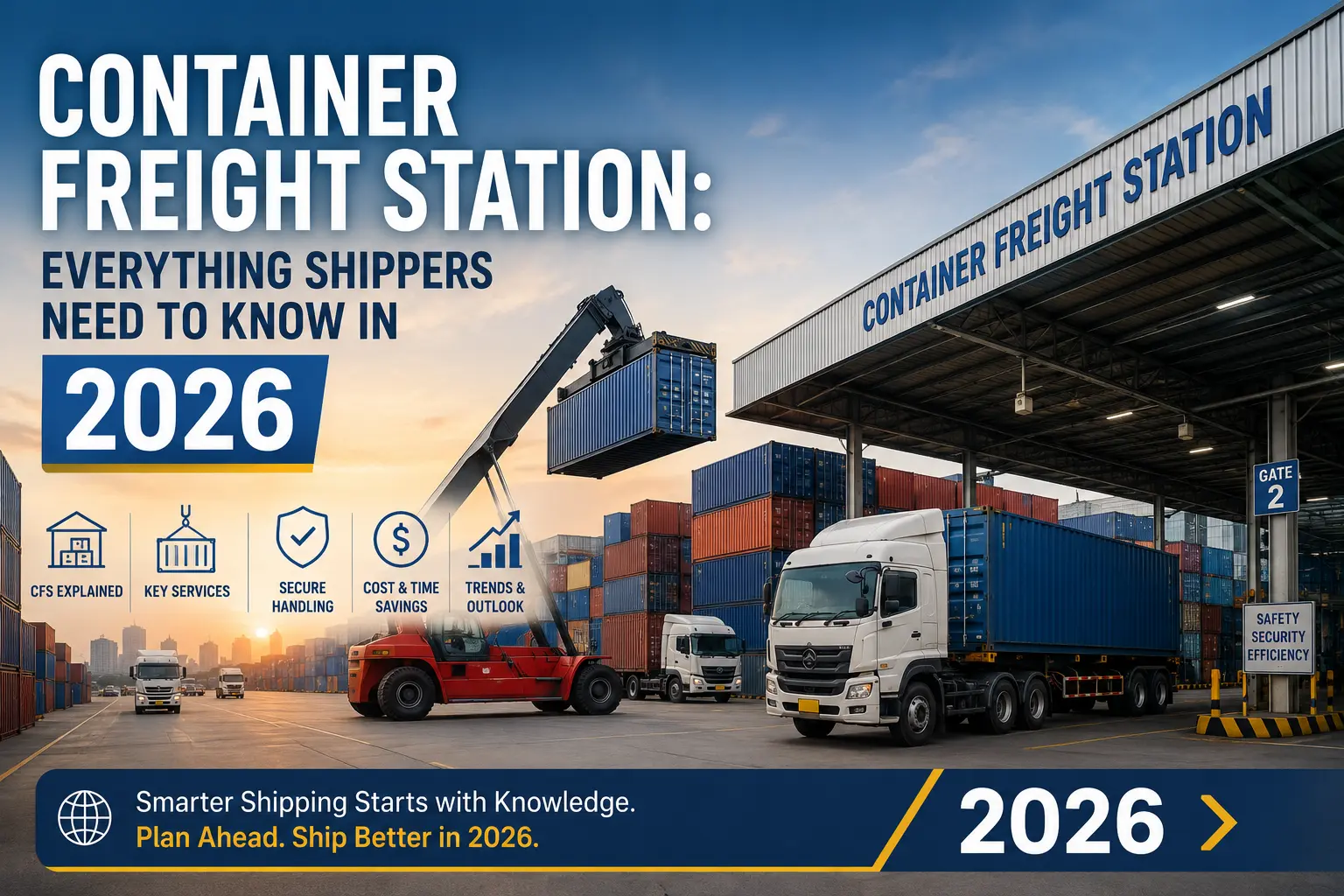
A Container Freight Station is a specialized facility where cargo from multiple shippers gets consolidated into one container before sailing, and separated again at the destination. It’s the backbone of LCL (Less than Container Load) shipping, and understanding how it works can save you real money and real headaches.
This guide covers everything from what CFS means and how it operates step by step, to exactly what you’ll pay and why, plus how to choose the right one for your lane. Whether you’re shipping from Osaka to Los Angeles or Kampala to Yokohama, this is the resource you needed before your last shipment.
What Is a Container Freight Station?
Think of a Container Freight Station as a sorting hub, a warehouse facility located near a seaport where smaller shipments from many different companies get grouped together into a single full container. Once that container reaches its destination port, the same type of facility breaks it apart again and hands each shipper’s goods back to the right recipient.
The analogy that works best is a post office. When you drop a parcel at your local post office, staff sort it alongside hundreds of other parcels heading to the same region, load them into a single delivery van, and then separate them again at the regional hub before final delivery. A CFS operates on exactly that principle, just at the ocean freight scale.
In shipping terminology, CFS exists specifically to serve LCL shipments. If your cargo doesn’t fill an entire 20-foot or 40-foot container, you share that container with other shippers moving goods to the same destination. The CFS is where that sharing gets organized, documented, and executed.
Every LCL shipment touches two CFS facilities: one at the origin port (the export CFS) and one at the destination port (the import CFS). Some shippers also hear the term LCL consolidation warehouse used in conversation. That’s simply another name for the same facility.
Here’s a simple example. Imagine you’re a furniture exporter in Kampala, Uganda, shipping 10 CBM of handcrafted goods to Osaka, Japan. Your cargo isn’t enough to fill a full container. At the origin CFS near the Port of Mombasa, your goods get loaded alongside shipments from two or three other Ugandan exporters, all heading to Japan. One sealed container sails. At the destination CFS in Osaka, your furniture gets separated from the others and prepared for your buyer to collect.
How Does a Container Freight Station Work? Step by Step
The full journey of an LCL shipment through a CFS has two halves: the export side at origin and the import side at destination. Here’s how each stage works in practice.
Export Side (Origin CFS)
Step 1: Cargo arrives at the CFS. You, or your trucking company, deliver your shipment to the origin CFS before the CFS cut-off date. This deadline is non-negotiable. Miss it and your goods wait for the next available sailing.
Step 2: Receiving and inspection. CFS staff weigh your cargo, measure its volume, and check it against your packing list. They’ll flag discrepancies, damaged packaging, or prohibited items before anything moves further. This step protects both you and the other shippers sharing your container.
Step 3: Documentation preparation. The CFS coordinates with your freight forwarder to prepare the Bill of Lading, packing list, and customs export declaration. In Japan, this ties into the NACCS (Nippon Automated Cargo and Port Consolidated System). In the USA, the Automated Export System (AES) filing happens at this stage.
Step 4: Consolidation (stuffing). Once enough LCL shipments are gathered for a given destination, CFS workers load them into a full container in a sequence that balances weight distribution, cargo compatibility, and delivery order. This process is called stuffing or consolidation.
Step 5: Container moves to the Container Yard. The sealed container gets transferred to the Container Yard (CY) at the port terminal, where it waits for vessel loading. From this point, it’s treated just like any other FCL shipment.
Import Side (Destination CFS)
Step 6: Container arrives and moves to destination CFS. After the vessel berths and the container clears port entry, it gets delivered to the destination CFS. This could be the Port of Los Angeles for US-bound cargo, Yokohama or Kobe for Japan, or the Kampala Inland Container Depot (ICD) for Uganda-bound goods.
Step 7: Customs inspection. Customs authorities examine the manifest before releasing individual shipments. US Customs and Border Protection (CBP) may examine containers selected for inspection. Japanese Customs, under Tokyo Customs or Yokohama Customs jurisdiction, applies its own protocols. In Uganda, the Uganda Revenue Authority (URA) manages customs clearance and has increased its use of scanner technology at the Kampala ICD in recent years.
Step 8: Deconsolidation (unstuffing). CFS staff unload the container and sort each shipper’s goods separately. Your cargo gets tagged, placed in a designated storage area, and matched back to your shipment reference.
Step 9: Notification and collection. The CFS notifies you or your customs broker that your cargo is available. You can arrange to collect it directly or have the CFS organize CFS to door delivery as part of your freight package.
Pro Tip: Missing your CFS cut-off date can delay your shipment by an entire vessel cycle, often 7 to 14 days. Always confirm the cut-off with your freight forwarder at least 72 hours before your planned delivery date.
CFS Charges Explained: What You Actually Pay and Why
CFS charges are one of the most misunderstood line items in an LCL invoice. They’re not a hidden markup. They’re a real service cost that covers the physical handling of your cargo at both ends of the shipment.
The main CFS fee covers stuffing and unstuffing labor, warehouse handling, storage during consolidation, forklift operations, and sometimes documentation processing. The fee is typically quoted per CBM (cubic meter) or per W/M (weight or measurement, whichever is greater). A 500kg shipment measuring 2 CBM, for example, would be charged at 2 CBM if the volume rate produces a higher charge, or at the weight equivalent if the carrier’s conversion favors that.
Typical CFS fee ranges vary significantly by region. At major US ports like Los Angeles and Long Beach, CFS handling fees generally run between $40 and $80 per CBM for standard dry cargo. At Japanese ports in Yokohama, Osaka, and Kobe, expect approximately JPY 3,000 to JPY 7,000 per CBM depending on the facility and the freight forwarder. In Uganda, CFS and ICD charges vary considerably based on the facility, commodity type, and whether goods transit through Mombasa before reaching the Kampala ICD.
Who pays depends on your Incoterms. Under EXW (Ex Works) and FOB (Free on Board) terms, the buyer typically absorbs the destination CFS charges. Under CIF (Cost, Insurance, Freight), the seller controls the freight arrangement but the buyer still usually pays destination handling at the CFS. Spell this out clearly in your sales contract before the shipment moves.
Beyond the base fee, watch for these additional charges: waiting fees if your driver arrives outside operating hours, overtime handling charges for urgent releases, demurrage if your cargo sits past the free storage days, and last-mile delivery costs if you opt for CFS-to-door service rather than collecting your cargo yourself.
Pro Tip: Always ask your freight forwarder for a full CFS fee breakdown before confirming your LCL booking. A surprise CFS charge at destination is one of the most common complaints among first-time LCL shippers, and it’s entirely avoidable with one simple question upfront.
| Fee Type | What It Covers | Who Typically Pays |
|---|---|---|
| Origin CFS Fee | Stuffing / consolidation labor and handling | Seller (under EXW/FOB terms) |
| Destination CFS Fee | Unstuffing / deconsolidation and sorting | Buyer (consignee) |
| CFS Storage Fee | Cargo held beyond free storage days | Consignee |
| Documentation Fee | B/L preparation, packing list, customs docs | Depends on agreement |
CFS vs CY (Container Yard): What’s the Difference and When to Use Which
The CFS vs CY question comes up constantly among shippers who are scaling their volumes. The core distinction is straightforward: CFS handles LCL shipments through shared containers, while a Container Yard (CY) handles FCL shipments where one shipper uses the full container. The implications for your shipping strategy, however, go deeper than that.
A CFS facility is typically located off-dock or just outside the port perimeter. Your cargo gets trucked to the CFS, consolidated there, and then the sealed container moves to the port’s Container Yard before vessel loading. A CY, by contrast, sits inside the port terminal. When you ship FCL, your loaded container goes directly to the CY without any intermediate sorting facility.
When CFS makes sense: if your shipment is under 15 to 20 CBM, or if you’re shipping goods that don’t justify booking an entire container, LCL through a CFS is almost always the more economical option. E-commerce sellers, small manufacturers, and first-time exporters nearly all benefit from the cost-sharing that a CFS enables.
When CY makes more sense: once your regular shipment volumes consistently fill or nearly fill a 20-foot container, generally around 25 CBM or more, the per-unit economics shift in favor of FCL. You avoid CFS handling fees, your cargo has fewer touchpoints with less risk of damage or delay, and transit times tend to be more predictable.
You’ll also see these four combinations listed on Bills of Lading: CFS/CFS (LCL both ways, most common for small shipments), CFS/CY (LCL at origin, FCL delivery at destination), CY/CFS (FCL at origin, LCL breakdown at destination), and CY/CY (full container both ways). Understanding which applies to your shipment helps you read your documents correctly and anticipate charges.
| Feature | CFS (Container Freight Station) | CY (Container Yard) |
|---|---|---|
| Cargo type | LCL, shared container | FCL, full container |
| Location | Near port / off-dock facility | Inside port terminal |
| Cargo handling | More touchpoints during consolidation | Fewer touchpoints, direct loading |
| Cost for small volumes | Lower per CBM for small shipments | Higher, full container cost regardless |
| Best for | SMEs, e-commerce, trial shipments | High-volume shippers, regular large orders |
Types of CFS Shipments
LCL cargo can move through a Container Freight Station in four different configurations, and the right one depends on your setup as a shipper and the services your freight forwarder offers.
CFS to CFS (pier to pier) is the most common arrangement for LCL freight. The seller delivers cargo to the origin CFS, and the consignee collects from the destination CFS. This is the default for businesses that handle their own local trucking at both ends.
CFS to Door is a popular option for importers who want the freight forwarder to handle last-mile delivery. The cargo consolidates at the origin CFS as normal, but at the destination the forwarder arranges trucking directly to the consignee’s warehouse or address. This works well for e-commerce businesses importing goods to US fulfillment centers or Japanese distribution hubs.
Door to CFS works in reverse. The shipper’s freight forwarder arranges pickup from the manufacturer’s factory or warehouse, and the cargo gets delivered to the destination CFS for the consignee to collect. This suits situations where the exporter has more control over inland logistics than the importer.
Door to Door is the most comprehensive option. The freight forwarder manages the entire journey from the seller’s premises to the buyer’s address, with the CFS handling happening in the background. Many first-time shippers choose door-to-door arrangements through UFI Shipping’s freight forwarding solutions precisely because it removes the complexity of managing each leg separately.
Why Container Freight Stations Matter for Small and Mid-Size Businesses
Before CFS infrastructure became widely available, shipping internationally was largely the domain of large corporations with enough volume to fill containers regularly. A small manufacturer or growing e-commerce brand had limited options: ship by air at significant cost, or wait until they had enough stock to justify a full container.
The Container Freight Station changed that. By enabling cost-sharing across multiple shippers, CFS made it economically practical for a tea exporter in Uganda shipping 5 CBM to access the same global shipping lanes as a large multinational. Ten shippers splitting one container’s ocean freight, port fees, and documentation costs means each pays a fraction of what they’d pay for a full container.
This matters differently across regions. In Japan, precision manufacturing and artisan goods producers frequently ship small batches of high-value products globally. LCL through Japanese CFS facilities at Yokohama, Kobe, or Osaka is a routine, well-organized process. In the USA, the growth of cross-border e-commerce has made LCL and CFS services increasingly important for importers bringing goods from Asia into Los Angeles or Long Beach. In Uganda and East Africa, growing agricultural exports and consumer goods imports have driven demand for better CFS services at the Kampala ICD and Mombasa gateway.
For any business that hasn’t yet reached full-container volumes, understanding LCL shipment processes and how the CFS fits into them is essential knowledge. Without CFS infrastructure, international trade for small businesses would be significantly more expensive and logistically impractical.
Choosing the Right Container Freight Station: 6 Things to Look For
Not all CFS facilities offer the same quality of service, and the one your freight forwarder partners with can directly affect your shipment’s transit time, safety, and final landed cost. Here’s what to evaluate.
1. Port proximity and connectivity. A CFS that sits close to the main port terminal reduces trucking time and cuts the risk of missing vessel cut-off windows. Ask how far the facility is from the Container Yard and whether it has dedicated transport arrangements with the port.
2. Customs clearance support and licensing. A CFS that operates as a licensed customs examination station streamlines your clearance process considerably. Many do in the USA under CBP authorization, in Japan under Tokyo Customs or Yokohama Customs jurisdiction, and in Uganda under URA licensing. Without this, customs examinations may require moving your cargo to a separate government facility, adding time and cost.
3. Handling of special cargo. If you’re shipping refrigerated goods, hazardous materials, or oversized items, confirm the CFS has the appropriate equipment, licensing, and storage. Not every facility is equipped to handle reefer containers or IMDG-classified dangerous goods.
4. Digital tracking and cargo visibility. A modern CFS should give you or your freight forwarder real-time updates on when your cargo was received, weighed, stuffed, and transferred. Some facilities offer online portals; others rely on email notifications. Either way, you need to know where your goods are at every stage.
5. Free storage days offered. Most CFS facilities offer a window of free storage, typically 3 to 5 calendar days at destination, before demurrage charges kick in. If your customs clearance takes longer than expected, storage fees accumulate quickly. Know the policy before your cargo arrives.
6. Reputation and compliance record. A CFS with a history of customs violations, cargo damage claims, or delayed releases is a liability. Ask your freight forwarder for references, or check whether the facility holds relevant certifications. Compliance with World Customs Organization guidelines on secure trade facilitation is a meaningful indicator of a well-run operation.
Common CFS Mistakes Importers and Exporters Make
Experience in this industry shows that the same few mistakes come up again and again, and most of them are entirely preventable.
Missing the CFS cut-off date is the most costly and most avoidable error. When you miss it, your goods sit at the CFS until the next available consolidation run, which can mean missing a weekly sailing. On busy lanes like Tokyo to Los Angeles or Mombasa to Osaka, that delay can cascade into 10 to 14 additional days of transit time. Confirm your cut-off date the moment you book, and build a buffer.
Not accounting for CFS charges in your landed cost calculation catches a lot of first-time importers off guard. The ocean freight quote your supplier sends often excludes destination CFS fees entirely. By the time your cargo arrives, you’re looking at additional charges you didn’t budget for. Always ask for a full cost breakdown, including destination handling, before you commit.
Choosing CFS over CY when your volume justifies FCL, or the reverse, affects both your costs and your cargo’s security. If you’re consistently shipping 18 to 20 CBM, you’re likely at the breakeven point. Running the comparison with your freight forwarder before each booking is worth 15 minutes of your time.
Not verifying documentation requirements for the destination country is another common slip. Japan requires specific HS code accuracy for duty calculation. The USA’s ISF (Importer Security Filing) must be submitted at least 24 hours before vessel departure, a requirement tied to the CFS process that many first-time importers don’t know about. Uganda’s URA has its own pre-arrival declaration requirements that affect how quickly your cargo clears the Kampala ICD.
Assuming door-to-door means no CFS involvement is a mistake too. The CFS is still in the chain. It still has cut-off dates. It still generates charges. Your freight forwarder handles it for you, but that doesn’t make the CFS invisible. It just means you’re relying on someone else to manage it correctly, which is exactly why choosing a reliable partner matters.
Frequently Asked Questions About Container Freight Stations
Q: What is a Container Freight Station (CFS)?
A Container Freight Station is a logistics facility located near a seaport where LCL cargo from multiple shippers gets consolidated into a single container for export, and deconsolidated again on arrival at the destination. It enables small and mid-size shippers to access ocean freight services without needing to fill an entire container on their own.
Q: What are CFS charges in shipping?
CFS charges are fees levied by the Container Freight Station for handling your cargo, including receiving, weighing, consolidating at origin, and deconsolidating at destination. They are typically calculated per CBM or per W/M and are separate from your ocean freight rate. Both origin and destination CFS charges can appear on your invoice depending on your Incoterms.
Q: What is the difference between CFS and CY in shipping?
CFS handles LCL cargo where multiple shippers share one container. CY handles FCL cargo where one shipper uses the full container. CFS facilities are usually located off-dock near the port, while a CY sits inside the port terminal. If your shipment is under roughly 15 to 20 CBM, CFS is typically the right choice.
Q: How long does cargo stay at a Container Freight Station?
At the origin CFS, cargo typically stays 1 to 3 days while consolidation is organized before the container moves to the port. At the destination CFS, most facilities offer 3 to 5 free storage days after the container is unstuffed. After that, daily storage fees apply. Customs examination delays can extend the time cargo sits in the CFS, so prompt clearance is important.
Q: What is a CFS cut-off date?
The CFS cut-off date is the deadline by which your cargo must arrive at the origin Container Freight Station to be included in the next scheduled consolidation and vessel sailing. Missing this date means your shipment waits for the next available sailing, which on many lanes means a delay of 7 to 14 days. Your freight forwarder should provide this date when you confirm your LCL booking.
Q: Is CFS the same as a warehouse?
Not exactly. A CFS performs warehousing functions such as receiving, storing, and releasing cargo, but its primary purpose is consolidation and deconsolidation of LCL shipments. It’s a logistics processing facility tied to port operations and customs procedures, not a general-purpose storage warehouse. Cargo stays at a CFS for a relatively short time compared to a bonded warehouse or distribution center.
Q: Who pays CFS charges, buyer or seller?
It depends on the Incoterms agreed in your sales contract. Under EXW or FOB terms, the buyer generally pays the destination CFS fee. The seller may pay the origin CFS fee depending on the booking arrangement. Under CIF terms, the seller controls the freight but the buyer still typically absorbs destination handling charges. Always confirm who bears each fee before the shipment moves.
Q: How does CFS work for LCL shipments?
For an LCL shipment, your cargo goes to the origin CFS before the cut-off date. The CFS receives, inspects, and documents your goods, then consolidates them with other shipments into a single full container. That container sails to the destination, where another CFS unstuffs it and separates your goods for customs clearance and collection or delivery to your address.
Final Thoughts
A Container Freight Station is the infrastructure that makes international shipping accessible to businesses of every size. Once you understand how the CFS process works, where the charges come from, and how to prepare your shipment to move through it efficiently, LCL shipping stops being intimidating and starts being a genuine competitive advantage for your supply chain.
Whether your cargo is moving between Kampala and Osaka, Los Angeles and Tokyo, or anywhere else across the global trade network, the same principles apply: know your cut-off dates, understand your CFS charges before you book, choose the CFS/CY configuration that fits your volume, and work with a freight partner who can guide you through each step.
If you’re shipping LCL cargo to or from Japan, the USA, or Uganda, working with an experienced freight partner makes all the difference. Explore UFI Shipping’s LCL and freight forwarding services to get a quote and expert guidance for your next shipment.