Table of Contents
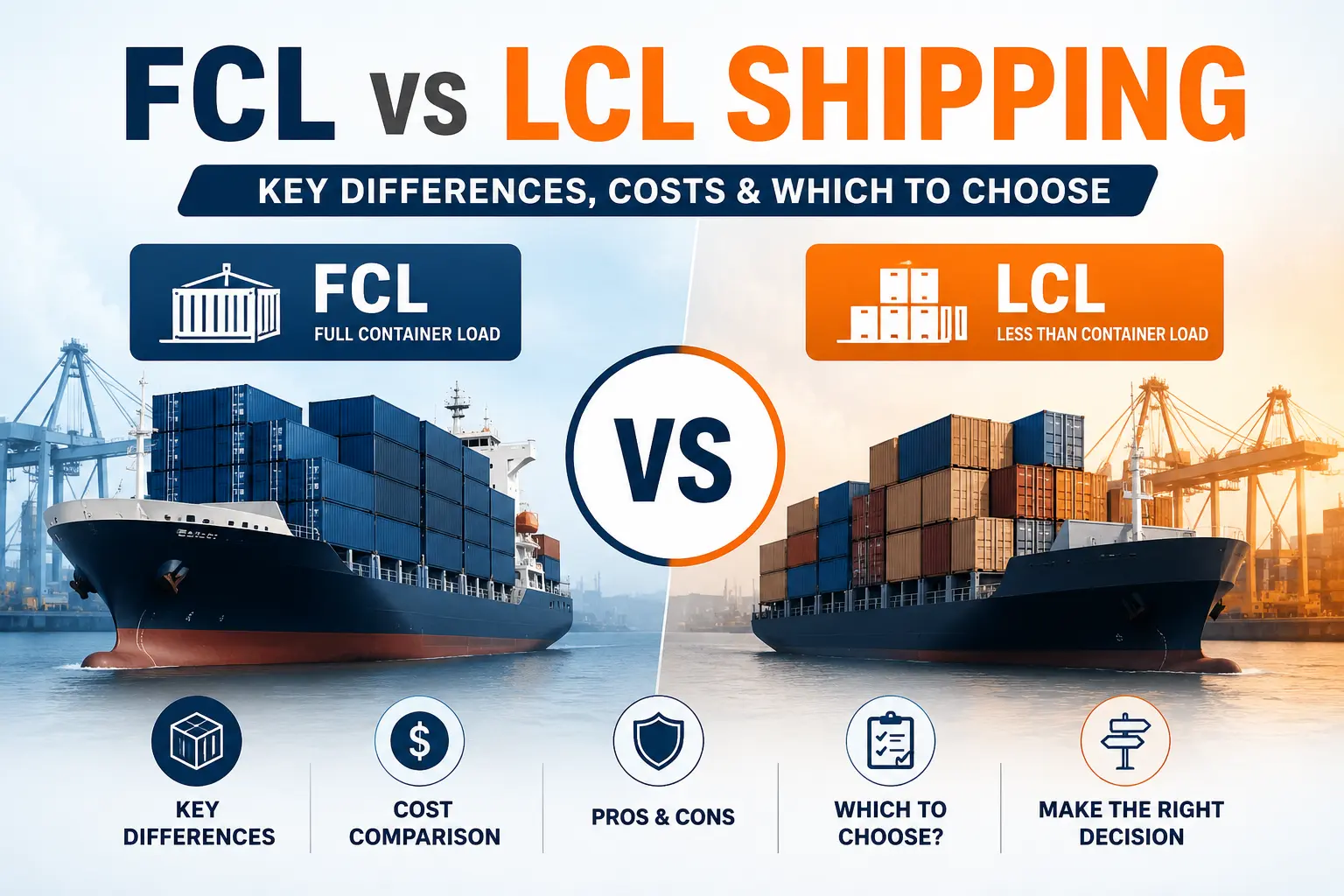
You book a shipment. Your freight forwarder asks: FCL or LCL? If you hesitate even for a second, this guide is for you.
That single decision affects how much you pay, how fast your cargo arrives, how safe it stays in transit, and how smoothly it clears customs. Most shippers pick based on habit or guesswork. The ones who pick based on actual math save real money — on every single shipment.
This guide breaks down everything: real costs, hidden charges most people never see coming, transit time differences, customs risk, and a clear decision framework so you always know which option makes sense for your cargo.
What Is FCL (Full Container Load)?
FCL means you book an entire shipping container exclusively for your cargo. The container is loaded at origin, sealed, and stays sealed until it reaches the destination. Nobody else’s goods go inside. You pay a flat rate for the container regardless of whether you fill it to the ceiling or leave some space unused.
Two standard sizes handle the majority of ocean freight:
A 20-foot container gives you roughly 28 to 33 cubic meters of usable space and can carry around 21,000 to 22,000 kilograms of cargo. A 40-foot container roughly doubles that volume, with 56 to 66 cubic meters of usable space. High-cube versions add extra vertical clearance, which matters for bulky, lightweight goods like furniture or mattresses.
FCL works best for businesses shipping in volume — typically anything above 13 to 15 cubic meters where the math starts to favor a full box over shared space.
What Is LCL (Less Than Container Load)?
LCL means your cargo shares a container with shipments from other companies. A consolidator — usually operating at a Container Freight Station (CFS) near the origin port — combines multiple smaller shipments into one full container. The container sails across the ocean, and at the destination CFS, it gets unpacked and each shipper’s goods are separated for individual delivery.
You pay only for the space your cargo occupies, priced per cubic meter (CBM) or per 1,000 kilograms of chargeable weight, whichever is greater.
That sounds like a great deal. And for small shipments, it genuinely is. But once your volume starts growing, LCL per-CBM rates add up fast — often crossing the cost of a full container before most shippers realize it.
The Real Cost Breakdown: Where the Math Actually Matters
This is where most guides fall short. They say “FCL is cheaper for big shipments, LCL is cheaper for small ones.” That is technically true and practically useless without knowing the breakeven point.
The general rule: 13 to 15 CBM.
Below this volume on most trade lanes, LCL is more economical. Above it, FCL starts winning on cost even though you are paying for the full box. Why? Because LCL pricing is not just the per-CBM ocean rate. It includes handling at origin CFS, handling at destination CFS, and documentation fees — charges that stack up on every single shipment regardless of size.
A 10 CBM LCL shipment might look cheaper than an FCL container on paper. But once you add origin CFS handling, destination CFS handling, and the per-CBM rate, the gap narrows dramatically. By the time you reach 15 to 17 CBM, an FCL 20-foot container on most Asia-to-Middle East or Asia-to-Europe lanes is either cheaper or within a very close range.
The exact breakeven varies by lane, carrier, and season. Your freight forwarder should run this calculation on every shipment. If they are not, ask them to.
Hidden LCL Charges Nobody Tells You About
This is the section that trips up importers the most. LCL quotes look attractive. The per-CBM rate seems manageable. Then the invoice arrives and there are line items you did not expect.
CFS (Container Freight Station) Charges at Origin: Your cargo arrives at the consolidation warehouse. The CFS operator charges for receiving, storage, and stuffing your goods into the shared container. This is separate from the ocean freight rate.
CFS Charges at Destination: When the container arrives, it goes to a destination CFS for deconsolidation. You pay again for de-stuffing, sorting, and releasing your goods.
Drayage: The inland movement of your cargo from the destination CFS to your warehouse. With FCL, this is one straight truck move. With LCL, the CFS adds a step in between.
B/L Split or Surrender Fees: LCL shipments sometimes have documentation handling fees that FCL containers, billed as a single unit, avoid.
Peak Season Surcharges: During busy periods — Q3 and Q4 especially — LCL rates spike more aggressively than FCL rates on many lanes because consolidators have limited space and high demand for shared slots.
Add these up on a 10 CBM shipment and the real all-in cost often surprises people. Always ask your forwarder for a fully inclusive LCL quote, not just the ocean rate.
Transit Time: The Real Door-to-Door Picture
FCL is faster. Not always by a massive margin on the ocean leg itself, but door-to-door the difference is meaningful.
An FCL container moves from factory to trucking to vessel to destination port to your warehouse with minimal handling steps. Once it clears customs, it rolls to your door.
An LCL shipment has two extra steps in that journey: consolidation at origin CFS before the vessel departs, and deconsolidation at destination CFS after arrival. This typically adds five to ten business days to the overall transit time. During peak season, it can be more.
For time-sensitive shipments — product launches, seasonal inventory, retail replenishment before a sales event — those extra days matter. FCL gives you a tighter, more predictable delivery window.
Cargo Safety and Damage Risk
Every time cargo changes hands or gets moved, the risk of damage increases slightly. FCL keeps that to a minimum. Your container is sealed at origin and does not open until destination. Nobody else’s goods touch yours.
LCL involves several additional handling points. Your goods are physically moved at origin CFS during stuffing and at destination CFS during de-stuffing. They share space with other shippers’ cargo, which you cannot inspect or control. If another shipper in the same container packs wet goods improperly, or if their items shift during the voyage, your cargo can be affected.
This does not mean LCL is unsafe. Consolidators are professional and careful. But for fragile items, high-value goods, or anything sensitive to moisture or pressure, FCL’s sealed environment is the lower-risk choice.
Customs Clearance: A Risk Most Shippers Miss
This is something almost every comparison article skips entirely.
An FCL container clears customs as a single unit tied to one consignee. Your documentation is self-contained. If everything is in order, clearance moves quickly.
With LCL, the entire container cannot be released until every shipper inside it clears their portion. If one co-loader in that container has a documentation problem, an inspection flag, or a compliance issue with customs authorities, your cargo sits and waits — even though your own paperwork is perfect.
This is not a rare edge case. It happens. And when it does, you face demurrage and detention charges for a delay that was completely outside your control.
For importers with tight delivery windows or customs-sensitive products, this hidden LCL risk is worth taking seriously. Understanding the full customs clearance process helps you anticipate and manage these delays before they hit your supply chain.
When FCL Is the Right Call
FCL makes the most sense when:
Your shipment volume is above 13 to 15 CBM and closing in on half a container or more. The cost math is simply better at this volume on most lanes.
Your cargo is fragile, high-value, or sensitive to moisture and handling. A sealed box with no co-loading is significantly lower risk.
Your delivery timeline is tight. FCL skips the consolidation and deconsolidation delays that add days to LCL shipments.
You are shipping repeating, predictable volumes. Once you commit to FCL regularly, you can negotiate better contract rates with carriers.
Your goods require strict customs control or have regulatory sensitivities. Single-consignee containers clear faster and cleaner.
When LCL Is the Right Call
LCL makes the most sense when:
Your shipment is genuinely small, typically under 10 to 13 CBM. Below this threshold, paying for space you do not use in an FCL container rarely makes financial sense.
You are testing a new market or sending product samples. Small initial orders do not justify a full container.
You need to ship more frequently in smaller batches rather than consolidating into large, infrequent FCL shipments. For businesses managing lean inventory, shipping smaller and more often via LCL can reduce warehouse holding costs even if the per-unit freight cost is higher.
Your cargo is not fragile or time-sensitive and can handle the additional handling points.
FCL vs LCL: Side-by-Side Comparison
| Factor | FCL | LCL |
|---|---|---|
| Cost structure | Flat rate per container | Per CBM or per ton |
| Best volume | 15+ CBM | Under 13 CBM |
| Transit time | Faster (fewer steps) | Slower (CFS adds 5-10 days) |
| Cargo safety | Higher (sealed container) | Moderate (multiple handling points) |
| Customs risk | Lower | Higher (co-loader delays possible) |
| Flexibility | Less (need to fill or accept waste) | More (ship any size) |
| Hidden charges | Fewer | More (CFS, drayage, documentation) |
| Peak season impact | Moderate | Higher surcharges |
Special Cases: Fragile, High-Value, and Time-Sensitive Cargo
If your goods fall into any of these categories, the FCL vs LCL math goes beyond pure volume.
Electronics, precision instruments, and fine goods benefit from FCL’s single-seal, no-touch-between-origin-and-destination model. The per-unit insurance premium saved often justifies the container cost even at lower volumes.
Perishables and temperature-controlled cargo almost always move FCL in refrigerated containers. LCL options exist for reefer cargo but are limited and expensive.
Cargo with tight launch deadlines — new product lines, seasonal items — should lean FCL to avoid the unpredictable extra days that CFS processing can add, especially during peak periods.
Understanding broader ocean freight fundamentals helps you see how FCL and LCL fit into your overall shipping strategy across different cargo types.
How Peak Season Affects Your FCL vs LCL Decision
Q3 and Q4 are the busiest periods in global ocean freight. Container space tightens, rates rise, and both FCL and LCL become more expensive. But they do not rise equally.
LCL rates during peak season often spike more sharply because consolidators face genuine capacity constraints. Shared slots fill up faster than full containers. Your LCL shipment may get bumped to a later sailing if consolidation space is unavailable on your preferred vessel.
FCL bookings, if made in advance and supported by a contract or solid forwarder relationship, tend to hold more stable pricing during peak periods.
If your business has seasonal patterns, plan FCL capacity early. The savings from forward booking can be significant on a busy trade lane. This connects directly to how you manage your broader international shipping costs — seasonal planning for FCL vs LCL is one of the most overlooked levers in freight cost control.
Frequently Asked Questions
What is the difference between FCL and LCL in shipping?
FCL means your cargo occupies an entire container by itself. LCL means your cargo shares a container with other shippers’ goods. The key differences come down to cost at different volumes, transit speed, cargo safety, and customs clearance risk.
At what volume does FCL become cheaper than LCL?
On most trade lanes, the breakeven point is roughly 13 to 15 CBM. Above this volume, the all-in cost of an FCL 20-foot container typically becomes competitive with or cheaper than LCL, especially once destination CFS charges and handling fees are factored in.
Is LCL shipping safe for fragile goods?
LCL is generally safe but involves more handling points than FCL. Fragile, high-value, or moisture-sensitive cargo is better protected in a sealed FCL container where no co-loading occurs and handling is minimized between origin and destination.
Why is my LCL shipment delayed even though my documents are in order?
LCL containers can be held at the destination port if any other shipper in the same container has a customs issue. Your cargo cannot be released until the entire container clears. This is a common but underappreciated risk with LCL shipping.
Can I switch between FCL and LCL for different shipments?
Yes. Most shippers use both depending on volume, urgency, and cargo type. There is no obligation to stick to one method. Your freight forwarder should help you run the cost comparison for each shipment individually.
Does FCL or LCL clear customs faster?
FCL generally clears faster because the container is tied to a single consignee. LCL clearance depends on all co-loaders in the container completing their paperwork and inspections, which introduces delays you cannot control.
What are CFS charges in LCL shipping?
CFS (Container Freight Station) charges are fees for receiving, consolidating, and later deconsolidating your cargo at the origin and destination warehouses. These are separate from the ocean freight rate and are a significant part of the true all-in cost of LCL shipping.
How does peak season affect FCL vs LCL rates?
Both modes become more expensive during peak season (Q3 and Q4), but LCL rates typically surge more sharply. Early FCL bookings with a forwarder or carrier contract tend to hold more stable pricing during high-demand periods.
The Bottom Line
FCL and LCL are not competing options where one is always better. They are tools. FCL is the right tool when your volume is large enough, your timeline is tight, your cargo is sensitive, or your customs situation requires the cleanest possible clearance. LCL is the right tool when your volume is genuinely small, you need flexibility, or you are testing a new lane or market.
The mistake most importers make is defaulting to one without running the actual math. Ask your forwarder for fully inclusive quotes on both options for any shipment in the 8 to 18 CBM range. The difference can be significant, and the right call shifts depending on the lane, the season, and your specific cargo.
If you need help making that call, UFI Shipping’s team works through exactly this analysis with importers every day. The right answer is always in the numbers.