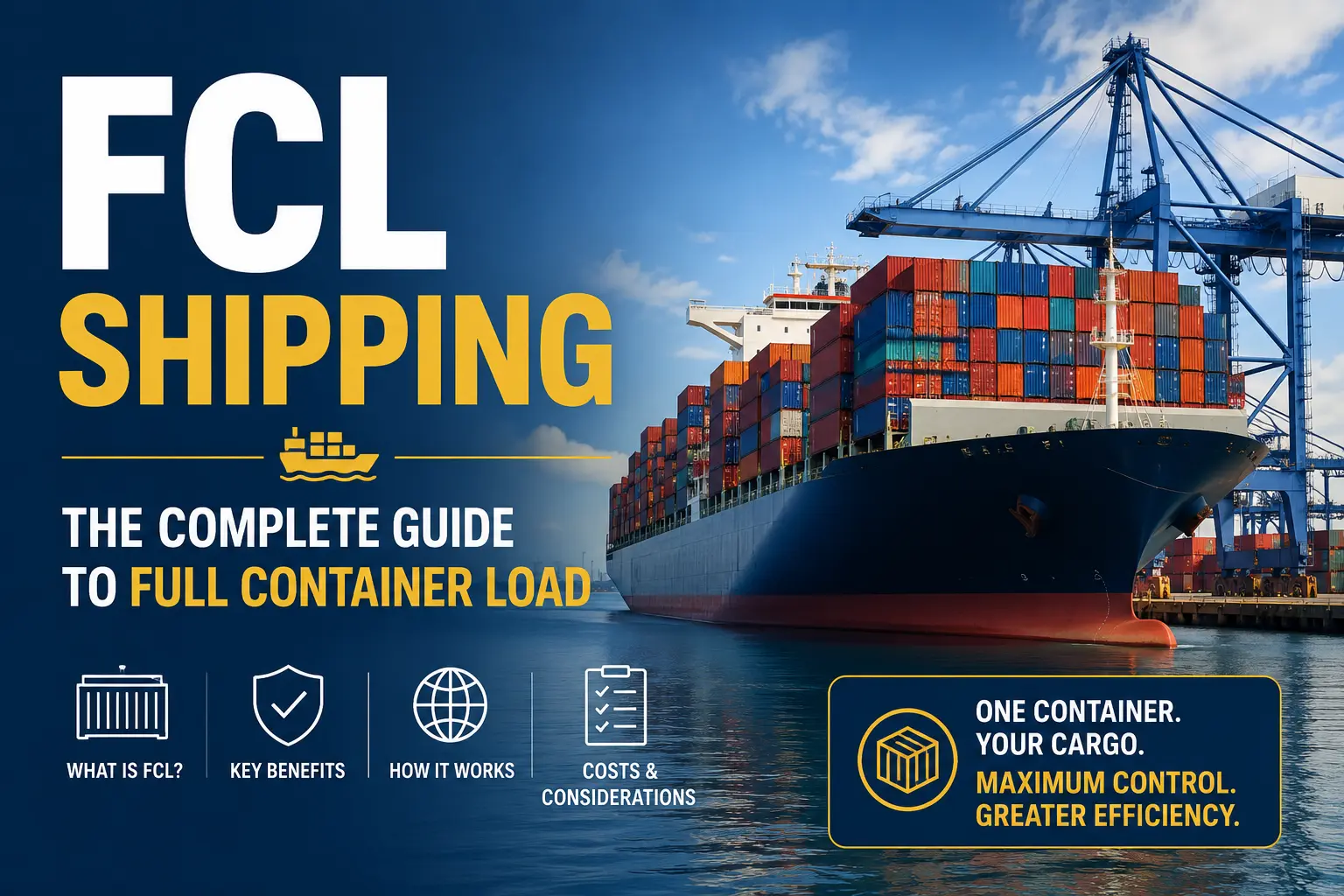
If you’re shipping goods internationally and your cargo is starting to fill more than half a container, FCL shipping is probably the most important decision you’ll make in your logistics setup. Get it right and you save money, reduce risk, and move goods faster. Get it wrong and you’ll be paying for space you didn’t need, dealing with delays you didn’t expect, or watching your cargo sit at customs because of a paperwork mismatch.
This guide covers everything you actually need to know about FCL shipping — what it is, how the entire process works step by step, which container type fits your cargo, how costs are calculated, what documents you need, and the mistakes that catch even experienced shippers off guard.
What Is FCL Shipping?
FCL stands for Full Container Load. It means you’re booking an entire shipping container exclusively for your cargo, regardless of whether that container is completely filled. Nobody else’s goods share that box with yours. The container is sealed at origin and stays sealed until it reaches its destination.
This is the defining feature of FCL: exclusivity. You control the container from loading to delivery. That’s what separates it from LCL (Less than Container Load), where your goods travel alongside shipments from other businesses in the same container.
The term “full” in FCL is slightly misleading for newcomers. You don’t have to physically fill the entire container to use FCL. If you’re shipping 18 CBM of goods and book a 20-foot container, that’s still FCL. You’re paying for the whole unit, not for the space you occupy.
FCL vs. LCL: Understanding the Core Difference
Most guides treat this as a simple size question — “if your cargo is big, use FCL.” That’s partly true, but the real difference runs deeper.
| Factor | FCL | LCL |
|---|---|---|
| Container ownership | Exclusive to you | Shared with other shippers |
| Loading control | You or your agent handles loading | Third-party consolidator handles it |
| Transit time | Faster, no consolidation delays | Slower, requires consolidation and deconsolidation |
| Customs dependency | Your cargo clears independently | Held if any co-loaded shipment is delayed |
| Damage risk | Lower, minimal handling | Higher, more touchpoints |
| Cost structure | Flat rate per container | Rate per CBM or weight |
| Ideal cargo volume | Generally above 15 CBM | Below 15 CBM |
| Best for | Bulk, fragile, high-value, time-sensitive goods | Small, infrequent, low-risk shipments |
The customs dependency point is one that most beginner guides skip over. With LCL, if another shipper in your container has a documentation problem, your cargo can be held at port even though your own paperwork is perfect. That risk doesn’t exist with FCL.
For a deeper comparison, see FCL vs LCL Shipping: Which Option Is Right for You.
When Does FCL Make Sense for Your Business?
There’s no single threshold that applies to every trade lane, but here are the situations where FCL is clearly the better choice.
Your cargo exceeds 15 CBM. Below that volume, LCL is almost always cheaper on a per-unit basis. Once you cross roughly 15 CBM, the flat rate per container starts to compete with or beat LCL pricing per CBM.
You’re shipping fragile or high-value goods. FCL keeps your cargo away from other people’s boxes, equipment, and freight crews. Fewer touchpoints means fewer opportunities for damage.
Time is a constraint. LCL shipments go through a consolidation warehouse at origin and a deconsolidation facility at destination. That process can add days. FCL skips both.
You’re shipping hazardous or regulated goods. Many carriers have strict rules about co-loading hazardous materials with general cargo. FCL sidesteps most of those compatibility problems.
Your product is sensitive to contamination. Food, pharmaceuticals, and some chemicals require dedicated containers with documented cleanliness histories. That’s only possible with FCL.
You want consistent costs. FCL pricing is typically a flat rate per container, which makes budgeting straightforward compared to LCL’s per-CBM fluctuations.
FCL Container Types: Choosing the Right Box
This is where most “complete guides” are surprisingly thin. They’ll mention 20-foot and 40-foot containers and stop there. But picking the wrong container type is one of the most common and costly mistakes in FCL shipping.
Standard Dry Containers
The workhorse of international trade. These are general-purpose steel boxes used for the vast majority of cargo, including consumer goods, electronics, textiles, machinery, and auto parts.
20-foot container (1 TEU) Internal dimensions: approximately 5.9m long x 2.35m wide x 2.39m high. Usable volume around 33 CBM. Maximum payload around 25,000 kg. Best for heavy, dense goods where weight fills the container before volume does.
40-foot container (1 FEU / 2 TEU) Internal dimensions: approximately 12.03m long x 2.35m wide x 2.39m high. Usable volume around 67 CBM. Maximum payload around 30,500 kg. The default choice for most FCL shipments.
40-foot High Cube (40HC) Same footprint as a standard 40-foot, but roughly 30 cm taller internally (2.7m internal height vs. 2.39m). This extra height matters enormously for lightweight, voluminous cargo like furniture, mattresses, or large appliances. Many shippers reflexively book a 40-foot standard when a 40HC would dramatically improve their load utilization.
Specialized Container Types
Reefer containers are temperature-controlled units designed for perishables, pharmaceuticals, dairy, frozen food, and fresh produce. They maintain temperatures between -30°C and +30°C. Available in 20-foot and 40-foot versions. They cost significantly more than dry containers, and not every shipping line offers them on every trade lane, so confirm availability before booking.
Open top containers have no fixed roof, replaced by a removable tarpaulin. Essential for cargo loaded from above (cranes, top-loading machinery) or goods that are taller than standard container height. Available in 20-foot and 40-foot versions.
Flat rack containers have collapsible side walls and no roof. Used for heavy or oversized cargo like construction equipment, industrial machinery, vehicles, and steel structures. The side walls fold down so cranes can load from multiple angles.
Tank containers are cylindrical vessels inside a standard ISO frame, used for bulk liquids — chemicals, foodstuffs, and industrial fluids.
Container Selection Summary
| Container Type | Best For | Key Advantage |
|---|---|---|
| 20ft Standard | Heavy, dense cargo | Cost-effective for weight-limited loads |
| 40ft Standard | General commercial goods | Highest availability worldwide |
| 40ft High Cube | Light, voluminous goods | Extra height, better space utilization |
| Reefer (20/40ft) | Perishables, pharma | Precise temperature control |
| Open Top | Tall or top-loaded cargo | Overhead loading access |
| Flat Rack | Oversized, heavy machinery | No dimensional limits |
The FCL Shipping Process, Step by Step
Understanding the full process is where most first-time shippers feel lost. Here’s what actually happens from the moment you decide to ship until your cargo arrives at its destination.
Step 1: Request a Quote and Book Your Container
You (or your freight forwarder) submit the shipment details to a carrier or freight platform. The information you need at this stage: origin and destination ports, container type and size, commodity type and HS code, gross cargo weight and volume, and the Incoterms governing the shipment.
The accuracy of what you provide here has a direct effect on pricing, documentation, and customs compliance later. Giving a rough estimate of weight and volume might save five minutes now and cost you a container upgrade or incorrect freight charge later.
Book early. During peak seasons (typically July through October before holiday retail, and the weeks around Chinese New Year), container availability tightens and rates spike. Booking two to three weeks in advance is a reasonable minimum; four to six weeks ahead during peak periods is wiser.
Step 2: Container Pickup and Stuffing
An empty container is delivered to your supplier’s facility or a designated loading point. Your team (or your supplier’s team) loads the cargo and seals the container with a custom seal, recording the seal number in your documentation.
How the container is loaded matters as much as what goes in it. Uneven weight distribution can cause cargo movement during transit, structural stress on the container, and even safety issues at sea. Secure all cargo with proper lashing and bracing. Use dunnage bags or airbags to fill voids. Document the loading arrangement — some buyers and carriers require photos.
Step 3: Export Drayage to the Port
The sealed container is transported from the loading point to the port of origin. This inland transport leg is called drayage. At the port, the container goes through export customs clearance before it’s cleared for vessel loading.
This is the first serious documentation checkpoint. Your commercial invoice, packing list, and export declaration need to be accurate and consistent with each other. A mismatch between the packing list and the commercial invoice is one of the most common causes of customs delays.
Step 4: Vessel Loading and Ocean Transit
The container is loaded onto the vessel. Transit times vary significantly by trade lane. Asia to North America typically runs 15 to 25 days depending on the specific origin and destination ports, with trans-Pacific routes from China averaging 14 to 20 days. Asia to Europe runs roughly 25 to 35 days. Short-haul regional routes within Asia or within Europe can be as little as a few days.
Use vessel tracking tools during this phase to stay ahead of potential delays. Port congestion, weather events, and equipment changes can shift arrival windows by several days.
Step 5: Arrival, Import Customs Clearance, and Delivery
When the vessel arrives at the destination port, the container is unloaded. Before it can be released to you, it must pass through import customs clearance. This means paying applicable import duties and taxes, submitting your bill of lading, commercial invoice, packing list, and any required certificates (certificate of origin, phytosanitary certificate, import license, etc.).
Once cleared, the container is either picked up by your inland carrier (drayage to your warehouse) or, if you’ve arranged door delivery, the freight forwarder handles the final leg.
Be aware of free time at the destination port. Most carriers grant a limited number of days (typically three to seven) to pick up or return the container before demurrage charges begin. These charges accumulate daily and can be substantial if customs clearance takes longer than expected.
FCL Shipping Costs: What You’re Actually Paying For
FCL pricing is quoted as a flat rate per container, but the number you see on your initial quote is rarely the full amount you’ll pay. Understanding the cost components prevents budget surprises.
Ocean Freight Rate
The base rate covers the ocean transportation itself, from origin port to destination port. This is what fluctuates most dramatically with market conditions. Trade lane, container type, time of year, and carrier choice all influence this number.
Origin Charges
These fees are charged at the port of origin. Common ones include: origin THC (terminal handling charge), documentation fee, seal fee, and bill of lading issuance fee. Origin charges are typically quoted separately from the freight rate.
Destination Charges
Charged at the destination port by the carrier and/or terminal. These include destination THC, customs examination fees, and port security surcharges. These are often misunderstood or overlooked by first-time importers.
Inland Transportation (Drayage)
The cost to move the container between the port and your warehouse, at both origin and destination. This is determined by distance, local trucking rates, and whether the inland move crosses a border.
Customs Duties and Taxes
Calculated based on the declared value of your goods and the applicable HS code tariff rate in the destination country. This isn’t a shipping cost per se, but it’s part of the total landed cost that should always be factored into your pricing calculations.
Surcharges
Fuel surcharges (bunker adjustment factor or BAF), peak season surcharges (PSS), currency adjustment factors (CAF), and congestion surcharges can all appear on an invoice. They fluctuate with market conditions. Always ask your freight forwarder to itemize these.
Demurrage and Detention
Demurrage is charged when your container sits at the port beyond the free time allowed. Detention is charged when you keep the container beyond the agreed return period. Both can accumulate quickly. Knowing the free time limits on your shipment before it departs is essential.
To get a clearer picture of how these charges stack up for your route, the international shipping cost guide at UFI Shipping breaks down landed cost components by trade lane.
FCL Shipping Documents: What You Need and Why
Documentation errors are the single most common cause of customs delays. Here is what a standard FCL shipment requires and what each document actually does.
Bill of Lading (B/L) — The foundational document of international shipping. It serves simultaneously as a receipt for the goods, evidence of the contract between the shipper and carrier, and a document of title. The original B/L must be surrendered at destination to release the cargo. Errors in the consignee name, commodity description, or container/seal numbers on the B/L will cause delays.
Commercial Invoice — Details the transaction between buyer and seller: commodity, quantity, unit value, total value, country of origin, and Incoterms. This is the primary document customs uses to assess duties.
Packing List — A line-item breakdown of what is in the container, including weights and dimensions per package. Must match the commercial invoice exactly. Any discrepancy between the two is a red flag for customs authorities.
Certificate of Origin (CO) — Confirms the country in which the goods were manufactured. Required for most international shipments and critical for claiming preferential tariff rates under free trade agreements.
Customs Declaration / Export Declaration — Filed in the origin country to formally declare the export. Required for customs clearance at origin port.
Import Permits or Licenses — Required for regulated goods: food products, agricultural goods, chemicals, electronics in certain markets, medical devices, and others. These vary by destination country. Always confirm what’s required before shipping.
Phytosanitary Certificate — Required for plant products and some agricultural goods to confirm they meet the destination country’s biosecurity standards.
One practical tip that most guides don’t emphasize: verify that the container seal number on your bill of lading matches the physical seal on the container before it leaves the loading facility. This discrepancy is a surprisingly common cause of customs holds, and it’s entirely preventable.
If you’re new to customs processes, the customs clearance guide covers the import and export procedure in detail.
Incoterms and FCL: How Responsibility Is Divided
Incoterms (International Commercial Terms) define who is responsible for what at each stage of the shipment. They’re issued by the International Chamber of Commerce and are recognized in trade contracts worldwide. Understanding which Incoterm applies to your FCL shipment determines who pays for each cost element and who bears risk during transit.
The most common Incoterms used in FCL ocean freight are:
FOB (Free on Board) — The seller is responsible until the cargo is loaded on the vessel at origin. From that point, the buyer assumes risk and cost. FOB is the most widely used term for ocean freight and is generally the best option for experienced importers who want control over their freight forwarder and carrier selection.
CIF (Cost, Insurance and Freight) — The seller arranges and pays for ocean freight and insurance. The buyer assumes risk once cargo is loaded, but the seller handles the freight booking. Less control for the importer, and sellers sometimes inflate the freight component.
EXW (Ex Works) — The buyer bears all responsibility from the moment goods leave the seller’s factory. Gives maximum control to the buyer but requires more active logistics management.
DDP (Delivered Duty Paid) — The seller is responsible for everything, including import duties and delivery to the buyer’s door. Common in e-commerce contexts but rarely used for traditional B2B FCL.
Choosing the right Incoterm is not a technicality. It directly affects your landed cost, your insurance obligations, and who you can hold accountable if something goes wrong during transit. For a full breakdown of all 11 terms, the Incoterms 2020 guide explains each one in practical, trade-scenario terms.
FCL Shipping: 7 Mistakes That Cost Businesses Money
These are the errors that come up repeatedly in practice, not just in theory.
1. Booking the wrong container size or type. The most common version of this is booking a standard 40-foot when the cargo would have fit in a 20-foot, or not recognizing that a 40HC would significantly improve load efficiency for voluminous goods. Always calculate CBM and weight before confirming the booking.
2. Providing inaccurate cargo details at booking. Weight and volume estimates given to freight forwarders affect rate calculations, container allocation, and vessel planning. Underestimating gross weight can create problems at the terminal weighbridge and trigger surcharges or even delayed loading under SOLAS VGM rules (which require verified gross mass declarations before container loading).
3. Mismatched documentation. The commercial invoice, packing list, and bill of lading must describe the same cargo with the same descriptions, values, and quantities. Inconsistencies trigger customs scrutiny. Incorrect HS codes in particular can result in misclassification, wrong duty assessment, and potential penalties.
4. Ignoring free time and demurrage rules. Many importers don’t check free time allowances until the container has already been sitting at port for two days. By then, the clock is already running. Know the free time terms on every shipment before the vessel departs.
5. Not planning for customs clearance time. Customs clearance can take anywhere from a few hours to several days depending on the destination country, the commodity, and whether the shipment is flagged for inspection. Building customs buffer time into your delivery schedule prevents expensive last-minute arrangements.
6. Skipping cargo insurance. FCL is lower risk than LCL, but ocean transit still carries real risk: vessel accidents, extreme weather events, and port mishaps do happen. The carrier’s liability is typically limited to amounts far below the actual cargo value. Cargo insurance is inexpensive relative to what it covers.
7. Choosing a freight forwarder on price alone. The cheapest quote sometimes reflects a forwarder with limited experience on your trade lane, weak carrier relationships, or a tendency to rebook shipments during peak season. The forwarder’s experience with your specific origin-destination pair and commodity type matters more than their headline rate.
FCL Shipping Timeline: What to Expect
This is a question that searches frequently but few articles answer with any specificity.
| Trade Lane | Typical Transit Time |
|---|---|
| China to US West Coast | 14 to 20 days |
| China to US East Coast | 25 to 35 days |
| China to Northern Europe | 28 to 35 days |
| China to Middle East | 18 to 25 days |
| Intra-Asia (e.g., Japan to SEA) | 5 to 15 days |
| Europe to North America | 12 to 18 days |
| India to US | 20 to 30 days |
These are port-to-port ocean transit times only. Add drayage, export customs, inland consolidation time at origin, and import customs clearance at destination to arrive at your total door-to-door timeline.
Total door-to-door timelines typically range from 25 to 50 days for most major intercontinental trade lanes, depending on origin/destination locations and customs clearance time.
How to Choose a Freight Forwarder for FCL Shipments
Your freight forwarder is your primary operational partner for everything in this guide. A good one makes FCL simple. A weak one makes it expensive and stressful.
Look for these qualities: demonstrated experience on your specific trade lane, knowledge of import regulations in your destination country, a network of carrier relationships that gives them rate options, transparent all-in quoting (not just the base ocean freight), and a responsive point of contact who can troubleshoot in real time.
Ask specifically about their experience with your commodity type. A forwarder who regularly handles electronics has different expertise from one who primarily moves industrial machinery. Regulatory requirements, documentation needs, and carrier preferences differ between commodity categories.
For context on how forwarder selection works in practice, the ocean freight forwarder guide walks through what to look for and what questions to ask before signing a contract.
FCL Shipping and Sustainability
This is a dimension that most FCL guides ignore entirely. It matters increasingly to businesses with environmental commitments and to regulators.
The International Maritime Organization (IMO) has set binding targets to reduce shipping’s greenhouse gas intensity. Major carriers are increasingly offering green shipping options — biofuel programs, carbon offset schemes, and vessels powered by alternative fuels. If your organization tracks Scope 3 emissions, your ocean freight is a significant line item.
When evaluating carriers, ask about their emissions reporting tools and whether they can provide verified carbon data for your shipments. The IMO’s Carbon Intensity Indicator (CII) ratings, which carriers are now required to publish, are a useful starting point for comparing carriers on sustainability grounds. You can find the IMO’s framework at imo.org.
Frequently Asked Questions About FCL Shipping
What is the minimum cargo size for FCL? There’s no minimum. FCL is a booking type, not a minimum volume. Practically speaking, it becomes cost-competitive with LCL at around 15 CBM, though on some trade lanes the crossover point is lower or higher depending on current LCL vs. FCL rate spreads.
Can I split an FCL shipment with another company? No. FCL is by definition exclusive to one shipper. If two businesses want to share a container, that’s LCL (or a privately arranged shared container, which is uncommon and comes with its own liability complications).
What happens if my cargo doesn’t fill the container? Nothing different operationally. You still get the full container, it still moves as FCL, and you still have all the same benefits. You’re paying for the exclusive use of the unit, not for the space you fill.
What is VGM and do I need it for FCL? VGM stands for Verified Gross Mass. Under SOLAS regulations, all container weights must be verified and declared to the carrier before loading. As the shipper, you’re responsible for providing an accurate VGM declaration. Failure to do so can result in the container being held from loading.
How do I track my FCL shipment? Most major carriers offer web-based container tracking using your container number or booking reference. Third-party logistics platforms and freight forwarders typically offer consolidated tracking dashboards. Container numbers follow a standard format: four letters followed by seven digits.
Is FCL cheaper than air freight? Almost always, significantly so — often by a factor of four to ten times on a per-kg basis, depending on cargo type and route. The tradeoff is transit time (ocean FCL takes weeks; air freight takes days) and the fact that FCL requires full container minimums.
Summary: Is FCL Right for Your Shipment?
FCL shipping is the right choice when your cargo volume makes sharing a container unnecessary, when the nature of your goods requires dedicated transport, or when time and security matter enough that the exclusive container is worth its flat rate.
The process is straightforward once you understand it, but the details — container selection, documentation accuracy, customs preparation, and cost structure — are where most problems originate. Working with an experienced freight forwarder, understanding your Incoterms, and knowing your free time allowances before you ship eliminates the majority of common FCL problems.
If you’re ready to get a quote or learn more about FCL shipping solutions, visit our ocean freight services page.