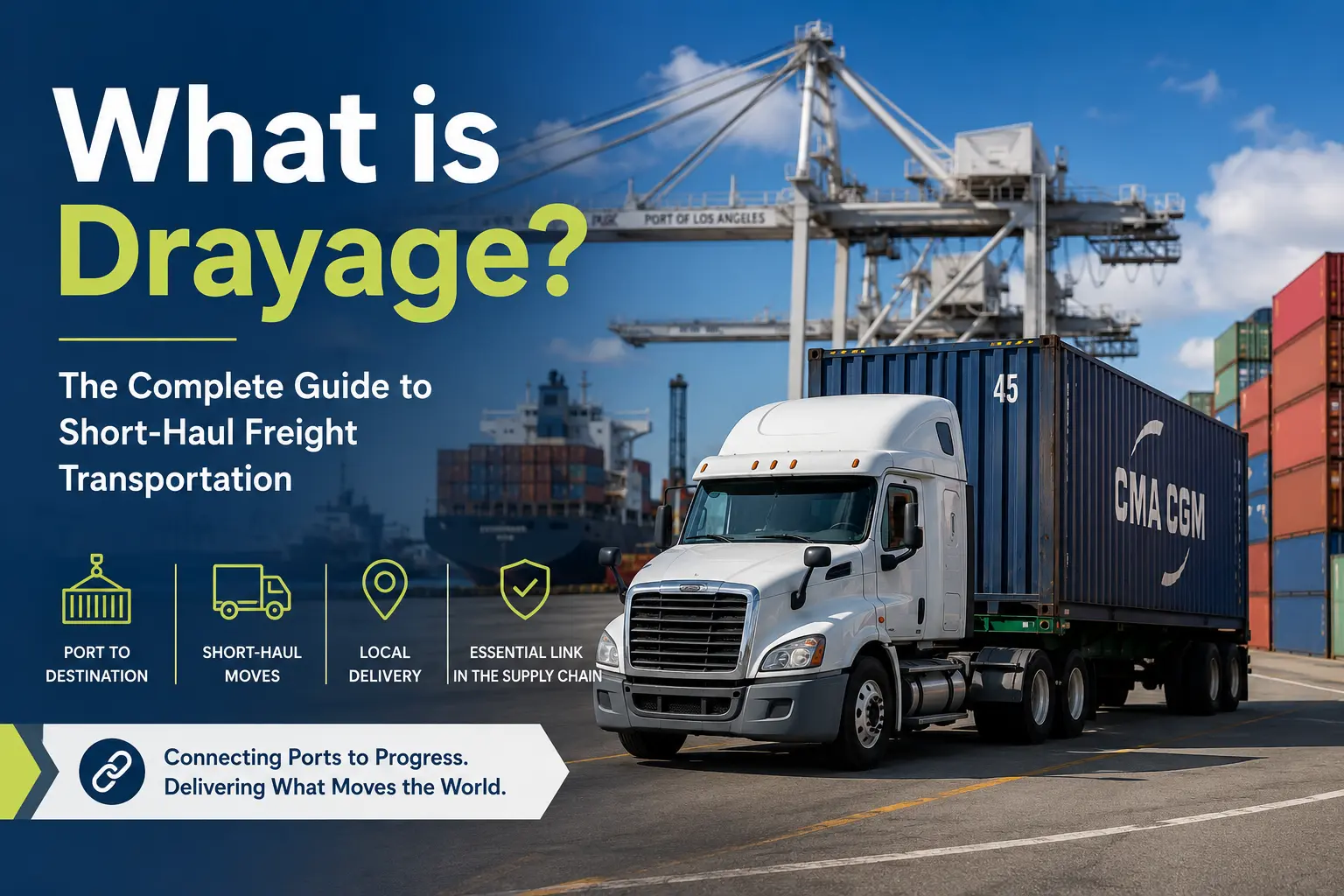
If your shipping container just arrived at a major U.S. port, it’s not done moving yet. In fact, the most critical part of its journey is about to begin. The short-distance move that gets it from the dock to the next step in your supply chain happens right now. That’s drayage, and it’s far more important than most shippers realize.
Drayage is quietly one of the most consequential services in global logistics. Miss it or mismanage it, and your entire shipment can stall. Get it right, and you unlock efficiency, save money, and keep your goods flowing smoothly through the supply chain. This guide covers everything you need to know to master drayage operations and make smarter decisions for your business.
Understanding Drayage: Definition and Core Concept
In logistics terms, drayage is the short-distance transportation of freight, typically containerized cargo, between transportation hubs. A drayage move usually covers less than 50 miles, though the exact distance varies by region and business need. More importantly, drayage is the bridge between major transportation modes.
Think of it this way: an ocean container arrives at the Port of Los Angeles. It needs to reach a warehouse 20 miles inland, or a rail terminal in a neighboring city, or a customer’s distribution center. The truck that moves that container from point A to point B is performing drayage. It’s the connection that keeps goods flowing when the long-haul trucking, rail, and maritime legs of the journey can’t directly reach their destination.
The word itself has historical roots. A “dray” was originally a low, sideless cart pulled by dray horses in 18th and 19th-century England. These horses were specifically bred for hauling heavy loads over short distances. The term stuck, even as dray carts evolved into modern semi-trucks with specialized equipment. Today, drayage drivers navigate port yards, rail terminals, and congested urban streets using trucks equipped with chassis, which are wheeled frames designed to carry shipping containers.
Drayage serves a fundamental purpose: it handles the “first mile” and “last mile” of containerized cargo, ensuring goods transition smoothly between ocean vessels, trains, warehouses, and final delivery points without being unloaded from their containers.
Why Drayage Is Critically Important to Supply Chains
Here’s what most people don’t realize until they experience a drayage breakdown: a small bottleneck at the local level can paralyze an entire supply chain.
Consider the Los Angeles and Long Beach port complex, which collectively handles more containers than any other port complex in North America. Every day, thousands of containers sit in terminal yards waiting for drayage pickup. If drayage trucks can’t move those containers fast enough, port congestion explodes. Containers pile up, demurrage charges accumulate, and that congestion ripples backward through the entire supply chain affecting importers, retailers, manufacturers, and ultimately consumers.
This is why industry professionals call drayage “the first domino.” If the first domino falls wrong, the rest of the chain topples too. Efficient drayage operations directly control several critical supply chain metrics.
Port Congestion Management: Without timely drayage pickups, containers linger at terminals, creating bottlenecks that delay other vessels and increase storage costs. The San Pedro Complex has experienced historic congestion in recent years due partly to drayage capacity shortages.
Cost Control: Drayage efficiency directly impacts your total landed cost. Delays trigger demurrage fees (charges for containers that sit beyond allowed free time), detention charges (fees for retaining drayage equipment), and chassis fees. A single miscoordinated pickup can cost hundreds or thousands of dollars.
Supply Chain Visibility: Drayage is often the least transparent part of the supply chain. A container can be perfectly tracked across the Pacific Ocean but completely invisible once it reaches the terminal. This creates real operational risk when you don’t have proper coordination with your freight forwarding partner.
Time-Sensitive Delivery: For e-commerce, pharmaceutical shipments, and perishable goods, drayage delays mean missed delivery windows, customer dissatisfaction, and revenue loss.
The reality is that drayage represents the intersection of multiple moving parts: ports, trucking capacity, equipment availability, labor, regulatory compliance, and scheduling. Getting drayage right requires understanding all these elements.
Complete Breakdown of Drayage Service Types
The logistics industry classifies drayage into distinct service types, each serving different supply chain needs. Understanding these categories helps shippers choose the right solution for their specific situation.
Port Drayage (Pier Drayage)
Port drayage is the most common type. A container is unloaded at a seaport and needs to reach the next destination. That could be a rail terminal, warehouse, distribution center, or manufacturing facility within the same region. For example, a container arrives at the Port of Houston containing automotive parts. A drayage truck picks it up and delivers it to a nearby inland facility where it’s transferred to rail for long-distance transport. Port drayage is essential for relieving port congestion and avoiding costly storage fees.
Intermodal Drayage
This service specifically facilitates the transfer of containers between different transportation modes without unloading the cargo. A container moves from a ship directly onto a rail flatcar, or from a rail terminal directly onto a truck bed. The container itself never opens, which preserves cargo integrity and reduces handling costs. Intermodal drayage is the backbone of modern intermodal shipping and handles enormous volumes, especially on transcontinental routes like Los Angeles to Chicago.
Rail Drayage
When containers need to move between rail yards and nearby facilities, rail drayage handles that transfer. This is common in inland markets where rail is the primary long-haul mode. Rail drayage trucks carry containers from ports to rail yards, or between rail hubs when rail-to-truck transfers are needed.
Shuttle Drayage (Temporary Storage Drayage)
During peak periods, when ports or rail yards reach capacity, containers are moved to nearby temporary storage yards or parking lots. Once space opens up at the primary terminal, the containers are shuttled to their intended destination. This service essentially provides relief during congestion spikes. Shuttle drayage is particularly important at Los Angeles and Long Beach, where peak periods can create massive queues.
Door-to-Door Drayage
This service delivers containers directly to the final customer without intermediate warehousing. A container arrives at the port and is transported all the way to the customer’s address or facility. Door-to-door drayage is popular in e-commerce and retail when customers need full-service delivery without additional handling.
Expedited Drayage
When cargo is time-sensitive or when standard schedules won’t work, expedited drayage prioritizes your shipment. This might involve same-day pickups, evening or night moves to avoid daytime port congestion, or priority scheduling. Expedited service costs more but is essential for high-value, urgent, or temperature-sensitive shipments.
Intra-Carrier Drayage
When a single carrier like a major shipping line or trucking company handles both the long-haul and drayage portions of the journey, that’s intra-carrier drayage. The advantage is single-point accountability and simplified coordination.
Inter-Carrier Drayage
When different carriers handle the long-haul and drayage portions, inter-carrier drayage coordinates the handoff. This is common when optimal routing requires different carriers for different legs of the journey. The challenge is coordinating between multiple parties.
Cross-Dock Drayage
Containers are moved to a cross-dock facility where cargo is sorted, consolidated, or repackaged before continuing to its final destination. This is common in e-commerce fulfillment and retail distribution.
Dedicated Account Drayage
Some major shippers maintain relationships with drayage providers who reserve equipment and capacity specifically for their shipments. This guarantees service availability and often includes predictable pricing.
How the Drayage Process Works: Step-by-Step
Understanding the actual mechanics of a drayage operation reveals why coordination is so critical and where delays typically occur.
1. Container Arrival and Documentation
When a ship docks, containers are unloaded and placed in the port terminal yard. The shipping line provides documentation (bills of lading, container numbers, cargo descriptions) that gets transmitted to the shipper, consignee, and drayage provider. Accuracy in this step is crucial because mismatched documentation can halt the entire process.
2. Appointment Scheduling
Most ports now require drayage carriers to schedule pickup appointments in advance. This reduces congestion but also creates bottlenecks when appointment slots fill up during peak periods. The shipper or their freight forwarder must coordinate the appointment with the drayage provider. Missing a scheduled appointment can mean a multi-day delay before the next available slot.
3. Equipment Allocation
The drayage company dispatches a truck equipped with an appropriate chassis (a 20-foot or 40-foot chassis depending on container size). Modern drayage fleets use telematics and GPS to track equipment in real-time. Equipment shortages, a persistent problem in today’s market, can delay pickups significantly.
4. Port Security and Gate Process
The drayage driver must pass through port security, present proper credentials (often a Transportation Worker Identification Credential or TWIC card for secure marine terminals), and wait for gate clearance. During congested periods, this can take hours. The driver must have all required documentation in order, or additional delays and fines result.
5. Loading and Inspection
At the terminal, a crane or gantry system loads the container onto the chassis. The driver verifies the container number, seal number, and cargo details match the documentation. Any discrepancies must be resolved before leaving the terminal.
6. Transport to Destination
The truck travels from the port to the next destination: a warehouse, rail yard, customer facility, or transload center. Route selection is critical. During peak hours, congestion on primary routes can add hours to a drive that should take 30 minutes. Experienced drayage operators know which routes avoid traffic and coordinate with real-time traffic data.
7. Delivery and Unloading
Upon arrival at the destination facility, the container is unloaded using equipment at that facility or the drayage company’s equipment. The driver obtains proof of delivery and photographs the container condition for records.
8. Equipment Return and Documentation
The empty container and chassis are returned to a depot or designated location. The drayage company submits final documentation confirming successful delivery, container condition, and any issues that occurred.
This eight-step process seems straightforward, but each step has multiple failure points. A missed appointment, traffic delay, documentation error, or equipment shortage can create a cascade of delays.
Drayage Costs: What You Actually Pay
One of the most confusing aspects of drayage for shippers is the fee structure. Unlike long-haul trucking where you typically pay a single per-mile rate, drayage involves multiple fees that can accumulate quickly.
Base Drayage Charge
This is the primary cost: the fee for moving the container from origin to destination. Rates vary based on distance, container size (20-foot vs 40-foot), cargo type, and regional market conditions. As of mid-2026, typical port drayage in major U.S. markets ranges from $150 to $400 per container for a basic port-to-warehouse move, though rates fluctuate based on fuel prices, equipment availability, and demand.
Fuel Surcharges
Most drayage carriers add a fuel surcharge that adjusts monthly based on diesel prices. When fuel costs spike, surcharges increase proportionally.
Chassis Fees
If the drayage company provides the chassis (the wheeled frame carrying the container), they charge a separate chassis fee. This is typically $50 to $150 per move, though some providers include it in the base rate.
Equipment Drop-Off or Detention Fees
If you keep the drayage equipment longer than the allowed free time (typically 24-48 hours depending on the port), demurrage and detention charges apply. These fees can be $100 to $300 per day, creating significant costs if cargo sits in a warehouse before being unloaded.
Port Congestion Charges
During peak periods, ports may impose additional fees for peak-hour surcharges or congestion pricing. These fees incentivize off-peak pickups.
Customs and Compliance Fees
If your shipment requires customs clearance or specialized handling, additional fees apply. These vary widely depending on cargo complexity. When working with a professional freight forwarder experienced in customs documentation, these fees are often minimized through proper advance planning.
Saturday/Sunday/Holiday Charges
Weekend and holiday pickups and deliveries incur premiums, typically 25-50% surcharges.
Appointment Cancellation Fees
If you schedule a drayage pickup and then cancel, ports often charge cancellation fees.
Real-World Cost Example
Let’s say you import a 40-foot container from Shanghai to Los Angeles. Ocean freight costs $2,000. Now add drayage costs:
- Base drayage (LA port to inland warehouse, 35 miles): $250
- Fuel surcharge (15%): $37.50
- Chassis fee: $75
- Port congestion charge (peak period): $50
- Total drayage: $412.50
That’s a 20% premium on top of ocean freight. But if you miss your delivery window and the container sits at the warehouse for 5 days before being unloaded, detention charges add another $500. Your total landed cost just increased by $912.50.
This is why drayage coordination is so important to overall logistics cost management. Understanding container transport charges and planning ahead can help avoid these unexpected expenses.
Current Challenges in Drayage Operations
Drayage is facing unprecedented challenges in 2026. Understanding these obstacles helps explain why service quality varies and why strategic planning is essential.
Port Congestion
Ports globally are experiencing persistent congestion. The Los Angeles and Long Beach complex, which handles roughly 35% of all U.S. containerized imports, has experienced multi-month backlogs in recent years. When congestion peaks, drayage trucks wait 8-12 hours just to enter the terminal. This creates a compounding effect: limited available drayage capacity gets stuck waiting at ports, which increases rates for other shippers.
Chassis Shortage
One of the most persistent problems is the shortage of available chassis. A modern drayage operation requires chassis to be repositioned constantly. An empty chassis dropped at a warehouse must be retrieved, deadheaded back to the port, and made available for the next pickup. When chassis are stuck in transits, yards, or on incomplete returns, the shortage cascades. Shippers sometimes can’t get drayage service simply because chassis aren’t available, not because drayage trucks are busy.
Driver Shortage and Labor Costs
The trucking industry faces an ongoing driver shortage. Drayage driving is particularly challenging because it involves tight schedules, congested ports, complex documentation, and regulatory compliance (TWIC cards, hazmat certifications, etc.). Driver wages have increased significantly, which drayage companies pass on to customers through rate increases.
Equipment Availability
Beyond chassis, specialized equipment is needed for certain cargo types: flat beds for oversized cargo, reefer containers for temperature-sensitive goods, tankers for liquids. During peak periods, this specialized equipment is often booked out.
Regulatory Compliance
Environmental regulations at major ports are tightening. California’s CARB (California Air Resources Board) regulations restrict older, high-emission trucks. Some ports now mandate electric or near-zero emission vehicles for certain hours. Compliance requires capital investment, which increases costs. This ties directly into broader customs clearance and regulatory requirements that your freight forwarder must manage.
Data and Visibility Gaps
Despite all the digitalization in logistics, drayage remains the least visible part of the supply chain. A container can be tracked across the Pacific but goes dark once it reaches the port. This lack of visibility makes it difficult to forecast delays or coordinate follow-on services.
Economic Volatility
Drayage rates are highly volatile. During low-demand periods, rates can drop 30-40% as carriers compete for volume. During peak seasons, rates spike 50% or more as capacity tightens. This makes budgeting difficult for shippers.
How to Choose a Drayage Provider: A Decision Guide
When you need drayage services, you have several options: using your freight forwarder’s preferred provider, contracting directly with a drayage carrier, using a 3PL logistics provider that includes drayage, or even managing drayage independently if you have high volume.
Key Evaluation Criteria
Service Coverage: Verify the provider operates in the specific ports and regions you need. A provider based in Los Angeles might not serve Houston effectively.
Equipment and Capacity: Ask what chassis they own versus what they subcontract. During peak periods, providers without owned equipment may struggle. Inquire about equipment condition and replacement cycles.
Appointment Management: How do they secure terminal appointments? Do they have direct relationships with port authorities? During congestion, appointment access is critical.
Technology and Visibility: Do they offer real-time tracking? Can you see when a container arrived at the terminal, when it’s picked up, and when it’s delivered? The best providers offer end-to-end visibility that integrates with your supply chain management systems.
Compliance and Credentials: Verify SCAC code (Standard Carrier Alpha Code), USDOT number, insurance coverage, and environmental compliance (CARB certification, if applicable). Do drivers have TWIC cards?
Rate Structure and Transparency: Get a clear breakdown of all fees. Are fuel surcharges clearly defined? Are detention fees clearly spelled out? Avoid providers with vague pricing.
Customer References: Request references from shippers in your industry. Drayage quality varies enormously between providers.
Scalability: If your business grows, can the provider scale with you? Some drayage companies max out at certain volume levels.
Specialization: If you have specialized cargo (oversized goods, hazmat, temperature-sensitive products), verify the provider has relevant experience and equipment.
Response and Support: How quickly do they respond to inquiries? What happens if something goes wrong? Good drayage providers are proactive communicators, not reactive problem-solvers.
A common mistake is choosing the cheapest provider. The lowest-cost operator often cuts corners on compliance, driver training, or equipment maintenance. The true cost of poor drayage is often hidden in delays, detention fees, and supply chain disruptions.
Best Practices for Optimizing Drayage Operations
If you manage logistics operations, these practices significantly improve drayage efficiency.
Plan and Schedule Ahead
Port appointments are limited. Schedule drayage pickups weeks in advance when possible, and always avoid peak hours if your shipment isn’t urgent. A pickup at 2 AM might cost 25% more, but if it avoids a multi-day appointment wait, it’s worth it.
Coordinate with Freight Forwarders
Your freight forwarder should be coordinating drayage from day one, not scrambling after cargo arrives. Clear communication between shipper, forwarder, and drayage provider prevents delays. A strong freight forwarding relationship ensures that your goods move smoothly from ocean port to inland destination.
Use Dedicated Equipment
If you have regular, predictable drayage needs, negotiate a dedicated account with a drayage provider. Reserved equipment and predictable pricing are worth the commitment.
Leverage Technology
Use Transportation Management Systems (TMS) that integrate with drayage provider APIs. Real-time tracking, automated notifications, and data integration reduce delays and improve visibility across your entire supply chain management process.
Consolidate Shipments
If you ship multiple containers to the same destination, consolidate them into fewer drayage moves. This reduces costs and simplifies coordination.
Unload Quickly
Once a drayage container reaches your facility, unload it immediately. Extended detention at your dock adds unnecessary costs.
Choose Off-Peak Windows
When possible, schedule pickups during off-peak hours. You might pay a slight premium, but avoiding multi-hour waits at congested terminals often saves money overall.
Maintain Compliance
Keep all documentation perfect. Mismatched or incomplete paperwork causes delays. Ensure your TWIC card holders are current and your hazmat certifications are valid.
Monitor Your Spend
Track all drayage costs and hold providers accountable. A 10-15% anomaly in fees might indicate a mistake or an unauthorized charge.
The Future of Drayage: What’s Changing
Drayage logistics is entering a period of significant transformation. Several trends are reshaping the industry.
Automation and Autonomous Vehicles
Automated cargo handling at ports, autonomous yard equipment, and eventually autonomous drayage trucks are in development. Some ports are testing automated straddle carriers (overhead equipment that moves containers without truck assists). Autonomous trucks for drayage are still years away, but the technology is advancing rapidly.
Electric and Zero-Emission Vehicles
California’s regulations require increasing percentages of drayage trucks to be zero-emission by 2030. Companies like Tesla, Volvo, and emerging EV manufacturers are producing electric trucks with range suitable for drayage (200-300 miles). However, charging infrastructure remains limited. Early-adopter companies are benefiting from incentives and regulatory advantages.
Digitalization and Real-Time Visibility
Blockchain for document verification, IoT sensors on containers, and real-time tracking systems are becoming standard. Shippers increasingly demand end-to-end visibility from factory to final destination.
Data-Driven Port Operations
Ports are using predictive analytics to manage congestion better. Real-time vessel tracking, AI-driven appointment scheduling, and dynamic pricing are reducing congestion and improving efficiency.
Nearshoring and Regional Distribution
As supply chains regionalize through friendshoring to allied nations, drayage becomes more important for distributed manufacturing and just-in-time logistics. Instead of one mega-port, goods are distributed across multiple smaller ports, increasing drayage volume but distributing congestion.
Sustainability Focus
Green logistics and carbon tracking are becoming mandatory for enterprise shippers. Drayage providers offering verified emissions reduction, carbon offset programs, and electric fleets have competitive advantages. As businesses focus more on their environmental impact, inland transportation guide practices are evolving to prioritize sustainability alongside efficiency.
Frequently Asked Questions
Q: What’s the difference between drayage and freight forwarding?
Drayage is the physical short-distance transport of containers. Freight forwarding is the overall service of coordinating international shipments: arranging ocean freight, customs clearance, drayage, and final delivery. A freight forwarder typically arranges drayage but doesn’t perform it. When you work with a freight forwarding company, they coordinate all these elements on your behalf, including selecting the right drayage partner.
Q: How long does a drayage move typically take?
A port-to-warehouse drayage move usually takes 24-48 hours from appointment time to delivery, though the actual transport time is often only 1-3 hours. The delay is primarily waiting for port appointments and processing.
Q: Can I arrange drayage independently, or do I need a freight forwarder?
You can arrange it independently if you have import-export expertise and direct relationships with drayage carriers. However, freight forwarders have preferred-carrier relationships and better appointment access. For most shippers, using a forwarder for drayage coordination saves money and stress. An experienced freight forwarder understands the nuances of appointment scheduling, compliance, and rate negotiation.
Q: What is demurrage vs detention in drayage?
Demurrage is the fee charged by ports when your container sits in the terminal longer than allowed free time (typically 5-7 days for imports). Detention is the fee charged by the drayage company when you keep their equipment (chassis) longer than allowed (typically 24-48 hours). Both fees accumulate daily and can be expensive.
Q: Is drayage included in my ocean freight rate?
Rarely. Most ocean freight pricing covers only port-to-port transport. Drayage, customs clearance, and inland delivery are separate services. Always clarify what’s included in your ocean freight quote. When reviewing your ocean freight guide and planning your logistics, make sure drayage costs are explicitly outlined.
Q: How do I track my drayage shipment?
This depends on your drayage provider. Best-in-class providers offer online tracking, GPS coordinates, estimated arrival times, and proof of delivery. If your provider doesn’t offer tracking, request it because it’s becoming an industry standard.
Q: What happens if my drayage container arrives damaged?
Report it immediately to the drayage provider and obtain photographic evidence. File a damage claim with your insurance carrier. Cargo insurance should cover most damage. The drayage provider’s liability is typically limited unless they caused the damage through negligence.
Q: Can drayage rates be negotiated?
Yes, especially if you commit to regular volume. However, avoid negotiating so aggressively that the provider compromises service quality. A provider making 3% margin is more likely to cut corners than one making 10-15% margin.
Final Thoughts: Why Drayage Matters to Your Bottom Line
Drayage is the unglamorous middle child of logistics. It’s not as visible as ocean freight or as easy to track as final delivery. But it’s often where supply chains break down and where small inefficiencies compound into major costs.
The companies that win on global supply chain efficiency understand drayage deeply. They plan ahead, maintain strong carrier relationships, use technology for visibility, and make strategic decisions about speed versus cost. They know that paying $50 more for expedited drayage to avoid congestion and detention fees is a smart trade-off.
As your business grows and your logistics become more complex, you’ll want to work with partners who understand these dynamics. A solid logistics company or freight forwarding partner can guide you through the complexities of drayage, help you optimize costs, and ensure your cargo moves smoothly from origin to destination.
As supply chains become more localized, as environmental regulations tighten, and as real-time visibility becomes mandatory, drayage expertise becomes a competitive advantage. The next evolution of your supply chain efficiency likely lives in optimizing this critical first mile.