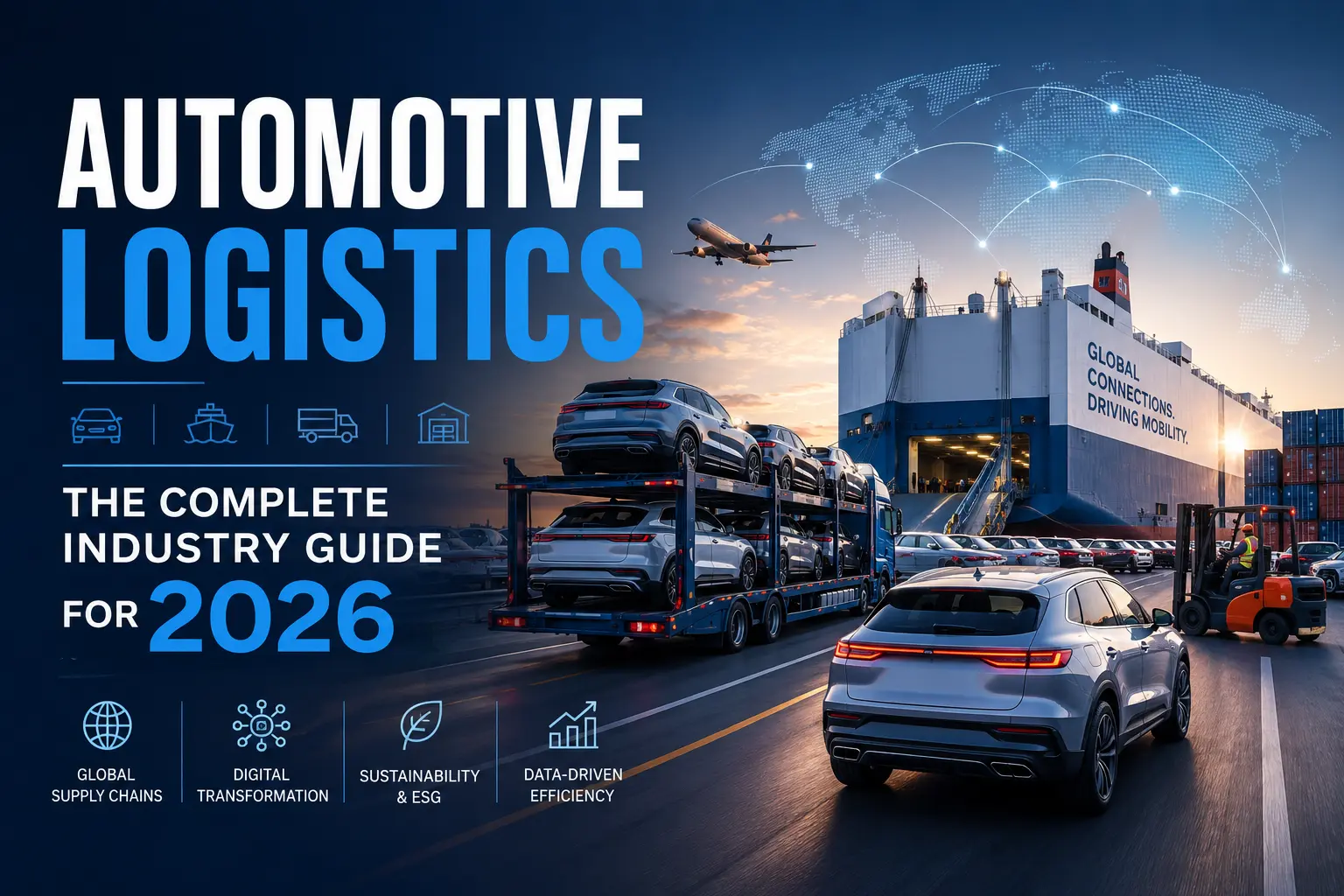
What Is Automotive Logistics?
Automotive logistics is the end-to-end management of the automotive supply chain, covering the movement, storage, sequencing, and distribution of parts and finished vehicles. Think of it as the invisible engine behind every car on the road. It makes sure raw materials, thousands of components, and fully assembled vehicles reach the right place at the right time and in perfect condition.
Automotive logistics can be broken into three primary areas: the supply chain of auto components for manufacturing, the logistics of finished vehicles, and the logistics of spare parts.
This is not a niche back-office function. The global automotive logistics market was valued at $306.27 billion in 2025 and is expected to grow to $458.47 billion by 2030 at a CAGR of 8.3%, making it one of the most economically significant logistics sectors in the world.
The Role of Automotive Logistics in the Supply Chain
The automotive supply chain is one of the most complex industrial systems ever built. A single modern vehicle contains over 30,000 individual parts sourced from hundreds of suppliers across dozens of countries. Coordinating all of this at scale, without halting a production line, is the core mission of automotive logistics.
The automotive supply chain is an interconnected network of organizations, resources, activities, and processes involved in the production, distribution, and delivery of vehicles, parts, and components. It typically includes raw materials suppliers, component manufacturers, OEMs, distributors, dealerships, and end customers.
At the center of this network sits the freight forwarder, who coordinates international shipments, manages documentation, and ensures cargo moves efficiently across borders. The process begins with raw material suppliers that mine and process materials like steel and aluminum. These suppliers send materials to component manufacturers that produce parts such as engines and transmissions. Once complete, they deliver them to assembly plants. After assembly, vehicles are customized and shipped to dealerships. The logistics process does not end with the sale either, since the aftermarket industry continues to supply additional parts and accessories.
Types of Automotive Logistics
1. Inbound Logistics
Inbound logistics involves transporting raw materials and components from suppliers into the manufacturing environment. Tier 1 suppliers deliver directly to OEMs, while Tier 2 suppliers feed into Tier 1s with sub-components. This stage often includes international shipping, customs clearance, and domestic drayage services.
Inbound logistics is the backbone of production continuity. Any disruption here, whether a delayed shipment, a customs hold, or a port backlog, can halt an entire assembly line within hours. The inbound segment dominated the automotive logistics market, accounting for around 44% share in 2025, driven by its crucial role in moving components, raw materials, and subassemblies from suppliers to OEM assembly plants, supporting just-in-time and just-in-sequence manufacturing processes.
2. Outbound Logistics (Finished Vehicle Logistics)
Once a vehicle rolls off the assembly line, outbound logistics takes over. This covers transportation from the factory to distribution hubs, ports, rail yards, and ultimately to dealerships or end customers.
Finished vehicle logistics encompasses all processes involved in moving fully assembled vehicles from production facilities to their final destinations. This specialized segment includes storage, inspection, transportation planning, and final delivery of completed vehicles.
Outbound logistics uses a multimodal mix of car carriers for road transport, rail car-haul trains, roll-on/roll-off ships for international export, and in rare cases, air freight for premium or urgent deliveries. For international vehicle exports, working with an experienced ocean freight provider is essential to managing RoRo bookings, port documentation, and transit timelines efficiently.
The North American finished vehicle logistics market is expected to increase from $19.62 billion in 2026 to $33.72 billion in 2036 with a 5.6% CAGR.
3. Reverse Logistics
Reverse logistics is often underestimated but it is growing rapidly. It covers the movement of goods backward through the supply chain, including product recalls, returned parts, end-of-life vehicle recycling, warranty replacements, and lease vehicle returns.
More than 300,000 EVs are expected to return from lease in 2026, adding to already saturated inventories, which makes reverse logistics for electric vehicles a pressing new challenge for OEMs and logistics providers.
Reverse logistics is the fastest-growing segment in North American automotive logistics, set to expand from $0.58 billion in 2026 to $2.05 billion in 2036 with a 13.5% CAGR.
4. Aftermarket Logistics
Aftermarket logistics manages the distribution of spare parts, accessories, and consumables to dealerships, repair shops, and direct consumers. It demands a very different operational model compared to production logistics since it involves smaller shipments, wider SKU ranges, and faster turnaround times. For smaller, consolidated shipments of auto parts, LCL and LTL consolidation services offer a cost-effective solution without the need to book a full container.
Key Players in Automotive Logistics
The automotive logistics ecosystem involves multiple tiers of participants working together.
OEMs like Toyota, Volkswagen, Ford, and General Motors orchestrate the entire supply chain but increasingly outsource logistics execution to specialists. Tier 1, 2, and 3 suppliers provide direct components, sub-components, and raw materials respectively. Third-party logistics providers such as DHL Supply Chain, Kuehne + Nagel, DB Schenker, and UPS offer end-to-end logistics services. DHL Supply Chain led the market with over 18.6% market share in 2025, and the top five players collectively held 53% of the market. Freight forwarders manage international shipping and customs, while carriers and haulers physically move vehicles and parts.
For a detailed breakdown of how these companies operate and what to look for when selecting one, see this guide on top freight forwarding companies.
Just-In-Time and Just-In-Sequence: The Precision Backbone
Two manufacturing principles define how automotive logistics operates at the production level.
Just-In-Time, or JIT, means parts arrive at the assembly plant only when they are needed, not days before and not hours late. This minimizes inventory costs and warehouse space but leaves zero buffer for disruption.
Just-In-Sequence goes one step further. Just-in-sequence delivery ensures parts arrive at the assembly line in the exact order they are needed for production. This reduces downtime and eliminates excess handling. Sequencing services often include cross-docking, staging, quality inspections, and precise line-side delivery.
These models work brilliantly in stable conditions. But as the COVID-19 pandemic and the semiconductor shortage of 2021 to 2022 proved, JIT leaves supply chains dangerously exposed. Automakers are now moving away from just-in-time logistics and localizing supply chains within North America to keep things more stable.
Automotive Freight Management: How Goods Actually Move
Effective automotive freight management coordinates multiple transport modes based on cost, distance, urgency, and cargo type.
Road transport using car carriers is the dominant mode for domestic finished vehicle delivery. Multi-level open or enclosed auto carriers can transport 6 to 12 vehicles per trip. For longer domestic distances, inland transportation services bridge the gap between ports, rail yards, and final delivery points efficiently.
Rail transport is cost-effective for long-distance domestic movement of finished vehicles, using bi-level and tri-level autorack rail cars. For international shipments, roll-on/roll-off shipping is the primary method where cars drive directly onto purpose-built RoRo vessels. Full Container Load shipping is a common option for transporting large volumes of auto parts cost-effectively, while Less than Container Load shipping offers flexibility for smaller shipments, enabling multiple consignees to share container space. Air freight is reserved for high-value components or urgent parts where production would otherwise halt.
When vehicles or parts move through ports, drayage services handle the critical last-mile connection between the port terminal and the inland destination, a step that is often overlooked but essential to keeping delivery timelines intact.
Challenges Facing Automotive Logistics in 2026
1. Geopolitical Tensions and Tariffs
This is probably the defining challenge of 2026. In the first month of 2026 alone, the industry faced major challenges as US trade relations became more strained, with threats of 100% tariffs on Canada and increased levies on South Korea, which pushed other nations to forge new trade deals among themselves.
Tariffs and trade barriers imposed by different nations increase operational costs and limit profit margins for logistics providers. OEMs are currently absorbing much of this cost, but vehicle prices are expected to rise as a result.
2. Semiconductor and Component Shortages
EVs need about 1,400 to 1,500 semiconductors, whereas a regular internal combustion engine needs roughly 400 to 500. Geopolitical tensions in 2025 and 2026 and trade conflicts again led to chip shortages, forcing automakers to cut production.
3. Electric Vehicle Logistics Complexity
EV logistics in 2026 is no longer an experimental extension of traditional vehicle transport. It is a high-stakes operational discipline requiring structured load planning, regulatory awareness, digital transparency, and predictive capacity management.
EV batteries are significantly heavier than ICE drivetrain components. They require temperature-controlled storage, are subject to strict hazardous materials regulations during transport, and demand specialized handling equipment throughout the journey from factory to dealer. Ensuring proper customs clearance and pre-export inspections for EV battery shipments is especially critical given the hazmat classification requirements that vary by country.
4. Labour Shortages and Skills Gaps
Rising labour and skills shortages affect 37% of automotive logistics operations. Skills shortages do not merely slow the resolution of supply chain problems, they prevent manufacturers from implementing the more sophisticated supply chain strategies the industry knows it needs.
5. Cost Pressures Across the Board
Automotive sector margins are being squeezed by tariffs, rising labour costs, energy costs, material costs, production inefficiencies, increasing competition, and the need to transition to electric vehicles, particularly given much cheaper Chinese EVs entering the market.
6. Cybersecurity in Connected Logistics
The automotive cybersecurity market is expected to more than double in size, reaching $17.3 billion by 2034. Features such as advanced infotainment systems, cloud-linked navigation, and AI have transformed vehicles into data hubs, opening multiple entry points for hackers. Fleet management systems integrated with logistics platforms create additional vulnerabilities that require dedicated security protocols.
Solutions: How the Industry Is Responding
Automakers and logistics providers are not sitting still. Supply chain regionalization is one of the biggest shifts happening right now. Tesla’s upcoming Gigafactory in Monterrey, Mexico, exemplifies this trend, aiming to serve both North and South American markets efficiently. BYD has also initiated construction of a $1 billion plant in Indonesia to begin operations by late 2025.
Beyond nearshoring, logistics providers are building more flexible multimodal networks that can switch between transport modes in real time. Many companies are also moving away from pure JIT to hybrid inventory models that hold modest strategic safety stock for critical components. And increasingly, the industry is deploying integrated digital platforms, combining Transport Management Systems, Warehouse Management Systems, and ERP tools that share real-time data across the full supply chain.
Warehousing is also becoming a strategic buffer asset. Modern warehousing and yard management facilities that sit adjacent to ports or assembly plants allow companies to hold safety stock, perform sequencing, and manage pre-delivery inspections without disrupting production flow.
Latest Trends Reshaping Automotive Logistics
Artificial Intelligence and Predictive Analytics
In 2026, the automotive AI market was valued at around $21.06 billion and is expected to grow to $67 billion by 2034 with a CAGR of 15.57%.
AI adoption in automotive is expected to become a strategic cornerstone in 2026, supporting engineering, diagnostics, logistics, remarketing, and customer experience. In logistics specifically, AI is being deployed for demand forecasting, dynamic route optimization, predictive maintenance of carrier fleets, and automated customs documentation.
A recent McKinsey report shows that AI-driven factory automation has the potential to bring down manufacturing costs by 30 to 50 percent, and the transition from reactive to predictive maintenance has enabled companies to lower maintenance costs by 18 to 25 percent.
IoT and Real-Time Visibility
Manufacturers that are digitally enabled with proper IoT and analytics capabilities can receive a real-time view on quantities of inventory, shipment location, and status. Access to reliable inventory data empowers companies to make data-driven decisions and ensure accurate inventory numbers.
Real-time GPS tracking, RFID tagging of individual parts, temperature sensors for EV battery shipments, and geofencing for yard management are all becoming standard practice rather than competitive advantages.
Warehouse Automation and Robotics
Modern automotive warehouses are deploying autonomous mobile robots for parts picking and sequencing, automated guided vehicles for pallet movement, and AI-powered sorting systems that can handle thousands of SKUs with minimal human intervention. Automation of warehouses and data-driven logistics optimization are key growth drivers expected to propel the market to $458.47 billion by 2030.
Autonomous Vehicle Logistics
Volkswagen Group is piloting autonomous vehicles at the Port of Emden, working on standardization and demand forecasting for finished vehicle logistics. Self-driving yard trucks and autonomous terminal vehicles are already operational at several major automotive ports, moving vehicles between storage areas and loading bays without human drivers.
Sustainable and Green Logistics
Environmental pressure from regulators and consumers is pushing automotive logistics toward lower-carbon operations. This includes transitioning carrier fleets to electric trucks, optimizing load factors to reduce empty miles, shifting from air to sea and rail freight where possible, and measuring Scope 3 supply chain emissions as part of OEM sustainability reporting. Companies that are serious about this shift are increasingly partnering with future-ready logistics providers that prioritize technology, transparency, and sustainability in their operations.
Software-Defined Supply Chains
CES 2026 highlighted a clear shift in automotive strategy, with cars increasingly positioned as intelligent, upgradable platforms within broader digital and data ecosystems. The next phase of competition will hinge less on electrification alone and more on intelligence, software capability, and scalable execution. This shift demands that logistics systems become equally software-driven, capable of adapting in real time to production changes, market signals, and disruptions.
Real-World Case Examples
Toyota and the Limits of JIT: Toyota pioneered just-in-time manufacturing and for decades ran one of the leanest supply chains in the world. The 2011 Japan earthquake and tsunami exposed the fragility of single-source supplier dependency, causing global production halts. Toyota responded by mapping its entire multi-tier supplier network and building strategic inventory buffers for critical components, a model now being adopted across the industry.
Volkswagen’s Autonomous Port Operations: VW is using autonomous vehicle technology not just in its cars but in its logistics operations. At the Port of Emden in Germany, one of Europe’s largest finished vehicle logistics hubs, VW is trialing autonomous vehicle movements within the port compound, removing human drivers from repetitive yard movements and reducing handling costs significantly.
Tesla’s Gigafactory Strategy: Tesla’s approach of building Gigafactories close to major markets in the US, Germany, China, and the planned Mexico facility is fundamentally a logistics strategy. By localizing production, Tesla reduces finished vehicle shipping costs and lead times, avoids cross-border tariff exposure, and simplifies the EV-specific battery logistics chain.
DHL’s Market Leadership: As the market leader with 18.6% share, DHL Supply Chain has invested heavily in automotive-specific capabilities including dedicated sequencing centers adjacent to OEM plants, proprietary automotive TMS platforms, and specialized EV battery handling certifications across its global network.
Automotive Logistics vs. General Freight Logistics: Key Differences
| Factor | Automotive Logistics | General Freight Logistics |
|---|---|---|
| Sequencing Requirements | Precise JIT/JIS delivery | Standard delivery windows |
| Cargo Complexity | 30,000+ unique part numbers | Standardized product ranges |
| Vehicle Transport | Specialized car carriers, RoRo | Standard containers/trucks |
| Regulatory Complexity | High (EV batteries, emissions, customs) | Moderate |
| Supply Chain Tiers | Multi-tier (T1/T2/T3 suppliers) | Typically 1 to 2 tiers |
| Disruption Impact | Line-stop risk within hours | Manageable delays |
| Technology Dependency | Very high (JIT, tracking, sequencing) | Moderate |
How to Choose an Automotive Logistics Partner
Whether you are an OEM, a Tier 1 supplier, or a dealership network, selecting the right logistics provider requires careful evaluation.
Your provider must understand automotive-specific requirements including JIT sequencing, pre-delivery inspection standards, EV handling protocols, and OEM compliance requirements. A strong global network is crucial for a freight forwarder to establish connections with automotive manufacturers, suppliers, and distributors worldwide, enabling comprehensive logistics solutions and access to transportation routes in various regions.
The automotive industry often requires transporting large, heavy, and delicate components, so a logistics provider should have access to specialized equipment like car carriers, flatbed trucks, and handling facilities capable of managing oversized and sensitive automotive cargo.
On the technology side, look for integrated TMS platforms, real-time shipment visibility, EDI and API connectivity with your ERP, and solid analytics reporting. And given the cost pressures and tariff impacts in 2026, the financial stability of your 3PL partner is a genuine risk factor worth checking. Understanding the difference between a freight forwarder and a freight broker is also important at this stage, since automotive shippers often need the full-service capabilities that only a licensed forwarder can provide.
FAQ: Automotive Logistics
Q1: What is the difference between automotive logistics and general logistics? Automotive logistics involves just-in-time and just-in-sequence delivery, multi-tier supplier networks, specialized vehicle transport equipment, and extremely tight production tolerances. A single missed delivery can halt an entire assembly line. General freight logistics operates with far more flexibility and simpler cargo requirements.
Q2: What are the main types of automotive logistics? The four primary types are inbound logistics (parts and materials moving into production), outbound logistics (finished vehicles moving to dealerships), reverse logistics (returns, recalls, lease vehicles, recycling), and aftermarket logistics (spare parts and accessories distribution).
Q3: How much is the global automotive logistics market worth? The global automotive logistics market was valued at $306.27 billion in 2025 and is expected to grow to $458.47 billion by 2030 at a CAGR of 8.3%.
Q4: What is Just-In-Time logistics in automotive manufacturing? JIT is a production philosophy where components arrive at the assembly line only when needed, eliminating excess inventory and storage costs. It requires precise logistics coordination and leaves little margin for supply chain disruption. Many automakers are now balancing JIT with strategic safety stock to build resilience into their operations.
Q5: How do electric vehicles change automotive logistics? EVs introduce significant new logistics complexity. EV batteries are heavier, affecting weight limits on carriers. They are also classified as hazardous materials requiring special handling and documentation. They are temperature-sensitive and part of a new battery supply chain involving lithium, cobalt, and rare earth materials that differs fundamentally from traditional ICE component flows.
Q6: What are the biggest challenges in automotive logistics right now? In 2026, the top challenges are tariffs and geopolitical trade disruptions, semiconductor shortages, EV logistics complexity, rising labour and skills shortages, cost pressures across fuel, energy, and labour, and the need to integrate AI and digital tools across fragmented supply chains.
Q7: What technology is transforming automotive logistics? Key technologies include AI and machine learning for demand forecasting and route optimization, IoT sensors for real-time shipment visibility, autonomous robots and AGVs in warehouses, blockchain for supply chain traceability, advanced TMS platforms, and autonomous yard vehicles at vehicle logistics hubs.
Q8: What does a 3PL do in automotive logistics? A third-party logistics provider manages logistics operations on behalf of OEMs or suppliers. This includes warehousing, sequencing, transportation management, customs brokerage, inventory control, and value-added services such as kitting, labeling, and pre-delivery inspections. Major automotive 3PLs include DHL Supply Chain, Kuehne + Nagel, DB Schenker, and UPS.
Conclusion
Automotive logistics is not a support function. It is a strategic competitive advantage. In an industry where a single missing component shuts down a billion-dollar production line, where geopolitical tensions can invalidate a supplier contract overnight, and where the shift to electric vehicles is rewriting the rules of freight management, logistics excellence separates resilient OEMs from vulnerable ones.
Automotive supply chains are navigating rising trade barriers, accelerating electrification, and fragmented digital tools, and industry leaders are recognizing that logistics must lead through disruption rather than simply react to it.
The organizations that will win in this environment are those investing now in AI-powered visibility, flexible multimodal networks, regionalized supply chains, and specialist logistics partners who truly understand the demands of automotive freight management.
Ready to optimize your automotive logistics operation? Get a quote today and speak with a specialist who understands the full complexity of automotive supply chains.