You’ve just landed your first overseas client. A machinery manufacturer in Ibaraki, Japan, your company has been building agricultural equipment for domestic buyers for years. Now a buyer in Australia wants a full consignment, and the signed purchase order is sitting on your desk. The excitement is real. So is the question you’re now staring at: how do you actually get the cargo there?
Understanding how international shipping works isn’t something most businesses figure out intuitively. There are freight modes to choose, customs declarations to file, carrier contracts to negotiate, and destination-country import rules to research, all before a single pallet moves. One wrong step can trigger a customs hold that costs you two weeks, a penalty, or worse, a frustrated first-time client who never comes back.
This guide walks you through every stage of international shipping, from product classification and documentation to ocean transit and last-mile delivery. You’ll understand exactly what’s involved, what it costs, what documents are required, and how to avoid the mistakes that trip up first-time exporters. Whether you’re shipping automotive parts, construction equipment, or agricultural machinery, the process follows the same core logic, and once you understand it, it stops being overwhelming.
What Is International Shipping?
International shipping is the process of moving commercial goods across national borders, from the seller’s facility to the buyer’s location, via air, ocean, road, or rail. It sounds simple, but the reality involves a chain of handoffs, each governed by separate regulations, documentation requirements, and fees.
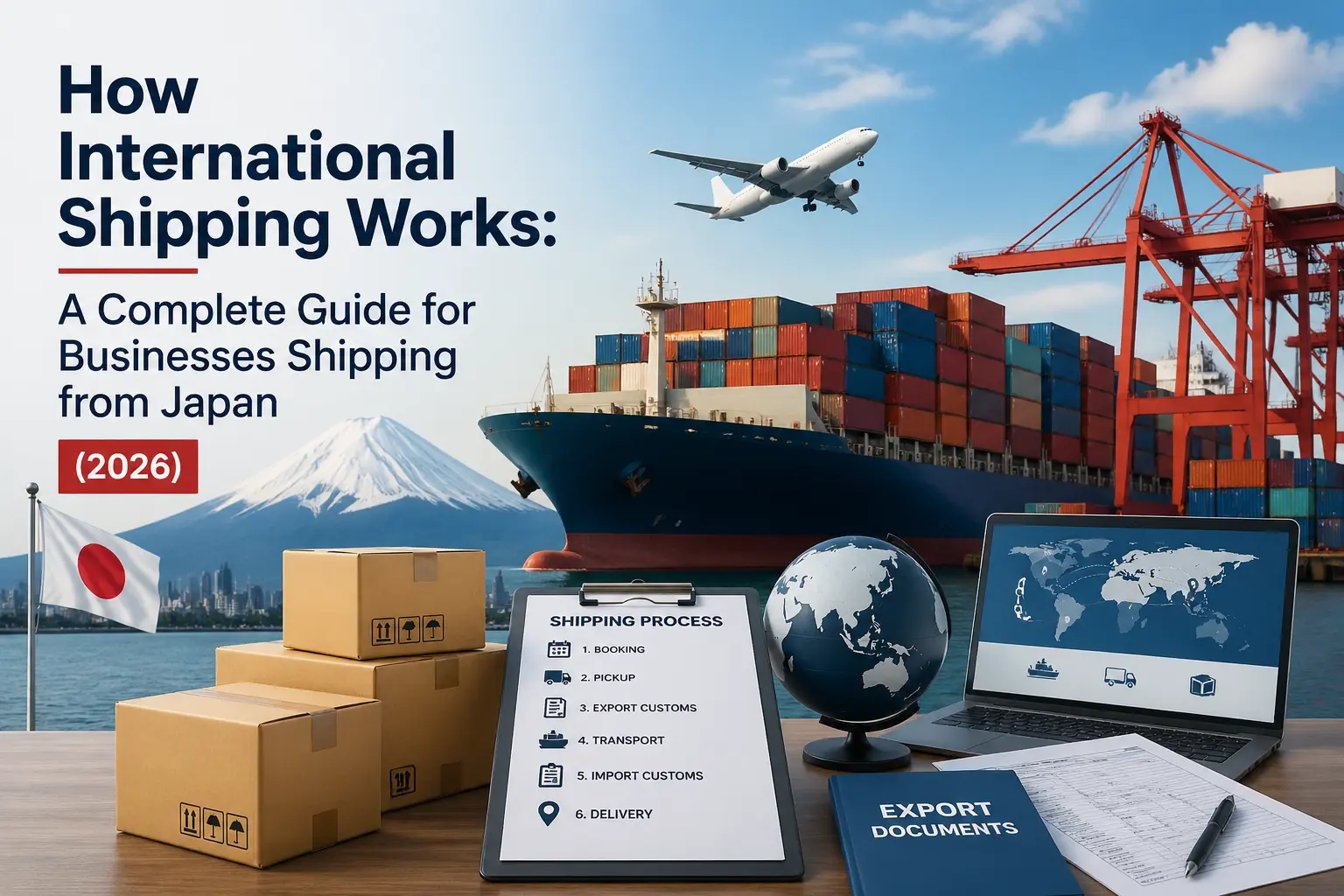
The full journey typically looks like this: your cargo leaves your warehouse, clears Japanese export customs, moves to a port or airport, travels by ocean vessel or aircraft to the destination country, clears import customs there, and then transfers via land to the buyer’s facility. Each stage has its own timeline, its own paperwork, and its own cost.
Japan is one of Asia’s largest exporters, ranking in the global top five for machinery, automotive parts, electronics, and agricultural equipment. For Japanese businesses, international shipping isn’t a rare event. For many, it’s a core operational function. Freight forwarding is the professional service that manages this entire chain on your behalf, coordinating carriers, handling documentation, clearing customs, and making sure your cargo arrives intact and on time.
How International Shipping Works: Step by Step
Step 1: Determine What You’re Shipping and Where
Every international shipment starts with two things: knowing exactly what you’re shipping and knowing exactly where it’s going. These two factors shape every decision that follows.
The most important classification element is the HS code (Harmonized System code), a standardized six-to-ten digit number that identifies every type of tradeable product in the world. Customs authorities in both Japan and the destination country use HS codes to determine applicable tariffs, import restrictions, and compliance requirements. If you ship a tractor gearbox, it won’t travel under “machine parts.” It’ll travel under something like HS code 8708.40 (gear boxes and parts). Getting this wrong can trigger a customs reclassification, additional duties, and sometimes cargo holds.
Your HS code also determines what duties your buyer will pay at the destination. Many trade agreements, including Japan’s EPAs with the EU, Australia, and ASEAN countries, offer preferential duty rates for goods that correctly declare their origin and HS classification. Using the wrong code means your buyer might overpay on duties they didn’t need to.
Equally important is destination research. What’s freely exported from Japan may face quota restrictions, import bans, or mandatory certifications at the other end. Agricultural equipment might require phytosanitary certificates. Certain electronic components may need compliance documentation. This step isn’t paperwork for its own sake. It’s how you avoid a customs refusal before your cargo even arrives.
PRO TIP Before booking any shipment, verify both Japan’s export regulations and the destination country’s import rules. UFI Shipping’s customs team can handle this verification for you. Contact us before your first shipment.
Step 2: Choose Your Shipping Method (Ocean vs Air, FCL vs LCL)
Once you know what you’re shipping and where, you need to choose how it travels. There are two primary modes: Ocean Freight and Air Freight. Each has a specific use case, and choosing the wrong one is one of the most common and costly mistakes first-time exporters make.
Ocean Freight is the backbone of global trade. It’s cost-effective for heavy, bulky, or high-volume cargo, and it handles virtually any commodity, from containerized machinery to raw agricultural goods. The tradeoff is time: ocean transit from Japan takes anywhere from five days to Southeast Asia to over thirty days for European destinations. For non-urgent shipments where cost efficiency matters, ocean freight is almost always the right choice.
Air Freight moves cargo in two to seven days, making it ideal for urgent shipments, high-value goods, or lightweight items where speed justifies the premium. The cost per kilogram is significantly higher than ocean, typically five to ten times more, so it’s rarely viable for heavy industrial cargo.
Within ocean freight, you’ll face another choice: FCL (Full Container Load) or LCL (Less than Container Load).
FCL means your cargo fills an entire container, typically a 20-foot or 40-foot unit. You pay for the whole container regardless of fill. The advantages are faster loading, greater cargo security, and often better per-unit rates when volume is high.
LCL means your cargo shares container space with other shippers’ goods heading in the same direction. You pay only for the cubic meters (CBM) your cargo actually occupies. This is significantly more economical for smaller shipments that don’t justify a full container.
| FCL | LCL | Air Freight | |
|---|---|---|---|
| Best for | Large volumes (15+ CBM) | Small/medium volumes (under 15 CBM) | Urgent or high-value cargo |
| Cost | Per container | Per CBM | Per kg (chargeable weight) |
| Transit speed | Standard ocean | Standard ocean + consolidation time | 2 to 7 days |
| Security | High (dedicated container) | Moderate (shared) | High |
| Typical use | Automotive parts, full machine loads | Samples, partial loads, mixed goods | Electronics, pharmaceuticals |
Companies like UFI Shipping offer LCL consolidation services, meaning your cargo is grouped with other shipments heading in the same direction so you only pay for the space you use. This is a critical service for businesses that ship regularly but not always in full-container volumes.
A useful rule of thumb: if your cargo is under 15 CBM, LCL is typically more cost-effective. Over 15 CBM, FCL usually wins on both cost and efficiency.
KEY INSIGHT For automotive parts, construction machinery, and agricultural equipment, which tend to be heavy and bulky, ocean freight FCL is almost always the smarter, more economical choice. The weight-to-value ratio makes air freight impractical at scale.
Step 3: Understand International Shipping Costs
Shipping costs are often misunderstood because the freight rate is just one component of the total. Here’s what actually determines what you pay.
Chargeable weight is the first concept to grasp. Carriers charge based on either actual weight or volumetric weight, whichever is greater. For air freight, the volumetric formula is: Length (cm) × Width (cm) × Height (cm) ÷ 6,000. For ocean freight, you calculate cubic meters (CBM): Length × Width × Height in meters. A light but bulky shipment will cost more than its physical weight suggests.
The actual freight rate varies by carrier, route, and season. Rates on high-demand routes, such as Japan to the US West Coast, fluctuate significantly based on capacity and global shipping conditions. Booking through an established freight forwarder who negotiates volume rates with multiple carriers almost always delivers a better rate than going direct.
Origin charges are fees at the departure end: inland pickup, port handling, export documentation fees, and terminal handling charges. These often catch first-time shippers off guard because they’re billed separately from the freight rate.
Destination charges mirror the origin side: import terminal handling, port delivery, customs clearance fees, and if you’re arranging delivery beyond the port, local transport costs.
Surcharges are additional fees layered on top of the base rate: BAF (Bunker Adjustment Factor for fuel), CAF (Currency Adjustment Factor), peak season surcharges, and in some cases congestion surcharges for busy ports.
Finally, customs duties and taxes at the destination are paid by whoever bears the risk and cost responsibility under the agreed Incoterms.
Incoterms (International Commercial Terms) define who pays for what, and where risk transfers from seller to buyer. The most common terms are:
- EXW (Ex Works): The buyer takes responsibility from your factory gate, carrying the maximum risk.
- FOB (Free On Board): The seller delivers cargo to the export port and clears it for export. Risk transfers when cargo is loaded onto the vessel.
- CIF (Cost, Insurance, Freight): The seller pays freight and insurance to the destination port. The buyer handles import clearance and local delivery.
- DDP (Delivered Duty Paid): The seller handles everything, including freight, insurance, import duties, and delivery to the buyer’s door.
To make this concrete: a pallet of automotive parts shipping from Yokohama to Los Angeles, weighing 500 kg and measuring 1.2m × 1m × 1.2m (1.44 CBM), might attract an ocean freight rate of $80 to $120 per CBM. Total freight cost before surcharges and destination handling would be approximately $115 to $172. Add terminal handling charges, documentation fees, and potential duties at the US end, and your total landed cost will be higher. Always model the full picture.
WARNING Hidden costs catch first-time shippers off guard. Always ask your freight forwarder for a total landed cost estimate, not just the freight rate. The freight rate is just one line item.
Step 4: Prepare Your Export Documentation
Documentation is where most international shipments run into trouble. Every document must be accurate, consistent, and submitted on time. A single discrepancy between the commercial invoice and the packing list can trigger a customs hold that costs you days.
Commercial Invoice is the foundation document. It details who the seller and buyer are, what’s being shipped, the HS code for each product, declared value, currency, quantity, and payment terms. Customs authorities at both ends use it to assess duties. It must be accurate, not a sales estimate.
Packing List is a detailed breakdown of every carton, its contents, gross weight, net weight, and dimensions. It must match the commercial invoice exactly. Discrepancies between these two documents are the most common trigger for customs queries.
Bill of Lading (B/L) is the carrier’s contract with the shipper and the proof that cargo has been received for shipment. A negotiable Bill of Lading can be endorsed and transferred, effectively allowing the cargo to be sold while it’s in transit. A non-negotiable (or straight) B/L names a specific consignee and can’t be transferred. For ocean freight, you’ll receive a B/L from the shipping line or from your NVOCC freight forwarder.
Certificate of Origin proves where the goods were manufactured. It’s required for preferential duty rates under Free Trade Agreements. Japan has EPAs with dozens of countries, and if your buyer is in an EPA partner nation, the right Certificate of Origin can significantly reduce their import duties.
Export Declaration (Japan Customs) is submitted electronically through the NACCS (Nippon Automated Cargo and Port Consolidated System). This is the official Japanese customs filing that authorizes your goods to leave the country. Your freight forwarder handles this on your behalf.
EAD (Electronic Advance Data) is mandatory in Japan since 2021. Shipping lines and freight forwarders must submit advance cargo data electronically before goods are loaded onto a vessel. This data, including HS codes, weight, and shipper and consignee details, is used by customs for pre-screening. If EAD is incomplete or missing, cargo can be held at port before it even boards the ship. Most businesses shipping with an experienced forwarder won’t encounter this as a problem, because the forwarder manages EAD submission as standard practice.
Destination Customs Documents vary by country. Depending on the destination, you may also need import permits, phytosanitary certificates for agricultural goods, safety compliance certificates, or other documentation. Research this before you ship, not after.
PRO TIP Missing or inaccurate documents are the number one cause of customs delays worldwide. UFI Shipping’s documentation team prepares and verifies every form before your cargo moves, so you never face a customs hold due to paperwork errors. See our customs clearance and pre-export inspections service.
Step 5: Export Customs Clearance in Japan
Once documentation is prepared, your cargo goes through Japanese export customs. This process is managed through the NACCS system, which handles electronic export declarations and communicates directly with Japan Customs (税関, zeikan).
Japan’s primary export ports are Tokyo, Yokohama, Osaka, Nagoya, and Kobe. Each has customs offices that process export declarations. The vast majority of standard commercial shipments are cleared without physical inspection. Japan Customs uses a risk-based system that targets shipments meeting specific criteria: high value, restricted commodity types, unusual routing, or random selection.
AEO (Authorized Economic Operator) status is a customs certification that designates a business as a low-risk, trusted trade partner. AEO-certified freight forwarders benefit from expedited clearance processing, an advantage worth noting if your business ships regularly at volume.
Goods that may trigger inspection include strategic goods such as military-use items and dual-use technologies subject to Japan’s Foreign Exchange and Foreign Trade Act, goods with incomplete documentation, and random selections. For most standard commercial exports, including machinery, equipment, and agricultural goods, clearance proceeds without incident when documentation is complete.
Typical export clearance timeline is one to three business days when all documentation is in order. Delays almost always trace back to documentation problems, not customs procedures themselves.
UFI UFI Shipping handles full customs clearance and pre-export inspections from Japan’s major ports, ensuring your cargo clears without delays.
Step 6: Ocean and Air Transport, and Tracking
With export clearance complete, your cargo moves to the port terminal for loading. For ocean freight, this involves port handling at the origin terminal, container stuffing for FCL or consolidation for LCL, vessel booking confirmation, and then the ocean voyage itself.
Container types matter more than many exporters realize. A standard dry container handles most general cargo. An open-top container is used for cargo that’s too tall to fit through standard container doors, with large construction machinery being the classic example. A flat rack handles oversized or overweight cargo that can’t be containerized at all. Reefer containers are refrigerated units for temperature-sensitive goods, including certain agricultural products.
Transit times from Japan vary considerably by route:
| Route | Typical Ocean Transit |
|---|---|
| Japan to US West Coast | 10 to 14 days |
| Japan to US East Coast | 18 to 25 days |
| Japan to Northern Europe | 28 to 35 days |
| Japan to Southeast Asia | 5 to 10 days |
| Japan to Middle East | 18 to 25 days |
| Japan to Australia | 10 to 18 days |
Modern freight forwarding gives you visibility throughout this journey. Professional forwarders provide tracking portals with milestone notifications: ETD (Estimated Time of Departure), vessel tracking while at sea, and ETA (Estimated Time of Arrival) updates. If there are route changes, port congestion delays, or transhipment issues, you’ll know well before they become surprises.
UFI provides full shipment visibility from pickup to delivery. You’ll always know where your cargo is.
Step 7: Import Customs Clearance at Destination
When your cargo arrives at the destination port, it enters import customs clearance, the destination country’s equivalent of what Japan’s customs system just processed on the export side.
The importer, your buyer, or their customs broker submits import documentation to the destination customs authority. Officials review the commercial invoice, packing list, Certificate of Origin, and Bill of Lading. Depending on the country and the commodity, a physical inspection may or may not occur. Most shipments clear without one.
De minimis thresholds determine when duties are applied:
- United States: shipments under $800 USD in declared value are duty-free
- European Union: shipments under €150 are duty-free (VAT may still apply)
- United Kingdom: shipments under £135 are duty-free
- Australia: shipments under AUD $1,000 are duty-free
For most business-to-business shipments of machinery, automotive parts, or agricultural equipment, values will exceed these thresholds and import duties will apply.
Who pays those duties comes back to your agreed Incoterms. Under DDP (Delivered Duty Paid), you as the seller arrange and pay for everything, including freight, import duties, and local delivery. Under DDU/DAP (Delivered At Place), your buyer handles import clearance and duty payment on their end. Make sure this is agreed clearly in your commercial terms before the order is placed.
Common reasons for customs holds at destination include: an incorrect or vague HS code, a declared value that doesn’t match market pricing, a missing Certificate of Origin when preferential duty rates are being claimed, or incomplete import permits for restricted goods.
If your cargo does get held, the resolution path is straightforward: contact the local customs broker immediately, identify the specific documentation gap, submit corrected or supplementary documents, and pay any assessed duties promptly. Time at port costs demurrage fees.
WARNING Never undervalue goods on customs documents to reduce duties. This is customs fraud. Consequences include cargo seizure, financial penalties, and permanent blacklisting with customs authorities. These consequences far outweigh any short-term duty savings.
Step 8: Last-Mile Delivery to the Final Destination
Import customs clearance is complete and your cargo is released, but it still needs to get from the port to your buyer’s facility.
Drayage handles the short-haul movement from the port terminal to a nearby warehouse, distribution center, or directly to the buyer. For buyers located close to the port, this might be a one-day truck move. UFI Shipping’s drayage services cover this critical first leg after port release.
For buyers located further inland, inland transportation takes over. Longer-haul trucking or rail moves the cargo from the port region to the final delivery point. This might be a two-day truck journey, or it might involve a rail segment for efficiency. UFI’s inland transportation handles this leg for shipments where the freight forwarding scope extends beyond the port.
Sometimes the buyer isn’t ready to receive the goods immediately, whether it’s a facility still under construction, a production schedule not yet aligned, or simple timing issues. In these cases, warehousing holds your cargo in a secure facility until the buyer is ready. UFI’s warehousing and yard management services cover this contingency.
Agree on delivery terms before the shipment begins. Door-to-door means you’re responsible from your facility to the buyer’s facility, the most comprehensive scope. Port-to-port covers only the ocean leg, and the buyer arranges all inland logistics. Door-to-port splits the difference. Know what you’re agreeing to before the cargo ships.
Delivery is confirmed via Proof of Delivery (POD) documentation, and it’s standard practice to conduct a cargo condition inspection at the point of receipt, particularly for high-value machinery or equipment where transit damage can occur.
Common International Shipping Mistakes Businesses Make
Using vague product descriptions. Writing “machine parts” or “industrial goods” on a commercial invoice isn’t acceptable for customs, and it’s an immediate red flag. Every item needs a specific description aligned with its HS code. Vague descriptions trigger inspections and often result in holds while customs requests more information.
Choosing a shipping method based purely on the freight rate. The cheapest freight quote doesn’t account for transit time, origin and destination handling fees, or total landed cost. A business that chooses LCL to save $200 on freight, then waits an extra ten days for consolidation when the buyer needed the goods urgently, has made a bad trade-off.
Ignoring Incoterms until there’s a dispute. Many first-time exporters agree to a sale without clearly specifying Incoterms. When the cargo arrives and the buyer is surprised by import duties and local delivery costs they thought were included, the relationship suffers. Agree on the Incoterms, in writing, before the purchase order is signed.
Undervaluing goods on customs documents. It happens more than it should. Businesses reduce the declared value on the commercial invoice to help their buyer pay less in import duties. This is customs fraud in most jurisdictions, and customs authorities have market pricing databases. The consequences, including fines, cargo seizure, and blacklisting, are severe.
Not checking destination country import regulations before shipping. Japan’s export regulations are well-understood, but destination country rules are the seller’s responsibility to verify. Agricultural goods going to Australia may need phytosanitary treatment. Certain electronics require compliance marks in Europe. Discovering this after the cargo is already on a vessel leads to expensive delays and potential cargo returns.
Handling first international shipments without a freight forwarder. This is the mistake with the highest price tag. Without professional guidance on documentation, HS codes, customs compliance, and carrier selection, first-time exporters regularly encounter delays, penalties, or cargo sitting at port while problems get resolved at the shipper’s expense. The cost of a freight forwarder is modest compared to any of these outcomes.
When Should You Use a Freight Forwarder?
Honestly? For truly simple, low-value document shipments, a courier envelope or a single small parcel, you probably don’t need one. International courier services handle that end of the spectrum well enough.
But for actual goods shipments, anything with commercial value, weight, and volume, a freight forwarder isn’t a luxury. It’s the practical choice. This is especially true for cargo categories like heavy machinery, automotive components, and agricultural equipment, where the regulatory complexity, documentation requirements, and carrier coordination make professional management the sensible option.
What a freight forwarder actually does is substantial: consolidates your cargo or books your full container, negotiates carrier rates through established volume relationships, prepares and submits all export documentation, handles export customs clearance in Japan, coordinates port operations, manages ocean transit tracking, arranges import customs at the destination, and deals with problems when they arise mid-journey. That’s a significant scope of work, work that requires expertise, licensed contacts at customs, and carrier partnerships your business probably doesn’t have in-house.
The ROI framing is worth considering. A single customs hold due to incorrect documentation can cost you days of demurrage fees, broker fees to resolve the issue, and a delayed delivery that damages your client relationship. A wrongly classified HS code can result in reassessed duties your buyer has to pay, and then disputes about who covers that. The cost of a professional freight forwarder is typically a fraction of what any one of these problems costs to fix.
This is exactly what UFI Shipping does for businesses across Japan, managing the entire freight journey so you can focus on your business, not logistics administration.
Why Businesses Choose UFI Shipping for International Freight from Japan
UFI Shipping, based in Bando, Ibaraki and operating under Unitokyo Freight International, has built its business around the specific needs of Japanese exporters in the automotive, construction, and agricultural sectors. These aren’t commodity industries. They ship heavy, high-value goods where getting logistics right directly affects business outcomes.
The one-window operation model is one of UFI’s most practical advantages. Rather than coordinating separately between a domestic hauler, a customs broker, an ocean carrier, and a destination agent, UFI manages the full chain under a single point of contact. One team, one account, one communication channel. For operations managers and business owners who don’t have dedicated logistics departments, this simplifies the entire process considerably.
UFI’s customs expertise covers the most complex and delay-prone part of international shipping. The team handles customs clearance and pre-export inspections from Japan’s major ports, including Yokohama, Tokyo, and Osaka, with the documentation accuracy and regulatory knowledge that prevents holds before they happen. For businesses new to exporting, this is the single most valuable thing a freight forwarder provides.
For smaller or irregular shipments, UFI’s NVOCC-based LCL consolidation services mean businesses don’t have to wait until they have enough cargo to fill a full container. Your shipment moves when it’s ready, sharing container space with other consolidation cargo heading in the same direction, and you pay only for the CBM you use. Competitive rates, global carrier partnerships, and multilingual support teams make UFI a practical choice for businesses across Japan’s industrial sectors.
FAQ: People Also Ask
Q1: How does international shipping work step by step?
International shipping follows a defined sequence: classify your product using its HS code, choose your shipping mode (ocean or air, FCL or LCL), prepare export documentation, clear Japanese export customs via the NACCS system, transport by vessel or aircraft to the destination country, clear import customs there, and arrange last-mile delivery to the buyer. Each step has its own documentation requirements, timelines, and costs. A freight forwarder manages this entire process on your behalf.
Q2: What documents are needed for international shipping from Japan?
The core documents for exporting from Japan are the Commercial Invoice, Packing List, Bill of Lading (or Air Waybill for air freight), Certificate of Origin, and the Japan Customs Export Declaration submitted via NACCS. Depending on the goods and destination, you may also need phytosanitary certificates, import permits, safety compliance documentation, or special certifications. Since 2021, EAD (Electronic Advance Data) submission is also mandatory for all ocean shipments departing Japan.
Q3: What is the difference between FCL and LCL shipping?
FCL (Full Container Load) means your cargo occupies an entire shipping container, and you book and pay for the whole unit. LCL (Less than Container Load) means your cargo shares container space with other shippers’ goods, and you pay only for the cubic meters your cargo uses. FCL is more cost-effective for large volumes, typically over 15 CBM, and offers greater cargo security. LCL is better for smaller or irregular shipments, offering flexibility without paying for unused space.
Q4: How long does ocean freight from Japan take?
Ocean freight transit times from Japan vary by destination: approximately 10 to 14 days to the US West Coast, 18 to 25 days to the US East Coast, 28 to 35 days to Northern Europe, 5 to 10 days to Southeast Asia, 18 to 25 days to the Middle East, and 10 to 18 days to Australia. These are vessel transit times only. Add export clearance time of one to three days, port handling, and destination customs clearance for total door-to-door estimates.
Q5: Who pays customs duties in international shipping?
Who pays customs duties depends on the Incoterms agreed between seller and buyer. Under DDP (Delivered Duty Paid), the seller covers all costs including destination import duties. Under DAP or DDU (Delivered At Place/Delivered Duty Unpaid), the buyer is responsible for import clearance and duty payment. Always specify Incoterms clearly in your sales contract before goods are shipped to avoid disputes.
Q6: What is a freight forwarder and do I need one?
A freight forwarder is a logistics professional who manages the entire international shipping process on your behalf, including booking carriers, preparing documentation, clearing customs at both export and import ends, tracking shipments, and handling problems when they arise. For any commercial goods shipment involving customs compliance, ocean freight booking, or multi-leg logistics, using a licensed freight forwarder is strongly recommended. The cost is typically far less than the financial and operational consequences of handling these processes incorrectly as a first-time exporter.
Q7: What is an HS code and why does it matter?
An HS code (Harmonized System code) is a standardized international product classification number, typically 6 to 10 digits, used by customs authorities worldwide to identify goods, assess tariff rates, and apply import and export regulations. Every product has a specific HS code. Declaring the wrong HS code can result in incorrect duty assessments, customs holds, penalties, or cargo reclassification. It also affects eligibility for preferential duty rates under Free Trade Agreements, making accuracy directly relevant to your buyer’s import costs.
Q8: What are Incoterms and which one should I use?
Incoterms (International Commercial Terms) are standardized trade terms published by the International Chamber of Commerce that define who pays for which costs and who bears risk at each stage of an international shipment. The most commonly used are EXW (buyer takes all responsibility from your factory), FOB (seller delivers to export port), CIF (seller pays freight and insurance to destination port), and DDP (seller handles everything including destination duties and delivery). For first-time exporters, FOB is often the practical middle ground: you handle export clearance and port delivery, and your buyer takes responsibility from there.
Conclusion:
International shipping from Japan follows a clear, proven sequence: classify your product, prepare documentation, clear export customs, move by ocean or air, clear import customs at the destination, and arrange final delivery to your buyer. Each stage is manageable with the right knowledge, and with an experienced freight forwarding partner, every stage is handled for you.
For most businesses, attempting to navigate this process alone on a first international shipment is a significant risk. The documentation requirements, customs regulations, and carrier coordination involved take experience to manage correctly, and the consequences of errors are measured in time, money, and client relationships.
International shipping from Japan is a well-established process. When you have the right partner, it becomes a competitive advantage, not a headache.