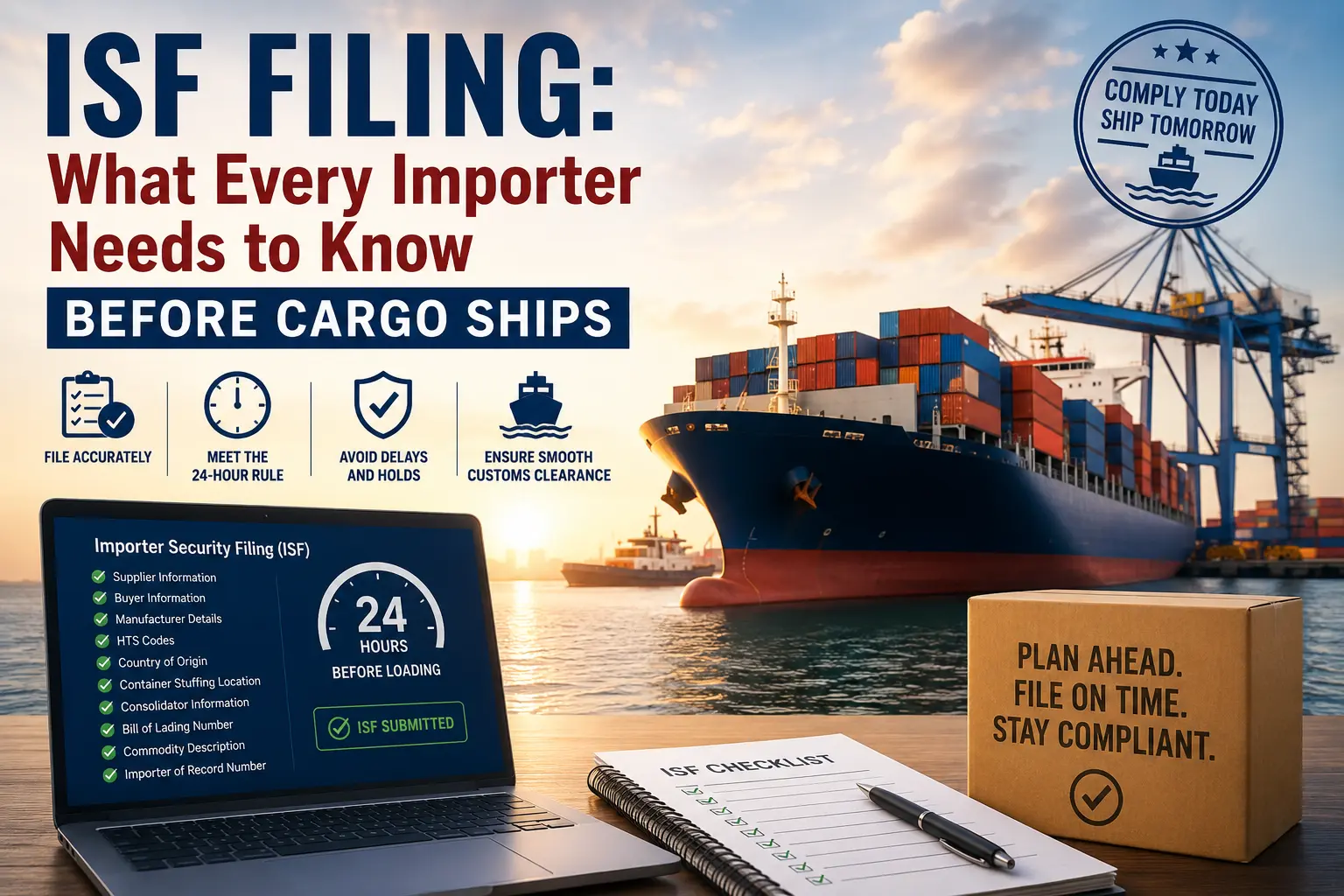
Missing your ISF deadline can cost you $5,000 per shipment in CBP penalties — and that’s before your cargo gets held at the port. If you’re importing goods into the United States by sea and you’re still fuzzy on what ISF actually requires, you’re not alone. Most new importers only hear about ISF after something goes wrong.
ISF, or Importer Security Filing, is a mandatory US Customs requirement that applies to virtually every ocean freight shipment entering the country. Get it right, and your goods clear customs smoothly. Get it wrong, and you’re looking at fines, cargo holds, and a very unhappy supply chain. This guide breaks down exactly what ISF is, how it works, what you need to file, and how to avoid the most common mistakes importers make.
Table of Contents
What Is ISF Filing? {#what-is-isf}
ISF filing is a mandatory pre-shipment data submission required by US Customs and Border Protection (CBP) for all cargo entering the United States via ocean vessel. The full name is Importer Security Filing, though most people in the freight world simply call it ISF or the “10+2” rule.
CBP introduced ISF as part of the SAFE Port Act, with enforcement beginning in January 2010. The purpose is straightforward: give US authorities enough advance information about incoming cargo to assess security risks before the ship reaches American waters.
This isn’t optional. This isn’t a formality. ISF is a legal requirement for any ocean freight shipment bound for a US port, and non-compliance carries serious financial consequences.
Related Read: Learn how UFI Shipping handles end-to-end ocean freight coordination in our Ocean Freight & Container Shipping services page.
ISF 10+2: What the Numbers Actually Mean {#isf-10-plus-2}
The “10+2” label is shorthand for the number of data elements required in an ISF submission: 10 from the importer and 2 from the ocean carrier. Each element tells CBP something specific about the cargo, the parties involved, and the supply chain behind the shipment.
The “10” side covers information the importer (or their customs broker) controls. Think seller names, buyer details, commodity descriptions, and container stuffing locations. The “2” carrier elements are vessel stow plans and container status messages, which the shipping line handles on their end.
Understanding this split matters because it clarifies accountability. The importer bears responsibility for the 10 elements. If your data is late or wrong, that’s on you, not your freight forwarder, unless you’ve explicitly authorized them to file on your behalf.
Who Is Responsible for Filing ISF? {#who-files-isf}
The legal responsibility for ISF filing falls on the importer of record. That’s the person or company whose name appears on the import documentation as the buyer or consignee of the goods.
In practice, most importers authorize a licensed customs broker or freight forwarder to file on their behalf. This is the recommended approach, especially if you’re new to importing or dealing with complex supply chains. A licensed broker knows the system, has direct access to CBP’s Automated Broker Interface (ABI), and can catch data errors before they become penalties.
What you cannot do is hand off the responsibility entirely and assume someone else will handle it by default. You need to explicitly authorize your broker in writing, and you still need to provide them with accurate, complete information. The importer remains the legally responsible party regardless of who pushes the button.
If you’re an e-commerce seller importing private label products or sourcing from overseas manufacturers, this applies to you too. The size of your shipment doesn’t exempt you from ISF requirements.
Need help with customs paperwork? UFI Shipping’s Customs Clearance & Pre-Export Inspections team handles the compliance side so you can focus on your business.
ISF Filing Deadlines: When You Must Submit {#isf-deadlines}
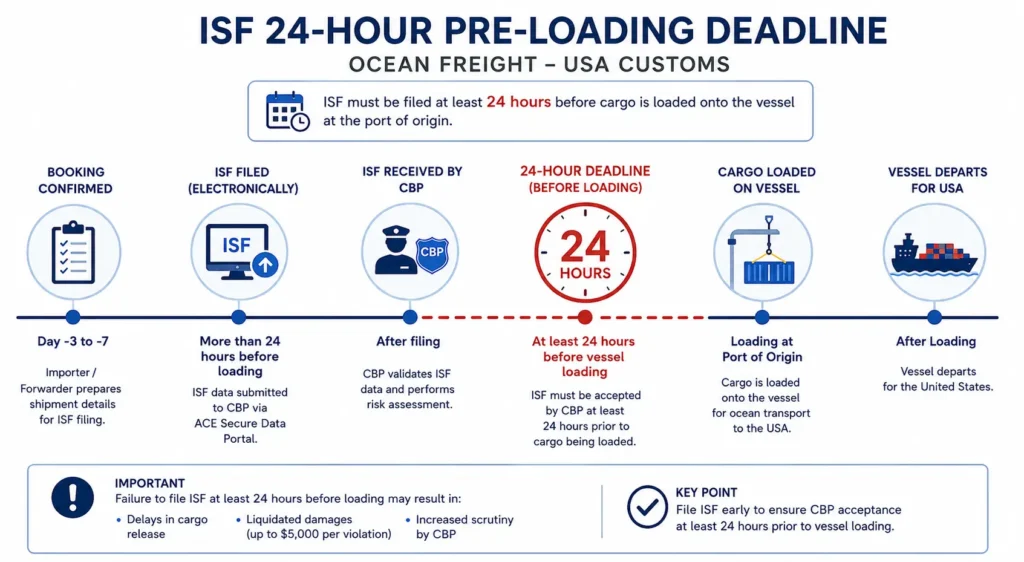
The ISF must be filed no later than 24 hours before the cargo is loaded onto the vessel at the foreign port of origin. Not 24 hours before arrival in the US. 24 hours before the ship leaves.
This deadline is the single most misunderstood part of ISF compliance, and missing it is the most common reason importers get penalized. Your goods might take two weeks to cross the Pacific, but CBP needs the data before the ship departs China, Vietnam, South Korea, or wherever your cargo originates.
Here’s what that means practically: you need to have your shipment details, product information, and supplier data ready well before loading. If your manufacturer is slow to confirm packing details, that’s a problem you need to solve upstream, not scramble to fix the night before vessel departure.
CBP does allow for amendments to an ISF after initial filing, but the original filing must still meet the 24-hour pre-loading window. If information changes after submission, you can update it, but you can’t use “information wasn’t available” as a defense for filing late.
The 10 Data Elements You Must Provide {#10-data-elements}
Each of the 10 importer-side elements serves a specific purpose in CBP’s cargo risk assessment system. Here’s what you’re required to submit:
1. Seller (Owner)
The name and address of the entity selling the goods. This is typically your overseas manufacturer or supplier.
2. Buyer (Owner)
The name and address of the entity buying the goods. Usually your US-based company.
3. Importer of Record Number
Your IRS EIN, CBP-assigned number, or Social Security Number. This identifies who’s legally responsible for the shipment.
4. Consignee Number
The US entity receiving the goods. This can be the same as the importer of record or different if you’re shipping to a third-party warehouse or fulfillment center.
5. Manufacturer (or Supplier)
The name and address of the entity that actually manufactured or assembled the product. Not always the same as the seller.
6. Ship-to Party
Where the cargo is going after it clears customs. This could be your warehouse, an Amazon FBA center, or a 3PL facility.
7. Country of Origin
The country where the goods were manufactured or substantially transformed. This is a critical element for tariff and trade compliance purposes.
8. Commodity HTS-6 Code
The Harmonized Tariff Schedule code at the 6-digit level. This classifies your product for customs purposes.
9. Container Stuffing Location
The address of the facility where cargo was loaded into the container. This is often a factory or consolidation warehouse in the origin country.
10. Consolidator (Stuffer)
The name and address of the party that physically stuffed the container. This might be your supplier, a freight consolidator, or a third-party logistics provider. For official compliance details and filing requirements, importers can review the CBP Official ISF 10+2 Guidance published by U.S. Customs and Border Protection.
Getting these 10 elements accurate matters as much as getting them in on time. CBP’s automated targeting system uses this data to flag potential security risks, and inconsistencies between your ISF data and the actual shipment documents create red flags.
The 2 Carrier Data Elements {#2-carrier-elements}
The carrier side of ISF 10+2 involves two data elements that the ocean shipping line submits directly to CBP:
Vessel Stow Plan: A complete manifest of where every container is physically located on the vessel. This must be submitted 48 hours after the vessel departs the last foreign port before arriving in the US, or 24 hours before arrival for voyages shorter than 48 hours.
Container Status Messages (CSMs): Electronic updates that track the status of containers as they move through the supply chain. The carrier transmits these to CBP as the container is gated in, loaded, and transited.
As an importer, you don’t file these yourself. Your shipping line handles them. But you should understand they exist because they’re part of what CBP cross-references against your ISF data. Discrepancies between what you filed and what the carrier reports can trigger a customs exam.
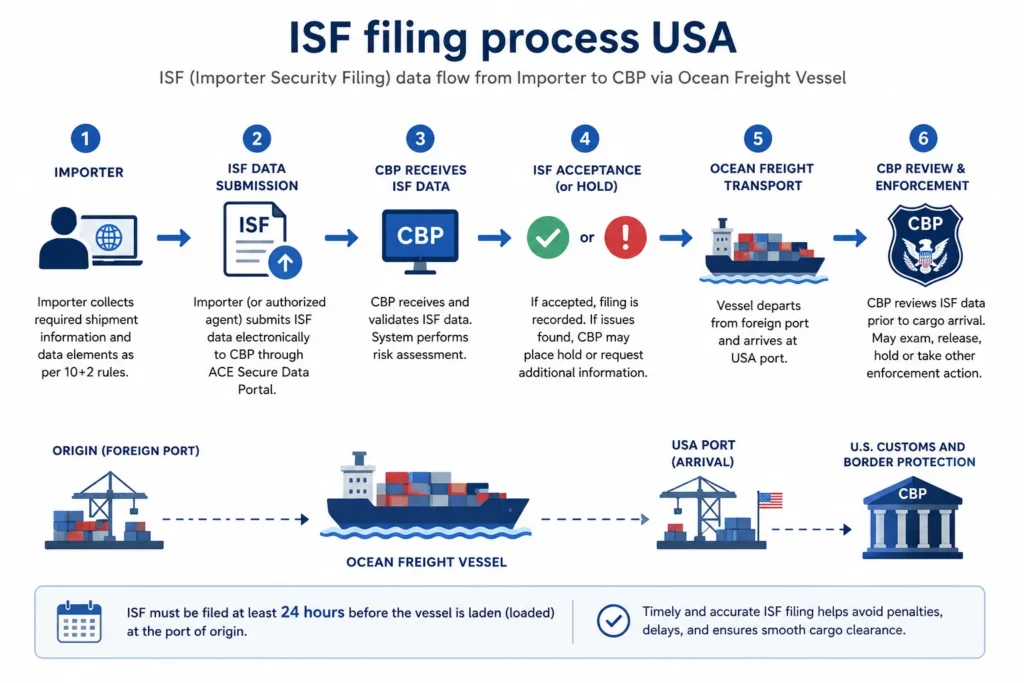
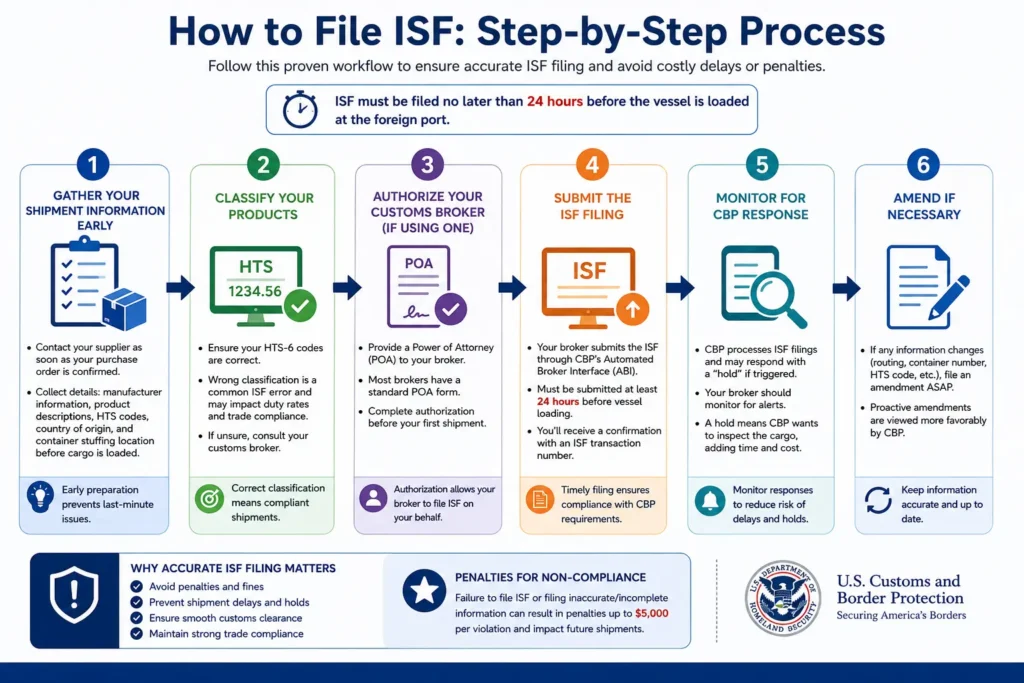
How to File ISF: Step-by-Step Process {#how-to-file}
The mechanics of filing ISF are simpler when you break them down into a repeatable workflow.
Step 1: Gather Your Shipment Information Early
Contact your supplier as soon as your purchase order is confirmed. You need manufacturer details, product descriptions, HTS codes, country of origin, and container stuffing location before the cargo is loaded. Don’t wait for the commercial invoice.
Step 2: Classify Your Products
Make sure your HTS-6 codes are correct. Wrong classification is one of the most common ISF errors, and it can create problems that extend well beyond the ISF itself, affecting your duty rates and trade compliance. If you’re unsure, a customs broker can help.
Step 3: Authorize Your Customs Broker (If Using One)
Provide a Power of Attorney to your broker so they can file on your behalf. Most brokers have a standard POA form. You’ll need to do this before your first shipment.
Step 4: Submit the ISF Filing
Your broker submits the ISF through CBP’s Automated Broker Interface no later than 24 hours before vessel loading. You’ll receive a confirmation with an ISF transaction number.
Step 5: Monitor for CBP Response
CBP processes ISF filings and may respond with a “hold” if something triggers their targeting system. Your broker should be monitoring for these alerts. A hold means CBP wants to inspect the cargo, which adds time and cost to your shipment.
Step 6: Amend If Necessary
If any information changes after filing (shipment is rerouted, container number changes, HTS code needs correction), file an amendment as soon as possible. Proactive amendments are treated more favorably than discrepancies discovered during customs examination.
ISF Penalties: What Happens If You Miss the Filing {#isf-penalties}
CBP can assess liquidated damages of up to $5,000 per shipment for ISF violations. These aren’t just for non-filing. Late filings, incomplete filings, and inaccurate data all expose you to the same penalty structure.
There are four main violation categories:
Late Filing: Submitting the ISF after the 24-hour pre-loading deadline. Even 30 minutes late counts.
Inaccurate Data: Filing with incorrect information, such as wrong HTS codes, misidentified manufacturers, or incorrect country of origin.
No Filing: Never submitting an ISF at all. This is the most severe category and almost guarantees a penalty if CBP catches it.
Failure to Amend: Knowing that filed information is wrong and not correcting it.
CBP does have mitigation guidelines, and first-time violations with strong compliance history can sometimes result in reduced penalties. But don’t count on mitigation as your safety net. The better strategy is building a process that makes violations unlikely in the first place.
Beyond the fines, cargo subject to ISF violations can be held, examined, and delayed at the port. In peak season, a hold at a major port like Los Angeles or Long Beach can mean days of delay and significant demurrage charges on top of any penalty.
ISF vs. Other Customs Filings: How They Differ {#isf-vs-other-filings}
ISF is often confused with other import documents, and the confusion is understandable. Here’s how it compares to the most common filings:
ISF vs. Entry Filing (CBP Form 3461 / 7501)
The entry filing is what formally imports your goods into the US and triggers duty assessment. The ISF comes before the shipment even departs the origin country. They serve completely different functions, and you need both.
ISF vs. Bill of Lading
The bill of lading is the carrier’s contract of carriage and receipt for your goods. The ISF is a security filing submitted to CBP. Some data overlaps (like container numbers and party names), but they’re separate documents with separate purposes.
ISF vs. AMS (Automated Manifest System)
AMS is filed by the ocean carrier and covers the entire vessel manifest. ISF is filed by the importer or their broker for specific shipments. CBP cross-references both systems.
ISF vs. AES (Automated Export System)
AES applies to exports from the US, not imports. If you’re shipping goods out of the US, AES is what you deal with. ISF is the import-side equivalent in terms of advance data requirements.
Understanding these distinctions prevents you from assuming one filing covers another. Each has its own deadline, responsible party, and legal basis.
Common ISF Mistakes and How to Avoid Them {#common-mistakes}
After working with hundreds of import shipments, the same errors come up repeatedly. Here are the ones that cause the most damage:
Filing Too Late
The 24-hour pre-loading rule catches importers off guard when they’re used to thinking in terms of vessel transit time. Build a workflow that triggers ISF preparation at purchase order stage, not when the cargo is already at the port.
Using the Wrong HTS Code
Misclassifying your product creates a chain of downstream problems: wrong duty rates, potential anti-dumping liability, and CBP examinations. Use a licensed customs broker or a tariff classification specialist for any product you haven’t imported before.
Incorrect Country of Origin
This is especially common for goods manufactured in multiple countries or assembled from components made in several locations. Country of origin rules are specific and sometimes counterintuitive. When in doubt, your broker or trade counsel can provide a country of origin determination.
Not Updating When Information Changes
Supplier swaps, production location changes, re-routing due to vessel delays: any of these can change ISF data after you’ve filed. Amend promptly rather than hoping CBP won’t notice.
Relying on Your Freight Forwarder Without Authorizing Them
Your freight forwarder may offer ISF filing as a service, but without an explicit Power of Attorney, they’re not authorized to file on your behalf. Make sure the authorization paperwork is in place before your first shipment.
[IMAGE SUGGESTION: Checklist graphic for ISF filing compliance showing common mistakes to avoid for US ocean freight importers]
Working with a reliable freight partner makes ISF compliance significantly easier. UFI Shipping’s NVOCC & LCL/LTL Consolidation service gives you expert coordination at every step of your ocean shipment.
FAQ {#faq}
Q: What is ISF filing and when is it required? A: ISF (Importer Security Filing) is a mandatory US Customs data submission required for all cargo entering the United States by ocean vessel. It must be filed at least 24 hours before the cargo is loaded onto the ship at the foreign port. Any company or individual importing goods by sea into the US must comply.
Q: What is the ISF 10+2 rule? A: The ISF 10+2 rule refers to the 12 data elements required for ocean freight security filings: 10 elements submitted by the importer (covering parties, commodity details, and logistics locations) and 2 elements submitted by the ocean carrier (vessel stow plan and container status messages).
Q: How much is the penalty for not filing ISF? A: CBP can assess liquidated damages of up to $5,000 per shipment for ISF violations, including late filing, inaccurate data, or failure to file at all. Cargo can also be held for examination, which adds additional delay and port charges.
Q: Can my freight forwarder file ISF for me? A: Yes, a licensed customs broker or freight forwarder can file ISF on your behalf, but only if you’ve authorized them in writing through a Power of Attorney. The importer of record remains the legally responsible party regardless of who submits the filing.
Q: Does ISF apply to air freight shipments? A: No. ISF applies only to ocean freight shipments arriving in the United States. Air freight is covered by separate advance data programs through CBP’s Air Cargo Advance Screening (ACAS) system.
Q: What HTS code level is required for ISF? A: The ISF requires the commodity’s Harmonized Tariff Schedule code at the 6-digit level. A more detailed 10-digit HTS code is required at the time of formal entry, but the 6-digit level satisfies the ISF requirement.
Q: When can I amend an ISF after filing? A: You can amend an ISF any time after the initial submission. The key is to amend as soon as you know information has changed, before CBP discovers the discrepancy through their own systems or a physical examination.
Getting ISF Right Protects Your Entire Supply Chain
Three things matter most when it comes to ISF compliance: file early, file accurately, and amend promptly when anything changes. These three habits will keep you clear of CBP penalties and cargo holds in the vast majority of situations.
ISF is not bureaucratic red tape to resent. It’s a system built around supply chain security, and once you understand how it works, it becomes a manageable part of your import process rather than a source of anxiety. Most experienced importers build ISF data collection into their supplier onboarding workflow so that the information is ready before it’s ever needed.
If you’re new to US importing, partnering with a licensed customs broker for your first several shipments is money well spent. And if you’re scaling up your import operations, investing in a compliance review of your ISF process can save you far more in avoided penalties than it costs.
Start with one shipment. Get the process right. Then repeat it at scale.
Ready to move cargo with a team that keeps compliance at the center? Get a quote from UFI Shipping and see how we handle ocean freight from Japan with zero guesswork on your end.