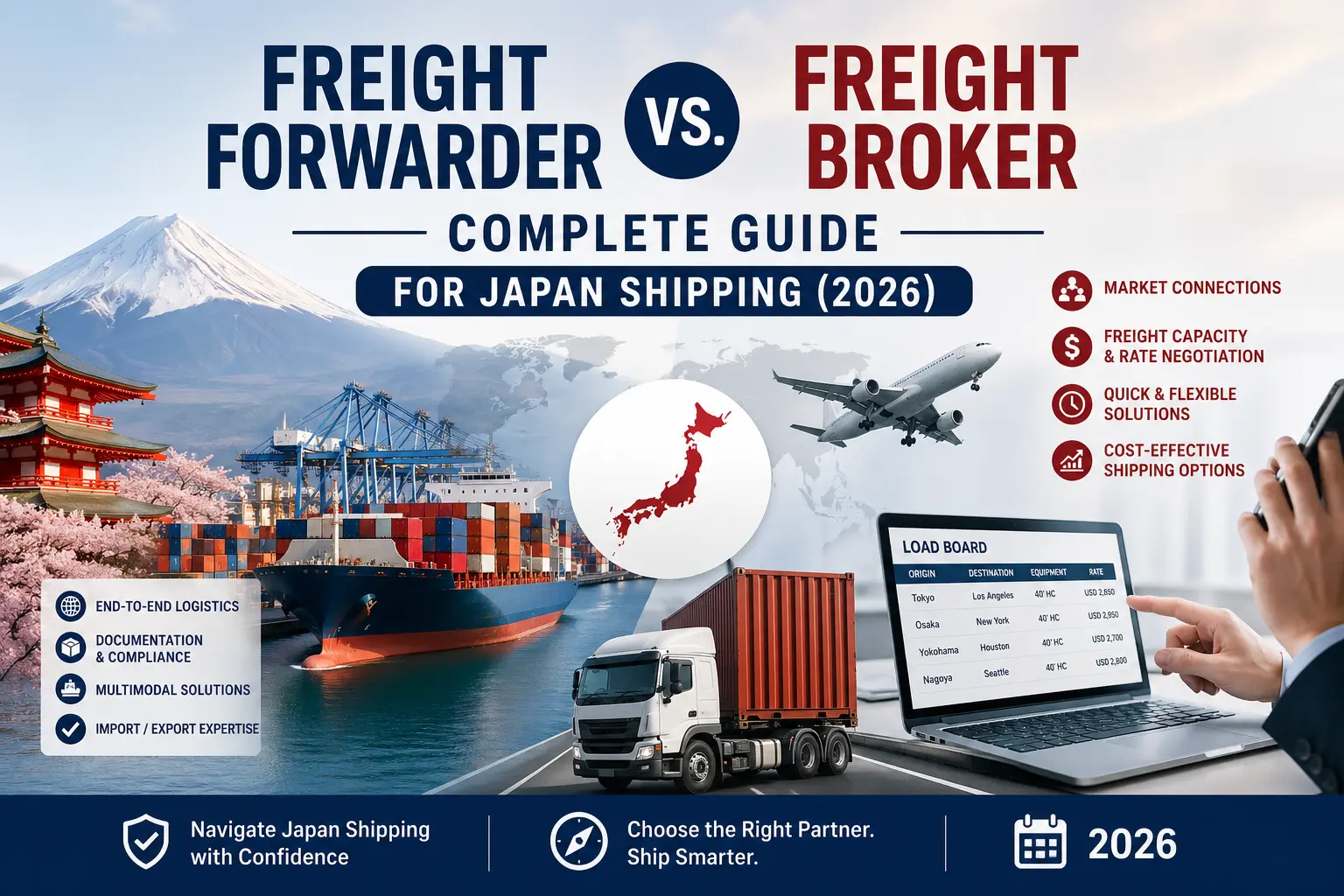
Your shipment is sitting at Yokohama Port and customs will not release it. The carrier has not confirmed the booking. And you have no idea who is actually responsible for sorting it out — your broker, your forwarder, or someone else entirely.
When it comes to the forwarder vs freight broker question, this situation plays out for importers and exporters every single week. The confusion almost always traces back to one basic problem: not knowing which logistics partner you hired, and what they are actually obligated to do on your behalf.
This guide breaks down the real differences between a forwarder vs freight broker, plus customs brokers and NVOCCs, with specific focus on Japan shipping lanes. The goal is simple — help you make the right call before cargo moves, not after something goes wrong.
What Is a Freight Broker?
A freight broker is essentially a middleman. Their job is to connect shippers — companies or individuals with cargo to move — with carriers, which are the trucking companies, ocean lines, or air cargo operators that physically transport goods. The broker holds no cargo, operates no vessels, and takes no physical responsibility for your goods.
In the United States, domestic freight brokers must be licensed by the Federal Motor Carrier Safety Administration (FMCSA). In international trade, the term is used more loosely, but the core function stays the same: arrange transportation on behalf of a shipper without taking physical custody of the cargo.
How freight brokers make money: Brokers earn through the spread between what they charge the shipper and what they pay the carrier. If a shipper pays $3,500 to move a container and the broker secures carrier space for $2,900, the broker keeps $600. This margin is typically not disclosed, though some brokers charge a flat fee instead. Because brokers profit from the spread, their incentive is to find the lowest-cost carrier, which may or may not line up with your need for reliability or careful cargo handling.
When a freight broker makes sense:
- Straightforward domestic or point-to-point international moves with no complex documentation
- Spot shipments or one-off moves where you have no established carrier relationship
- Situations where you already have a customs broker and documentation sorted
What Is a Freight Forwarder?
A freight forwarder is a much more comprehensive logistics partner. Rather than simply connecting you to a carrier, a freight forwarder manages the entire international shipping process. This includes booking cargo space, coordinating inland transport, preparing and filing documentation, arranging insurance, handling customs clearance, and managing every handoff along the route.
Think of a freight forwarder as your outsourced international logistics department. They act as your agent and often as a principal in their own right, taking on contractual responsibility for the shipment’s movement from origin to destination.
In the US, ocean freight forwarders must be licensed by the Federal Maritime Commission (FMC). In Japan, they operate under the Ship Agent and Freight Forwarder Law, overseen by the Ministry of Land, Infrastructure, Transport and Tourism.
What a freight forwarder typically handles:
- Ocean or air freight booking, often at negotiated rates due to volume
- Export documentation including Bills of Lading, certificates of origin, packing lists, and commercial invoices
- Import documentation, coordinating with customs brokers at the destination
- Inland transportation such as drayage to port and last-mile delivery
- Warehousing and consolidation for smaller shipments (LCL)
- Cargo insurance arrangements
- Track and trace monitoring throughout the journey
Japan-focused forwarders like UFI Shipping bring specialized knowledge of Japanese customs procedures, port protocols, and local carrier relationships that generalist freight brokers simply cannot replicate.
What Is a Customs Broker?
This is where many shippers get confused. A customs broker is neither a freight broker nor a freight forwarder, though their work frequently overlaps with both.
A customs broker is a licensed professional who specializes exclusively in clearing goods through customs. In the US, customs brokers are licensed by US Customs and Border Protection (CBP). In Japan, they are called tsukan gyosha (通関業者) and are licensed by the Ministry of Finance.
Their specific responsibilities include classifying goods under the Harmonized Tariff Schedule (HTS), calculating applicable duties and taxes, preparing and filing entry documentation, securing release of cargo from customs holds, and advising on regulatory compliance.
The critical distinction is simple. A customs broker clears your goods. A freight forwarder moves your goods. A freight broker finds a carrier for your goods. These are three different functions.
UFI Shipping handles Customs Clearance and Pre-export Inspections as an integrated service, which means you get both the forwarding and the customs expertise under one roof — no confusion about who is responsible.
For Japan specifically, errors in HS code classification or a missing certificate can mean weeks of delay. Japan Customs operates one of the more rigorous import screening systems in the world, covering food safety, pharmaceutical regulations, and detailed documentation for everything from electronics to textiles.
What Is an NVOCC? (And Why It Matters When Choosing a Forwarder vs Freight Broker)
NVOCC stands for Non-Vessel Operating Common Carrier. This is one of the most important and most misunderstood designations in international ocean freight.
An NVOCC is a company that issues its own Bills of Lading and acts as a carrier to its customers, but does not own or operate the vessels that physically move the cargo. Instead, the NVOCC purchases bulk space from actual ocean carriers like Maersk, MSC, or NYK Line and resells that space to shippers, often in smaller lots.
The actual ocean carrier issues a Master Bill of Lading to the NVOCC. The NVOCC then issues its own House Bill of Lading to the shipper and assumes full carrier liability. This is a fundamental difference from a freight broker, who arranges transportation but accepts zero carrier liability.
UFI Shipping operates as a licensed NVOCC with dedicated NVOCC and LCL/LTL Consolidation services on Japan trade lanes. This means shippers receive House Bills of Lading under UFI’s liability, backed by volume-negotiated carrier rates that smaller shippers could not access on their own.
Why NVOCCs matter for Japan shipping:
- LCL access at competitive rates. NVOCCs consolidate cargo from multiple shippers, making ocean freight viable for shipments that do not fill a full container. This is particularly valuable for SMEs importing or exporting with Japan.
- Guaranteed space. Because NVOCCs hold contracted space with carriers, they can often guarantee bookings even during capacity crunches on transpacific lanes.
- Japan-specific expertise. NVOCCs focused on Japan trade understand the documentation quirks at Yokohama, Kobe, Nagoya, and Tokyo ports.
- Clear liability coverage. There is a clear contractual party to hold responsible if cargo is damaged, lost, or delayed — unlike with a broker-only arrangement.
Forwarder vs Freight Broker: Side-by-Side Comparison
| Comparison Point | Freight Broker | Freight Forwarder |
|---|---|---|
| Core Function | Connects shippers to carriers | Manages end-to-end international shipment logistics |
| Issues Bill of Lading | No | Yes (House Bill of Lading) |
| Handles Customs Clearance | Rarely | Often (in-house or via partner broker) |
| Prepares Export/Import Docs | No | Yes |
| Assumes Carrier Liability | No | Yes, when acting as NVOCC |
| Arranges Cargo Insurance | Rarely | Yes |
| LCL Consolidation | No | Yes (if also NVOCC or with NVOCC partner) |
| Best For | Simple domestic or spot shipments | Complex international shipments, regulated markets |
| Japan Trade Expertise | Low (generalist) | High (specialized forwarders) |
| Regulatory Licensing (US) | FMCSA (domestic) | FMC (ocean freight) |
Forwarder vs Freight Broker: Which One Do You Actually Need?
If you are shipping domestically within the US and just need a truck: A freight broker is likely sufficient.
If you are importing goods to the US from Japan: You need a licensed ocean freight forwarder with customs brokerage capability on both ends. UFI Shipping’s Ocean Freight services cover this end-to-end.
If you are exporting goods from the US to Japan: You need a freight forwarder familiar with Japanese customs requirements and the specific port of entry — whether Yokohama, Tokyo, Nagoya, Kobe, or Osaka.
If your shipment is less than a full container (LCL): You need an NVOCC or a forwarder that operates LCL consolidation services on your trade lane. UFI’s NVOCC and LCL consolidation service is built exactly for this.
If your goods are regulated — food, pharmaceuticals, electronics, or chemicals: You need a freight forwarder and a customs broker, ideally under one roof, with specific experience in Japanese regulatory compliance.
If you are shipping high-value cargo and need clear liability coverage: An NVOCC or forwarder who issues their own House Bill of Lading is essential. Do not rely on a broker-only arrangement.
If you are scaling a regular Japan trade lane and want predictable costs: A forwarder or NVOCC with a service contract on that lane will consistently outperform spot-market brokers over time.
How Incoterms Affect the Forwarder vs Freight Broker Decision
Incoterms, published by the International Chamber of Commerce, define exactly where your responsibility ends and your counterparty’s begins. Your Incoterm directly determines which logistics partner you need.
EXW (Ex Works): The seller’s responsibility ends at their factory door. The buyer arranges everything — inland transport to port, export customs clearance, ocean freight, Japan import customs, and inland delivery. This Incoterm demands a full-service freight forwarder with Japan customs expertise on both ends.
FOB (Free On Board): Responsibility transfers to the buyer when goods are loaded on the vessel at the named port. You control the ocean freight booking, choosing your preferred forwarder or NVOCC and your insurance coverage. FOB is one of the most common terms on Asia-US lanes and one of the most recommended for US importers buying from Japan.
CIF (Cost, Insurance, Freight): The seller arranges and pays for ocean freight and insurance to the destination port. The buyer takes over once goods arrive. With CIF, the seller often picks the carrier, which limits your control over transit times. Many experienced importers prefer FOB for exactly this reason.
DDP (Delivered Duty Paid): The seller handles everything — origin export, ocean freight, destination customs, duties, taxes, and final delivery. If you are selling DDP into Japan, you need a licensed Japanese customs broker and a forwarder with a strong Japan agent network.
The practical rule: the more responsibility you hold under your Incoterm, the more you need a full-service freight forwarder or NVOCC rather than a simple broker.
Japan-Specific Considerations for Importers and Exporters
Japan presents a distinct set of logistics challenges that make generalist providers inadequate for many shipments.
Japan Customs (税関, Zeikan) operates under the Customs Tariff Law and the Foreign Exchange and Foreign Trade Act. Japan requires advance filing before cargo is released from the bonded area at port. Certain goods including food, cosmetics, pharmaceuticals, and medical devices require additional ministry-level approvals before clearance can proceed. Japan also has strict Japanese-language labeling requirements that customs may inspect for compliance.
Japan Customs uses the NACCS electronic clearance platform. Working with a licensed customs broker integrated with NACCS is essential for efficient and accurate clearance.
Major Japanese ports each serve specific trade functions. Yokohama is Japan’s largest container port and the primary transpacific gateway. Nagoya handles the highest cargo volume in Japan and is critical for automotive supply chains. Kobe has strong Southeast Asia and Europe connections and is especially important for food imports. Osaka serves as the main gateway for the Kansai region.
For more information on Japan’s import regulations by product category, JETRO’s import/export resources are a useful starting point.
UFI Shipping has Drayage services that connect port arrivals seamlessly to inland destinations across Japan, reducing dwell time and port-related delays.
Liability and Cargo Insurance: A Critical Forwarder vs Freight Broker Difference
Freight broker liability: A freight broker has extremely limited liability. Under US law, a freight broker is generally not liable for cargo loss or damage. Their role is to arrange transportation, not carry goods. If cargo is lost, your claim is against the carrier, not the broker.
Freight forwarder liability: When a forwarder issues their own House Bill of Lading and acts as an NVOCC, they assume carrier liability, typically limited by applicable conventions to approximately $500 per package or $2 per kilogram, whichever is higher.
Cargo insurance covers physical loss or damage to goods in transit and is separate from carrier liability. For Japan trade lanes, All Risk coverage is standard for most commercial shipments, with premiums typically running 0.3% to 1.0% of cargo value.
The rule is simple: never move goods without cargo insurance regardless of carrier liability coverage, and never assume your broker’s or forwarder’s standard service includes insurance. It must be explicitly purchased and confirmed in writing.
2025-2026 Shipping Landscape: What Has Changed
Red Sea disruptions have forced most major ocean carriers to reroute Asia-Europe services around the Cape of Good Hope since late 2023. This adds 10 to 14 days to transit times and has kept freight rates on Japan-Europe lanes elevated.
Transpacific capacity volatility remains a challenge. Trade policy uncertainty in 2025 created significant front-loading activity as importers accelerated shipments ahead of tariff changes. Long-term service contracts and NVOCC relationships with guaranteed space have consistently outperformed pure spot-market strategies.
NACCS digital upgrades at Japan Customs now include new API integrations that allow licensed customs brokers to file and receive clearance notifications digitally. Forwarders not integrated with NACCS operate at a structural disadvantage.
Carbon reporting is also becoming a real selection criterion. The IMO’s Carbon Intensity Indicator (CII) rating system is now active, and corporate sustainability teams are increasingly requiring forwarders to provide verified emissions data for scope 3 reporting.
Conclusion:
The forwarder vs freight broker decision is not just about terminology. It is the difference between having a single accountable partner who owns your shipment from door to door and having a middleman who steps aside the moment something goes wrong.
For Japan trade specifically, where customs requirements are rigorous, ports have specific protocols, and carrier relationships determine your service quality, your choice of logistics partner directly affects landed costs, compliance exposure, and supply chain reliability.
If you are importing precision components from Nagoya, exporting agricultural products through Yokohama, or building a regular bilateral trade lane, UFI Shipping offers licensed NVOCC services, full freight forwarding, customs clearance, inland transportation, and warehousing — all purpose-built for Japan trade. Get a quote today and let the right partner handle the complexity.