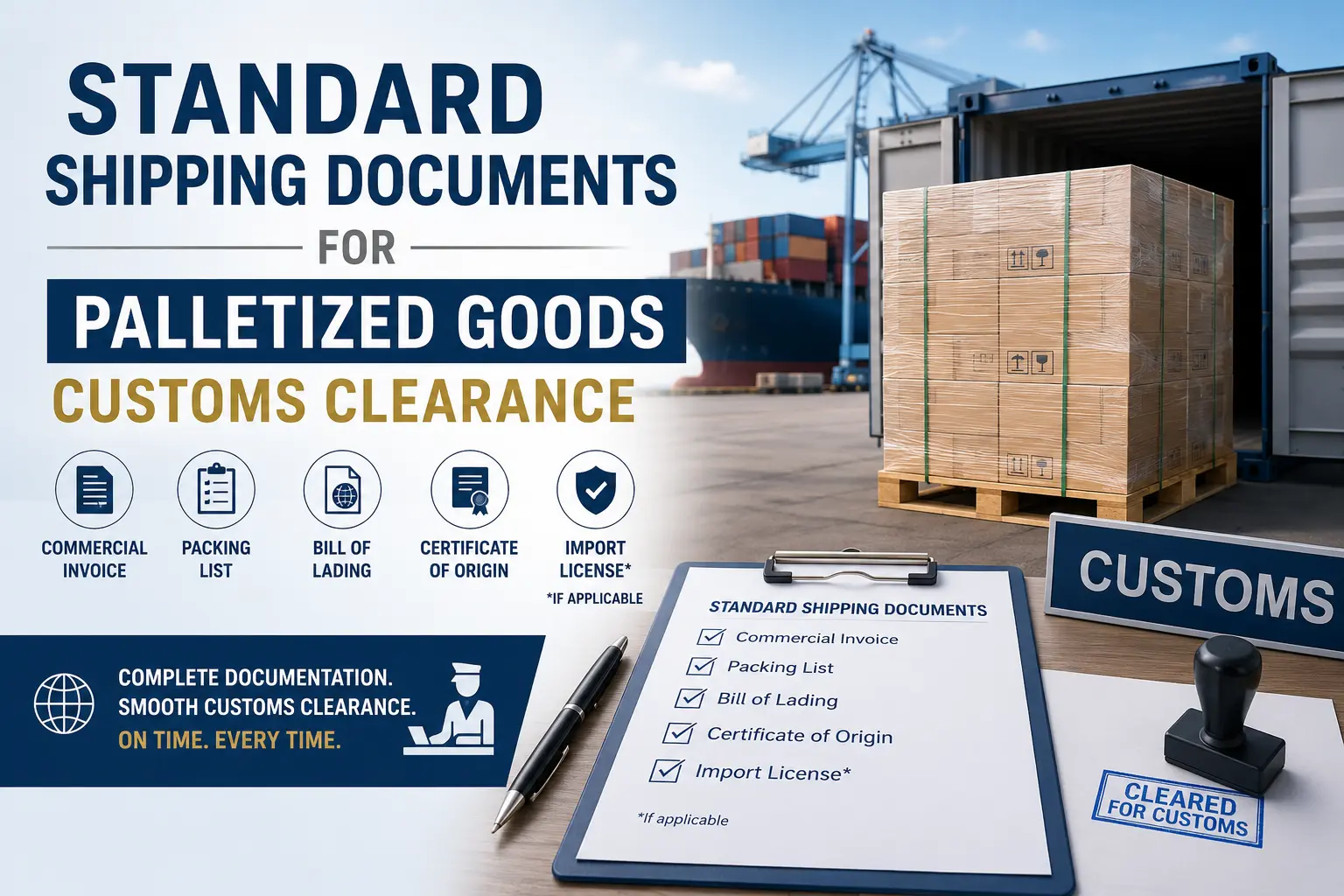
When a shipment sitting on wooden pallets gets held at port, it rarely comes down to the goods themselves. It comes down to paperwork. A missing fumigation certificate, a weight mismatch between the commercial invoice and bill of lading, or a pallet that lacks a proper IPPC stamp — these are the real reasons palletized cargo fails customs clearance. And they are entirely preventable.
This guide covers every standard shipping document required for palletized goods customs clearance, explains what each document must actually contain, and flags the specific errors that cause holds, fines, and delays. If you are shipping on pallets internationally, this is the checklist you need before your cargo leaves the origin facility.
Why Palletized Shipments Have Unique Documentation Requirements
Most shipping documentation guides treat all cargo the same. But palletized goods carry a layer of compliance that loose carton shipments do not. The moment wood enters the equation — whether it is a standard wooden pallet, a crated machine, or dunnage inside a container — international phytosanitary regulations activate. Those regulations require specific documentation that has nothing to do with the goods themselves.
Beyond the wood packaging rules, palletized shipments tend to be heavier and more structured than parcel shipments, which means packing lists need to reflect individual pallet counts, gross weights per pallet, and stacking configurations. Customs examiners use this information to cross-verify the physical cargo against declared values. Discrepancies at this level are one of the most common triggers for intensive physical examinations.
Understanding this two-layer reality — commercial documentation plus packaging compliance documentation — is the starting point for getting palletized cargo through customs without delay.
Core Commercial Documents
1. Commercial Invoice
The commercial invoice is the foundational document for every international shipment. Customs authorities in the destination country use it to assess import duties, verify the declared value of goods, and confirm the terms of the transaction between buyer and seller.
For palletized shipments, a weak or incomplete commercial invoice is the single most common cause of clearance delays. Here is what it must include without exception:
- Full legal names and addresses of the seller (exporter) and buyer (importer/consignee)
- Detailed description of goods — specific enough to match an HS code, not vague terms like “machine parts” or “general merchandise”
- Quantity per line item with unit of measure
- Unit price and total value per line item
- Total invoice value in the transaction currency
- Country of origin for each product
- Incoterms 2020 rule with the named place (e.g., FOB Shanghai, CIF Los Angeles)
- Payment terms
- Invoice date and a unique invoice number
One thing most guides skip: your Incoterms declaration directly affects how customs calculates the customs value. For example, under CIF terms, insurance and freight are included in the customs value used for duty calculation. Under FOB, they are not. Getting this wrong can mean underpaying or overpaying duties, both of which create downstream compliance issues.
For ocean freight shipments entering the US, the commercial invoice also feeds into the Importer Security Filing data. If HS codes or origin data on the invoice conflict with what was declared in the ISF, customs flags it immediately.
2. Packing List
Think of the packing list as the physical map of your shipment. Where the commercial invoice addresses the financial and legal side of the transaction, the packing list describes what is physically inside the shipment, how it is packed, and how it is arranged. Customs examiners rely on it to verify cargo against the transport document without opening every box.
For palletized goods, the packing list must go beyond a simple item count. It should reflect:
- Total number of pallets
- Individual pallet numbers or identifiers
- Items loaded on each pallet (with quantities and descriptions)
- Net weight and gross weight per pallet
- Dimensions of each pallet (length x width x height)
- Total net weight and gross weight of the entire shipment
- Container number and seal number (if FCL)
- Shipping marks and numbers as they appear physically on the pallets
The gross weight on the packing list must match the gross weight on the bill of lading and the commercial invoice exactly. Even a 50 kg discrepancy — something that happens routinely when a supplier estimates rather than weighs — triggers what customs compliance teams call a “three-way match failure.” Once that flag goes up, the entire shipment moves to a hold queue pending document amendment.
A packing list is technically not a mandatory document in all jurisdictions, but in practice no experienced customs broker would submit a declaration without one. The additional clarity it provides speeds up examinations and reduces the chance of a physical inspection.
3. Bill of Lading (B/L) or Sea Waybill
For ocean freight — which is the primary mode for most palletized commercial shipments — the bill of lading (B/L) serves three distinct functions simultaneously. It is a receipt confirming the carrier received the goods. It is a contract of carriage defining the terms under which the goods will be transported. And, if issued as a negotiable (or “to order”) bill of lading, it is a document of title, meaning whoever holds the original controls release of the cargo.
There are two main types worth knowing:
Straight Bill of Lading: Non-negotiable. The cargo can only be released to the named consignee. Used when the buyer is known and trusted, with no letter of credit involved.
Negotiable (To Order) Bill of Lading: Can be endorsed and transferred. Required for most letter of credit transactions because the issuing bank needs to control the title until payment is made.
For palletized goods, the bill of lading must reflect the pallet count accurately. If the B/L says “25 pallets” but the packing list shows 26, the discrepancy must be resolved before the destination customs authority will release the cargo. This kind of error typically originates when a shipper amends the packing list after the shipping instructions have been submitted to the carrier.
If you are shipping by air, the airway bill (AWB) replaces the B/L. Unlike a B/L, an AWB is always non-negotiable and does not function as a document of title.
Palletized Goods Specific Documents
4. Phytosanitary Certificate and ISPM 15 Compliance
This is where palletized cargo diverges sharply from other shipment types, and it is the area most frequently mishandled.
ISPM 15 is an international standard issued by the International Plant Protection Convention (IPPC) governing the treatment of solid wood packaging materials used in international trade. It mandates that all solid wood packaging — including wooden pallets, crates, and dunnage — must be debarked, heat treated (HT) or methyl bromide fumigated (MB), and permanently stamped with the official IPPC mark before crossing an international border.
The IPPC mark itself must appear on at least two opposite sides of the wood packaging and must include:
- The IPPC wheat logo
- Country code (e.g., US, CN, DE)
- Producer/treatment provider registration number
- Treatment method (HT for heat treated, MB for methyl bromide)
- Debarked indicator (DB)
Here is the critical point that most guides gloss over: the IPPC stamp on the pallet substitutes for a separate phytosanitary certificate in most countries. You do not need an additional certificate if the wood is properly stamped. However, certain countries — notably Australia and New Zealand — require a separate wood packing declaration on company letterhead confirming ISPM 15 compliance in addition to the physical IPPC stamp on the wood. Shipments transiting through or destined for these markets require both.
What happens when ISPM 15 compliance fails:
| Consequence | Detail |
|---|---|
| Rejection at port of entry | Entire shipment refused; must be re-exported at shipper’s expense |
| On-site treatment | Cargo pulled for approved treatment; expensive, time-consuming |
| Destruction | Some authorities destroy non-compliant wood packaging rather than treating it |
| Re-export costs | Can exceed $5,000 per container for re-export orders |
Plastic and plywood pallets are exempt from ISPM 15 requirements entirely. If you are shipping high-value goods on a recurring basis and want to eliminate phytosanitary risk completely, switching to plastic or plywood pallets removes this documentation requirement from the equation.
The IPPC maintains the official registry of this standard. You can verify treatment requirements by destination country through the IPPC’s official resources at ippc.int.
5. Fumigation Certificate
A fumigation certificate is required when pallets or wooden packaging materials have been treated with methyl bromide (MB) as their ISPM 15 treatment method, or when the destination country’s customs authority requests specific certification beyond the physical IPPC mark.
The certificate is typically issued by a licensed pest control or fumigation company and confirms that the wooden packaging was treated according to the relevant standards, the date and location of treatment, the treatment method and chemical concentration used, and the duration of treatment.
Some countries — particularly in Southeast Asia and the Middle East — routinely request fumigation certificates for incoming shipments regardless of whether the IPPC stamp is present. Checking the specific requirements of your destination country before shipping, rather than assuming the stamp alone is sufficient, can save you from a hold at the port of arrival.
6. Export Packing Declaration
The export packing declaration (EPD) is a written statement from the shipper, typically on company letterhead, that identifies all packaging materials used for the shipment and confirms whether those materials are ISPM 15 compliant.
It is most commonly required for shipments going to Australia, New Zealand, and certain Pacific Island nations, but is increasingly requested by customs authorities in other regions as biosecurity concerns grow globally. The declaration generally includes:
- Shipper and consignee details
- Shipment reference numbers
- Description and quantity of packaging materials (pallets, crates, dunnage)
- Statement confirming ISPM 15 treatment and certification
- Reference to fumigation certificate or IPPC stamp numbers
- Date and signature of the shipper
Think of the EPD as the shipper’s own written guarantee that their packaging is compliant. Where the IPPC stamp is the physical evidence on the wood, the EPD is the documentary paper trail confirming that evidence.
Trade and Regulatory Documents
7. Certificate of Origin (COO)
The certificate of origin formally states the country in which the goods were manufactured or produced. For many shipments, it is the document that unlocks preferential tariff rates.
Under various Free Trade Agreements (FTAs) — such as USMCA for North American trade, the ASEAN agreements for Southeast Asia, or the EU’s GSP arrangements — goods from qualifying countries may attract significantly reduced or zero import duties. Without a valid COO confirming origin, the goods default to the standard Most Favoured Nation (MFN) duty rate, which can be substantially higher.
There are two main types of certificates of origin:
Non-preferential COO: Simply confirms the country of origin for general customs purposes. Does not trigger FTA duty reductions. Typically issued by a Chamber of Commerce.
Preferential COO: Confirms the goods meet the specific rules of origin under a particular trade agreement. Required to claim FTA duty benefits. The exact format depends on the agreement (for example, Form A for GSP, EUR.1 for EU agreements, or a self-certification statement for USMCA).
For palletized commercial shipments, getting the COO issued before the vessel departs is important. Retroactive certificate issuance is possible in some countries but complicated, and destination customs authorities may not accept backdated documents.
In 2026, with elevated Section 301 tariffs on China-origin goods and ongoing trade policy shifts, accurate country of origin documentation has become more consequential than ever. Misrepresenting origin — intentionally or through sloppy documentation — now carries much more severe penalty exposure.
8. Importer Security Filing (ISF) for US Ocean Imports
The ISF — also called “10+2” — is a mandatory pre-arrival filing requirement by US Customs and Border Protection (CBP) for all cargo arriving in the United States by ocean vessel. It is not a document in the traditional sense, but rather an electronic data submission that must happen before your palletized shipment even gets loaded on the vessel at the origin port.
The importer (or their licensed customs broker) must submit 10 data elements to CBP at least 24 hours before cargo is loaded onto a vessel bound for the US. Late or inaccurate filing carries a penalty of $5,000 per occurrence for late filing and up to $10,000 for inaccurate information.
The 10 data elements the importer must provide:
- Seller (name and address)
- Buyer (name and address)
- Importer of Record number
- Consignee number
- Manufacturer or supplier (name and address)
- Ship-to party (name and address)
- Country of origin
- HTS (Harmonized Tariff Schedule) number
- Container stuffing location
- Consolidator (name and address)
The carrier provides the remaining two elements: vessel stow plan and container status messages.
If you are importing palletized goods from China, the ISF is particularly critical in 2026 because CBP cross-references ISF origin data against the commercial invoice to identify potential duty circumvention under the current tariff landscape. Any inconsistency between the ISF and the subsequent customs entry creates an immediate red flag.
For a detailed breakdown of the ISF process, including how to handle amendments and avoid the most common filing errors, see the ISF filing guide for importers.
9. Cargo Insurance Certificate
The cargo insurance certificate proves that the shipment is covered against loss or damage during transit. While it is not universally mandatory for customs purposes, many destination countries’ customs regulations require it, and it is a standard requirement under letter of credit transactions.
For palletized cargo, where a single pallet can carry goods worth tens of thousands of dollars, insurance coverage is not optional from a risk management standpoint. The certificate should state the coverage amount, the risks covered (all-risks versus named perils), the insured party, and the claims contact procedure.
Under CIF and CIP Incoterms, the seller is contractually required to arrange insurance on behalf of the buyer. Under EXW, FOB, and FCA terms, the buyer arranges their own coverage. The Incoterms rule on your commercial invoice should match your insurance arrangements. Mismatches between these create confusion about who is responsible for the claim if cargo is damaged.
Conditional Documents Based on Goods Type
Some palletized shipments require additional documentation depending on what is on the pallet. These are not universal requirements, but failing to have them ready when needed results in the same port hold as any missing mandatory document.
| Document | When Required | Issued By |
|---|---|---|
| Phytosanitary Certificate | Plants, seeds, agricultural products | Government plant protection authority |
| Health Certificate | Food products, meat, dairy | Government health/agricultural authority |
| FDA Prior Notice | Food shipments entering the US | Filed electronically via FDA system |
| Dangerous Goods Declaration (DGD) | Hazardous materials (IMO classification) | Shipper/trained DG professional |
| Safety Data Sheet (SDS/MSDS) | Chemical products, flammable goods | Manufacturer |
| Import License | Controlled or restricted goods (some electronics, pharmaceuticals, firearms) | Government authority in destination country |
| Export License | Controlled goods, dual-use items | Government authority in origin country |
One category that trips up experienced shippers: batteries and electronics. Many palletized shipments of consumer electronics or industrial equipment contain lithium batteries. These require a Dangerous Goods Declaration prepared by a certified professional and specific marking on the packaging. Customs authorities in the US, EU, and Australia have increased inspection rates for electronics shipments since 2025, partly due to changes in HS classification chapters 84-85.
The Three-Way Match Rule: The Single Biggest Cause of Customs Holds
Experienced freight professionals refer to the “three-way match” as the non-negotiable check that must pass before any palletized shipment clears customs cleanly. The three documents that must align precisely are:
Commercial Invoice + Packing List + Bill of Lading
The following fields must be identical across all three:
- Gross weight (total and per line where applicable)
- Net weight
- Number of packages/pallets
- Goods description
- Consignee name and address (exactly as it appears, no abbreviations)
- Shipper name and address
- Container number and seal number (where applicable)
Here is where shippers run into trouble most often: the commercial invoice is prepared early, the packing list is finalized at the warehouse, and the bill of lading reflects what the carrier actually loaded. These three documents are created at different times by different people. By the time all three reach the customs broker, they often have subtle discrepancies.
A weight difference of even 50 kg between the invoice and the packing list is enough for customs software to flag the shipment. The consignee name appearing as “ABC Trading Co. Ltd.” on the B/L but “ABC Trading Company” on the invoice is enough for a mismatch alert. These are not significant commercial differences, but customs systems are designed to catch them.
The practical fix: create a master shipment data sheet before any documents are prepared, and require all document preparers — the supplier, the freight forwarder, the carrier — to work from that single source. Review all three documents against each other before the booking is confirmed.
Document Preparation Timeline for Palletized Shipments
Knowing which documents are needed is half the job. Knowing when they need to be ready is the other half. Below is a practical preparation sequence:
Before booking confirmation:
- Verify HS codes for all products on the shipment
- Confirm whether a Certificate of Origin is required and which type
- Confirm ISPM 15 pallet compliance with your supplier or packing facility
- Check destination country-specific requirements (fumigation certificate, packing declaration, etc.)
At time of booking:
- Prepare commercial invoice with accurate values, Incoterms, and HS codes
- Submit ISF data to customs broker (for US ocean imports — no later than 24 hours before vessel loading)
- Confirm cargo insurance coverage
Before vessel cutoff:
- Finalize packing list after actual weighing and measuring of pallets
- Cross-check three-way match across commercial invoice, packing list, and draft B/L
- Obtain fumigation certificate if applicable
- Complete export packing declaration if required by destination
After vessel departure:
- Verify IPPC stamp documentation is in the document package
- Send complete document set to destination customs broker
- Retain copies for your records — CBP and other customs authorities can request re-verification up to several years after the shipment
Country-Specific Nuances Worth Knowing
Most content on this topic presents documentation requirements as universal. In practice, the destination country introduces significant variation.
United States: ISF filing is mandatory for ocean imports (no equivalent for air or land). CBP Form 7501 (Entry Summary) is required for formal entry of commercial shipments. FDA Prior Notice for food products must be filed before the shipment arrives. Plastic and heat-treated wood pallets both accepted; untreated solid wood results in immediate hold or re-export order.
European Union: Customs declaration through the ICS2 system for advance cargo information (equivalent of ISF for ocean and air to EU). EUR.1 or GSP Form A required to claim preferential duty rates under EU trade agreements. ISPM 15 strictly enforced at all EU ports; non-compliant shipments quarantined.
Australia and New Zealand: Among the strictest biosecurity regimes in the world. Both countries require a signed wood packing declaration alongside ISPM 15-compliant pallets. All incoming pallets may be subject to physical inspection by the Australian Border Force (ABF) or New Zealand Customs. Non-compliant wood packaging is destroyed at the shipper’s expense, not returned.
China (for imports into China): Customs declaration through the Single Window system. Physical inspections of wood packaging are frequent. Non-compliant WPM (wood packaging material) is typically re-exported or destroyed. Certificates issued by government-authorized inspection and quarantine agencies carry more weight than those from private fumigation companies.
Understanding customs clearance processes in your specific destination markets, rather than applying a one-size-fits-all document set, is what separates shippers who clear smoothly from those who accumulate demurrage charges.
What Happens If Documents Are Incomplete or Incorrect
The consequences of documentation errors scale with the severity and jurisdiction, but they follow a predictable pattern.
Minor discrepancies (small weight differences, typographical errors in non-critical fields): Customs may request a letter of explanation or an amended document. Clearance is delayed by 1-3 days while amendments are processed. Demurrage charges begin accumulating after the port’s free period expires.
Missing mandatory documents (no fumigation certificate, absent ISF filing, missing COO when required for FTA rates): Shipment placed on hold until the document is provided. If the document cannot be produced retroactively (as with ISF, which must be filed pre-departure), a penalty is assessed regardless. Free periods at US ports typically range from 3-5 days; after that, per-diem detention and demurrage fees of $80-$150 per container per day at major ports can accumulate rapidly.
Serious discrepancies (invoice value significantly lower than declared in other documents, origin mismatch suggesting circumvention): Physical examination ordered. The importer bears all costs for examination, including moving the container to an examination facility, unloading, reloading, and return to the terminal. This process can cost thousands of dollars and delay the shipment by 1-2 weeks.
ISPM 15 non-compliance (untreated or improperly marked wood pallets): Immediate hold. Depending on the destination country, outcomes range from treatment on arrival (expensive) to re-export or destruction. There is no appeal process for re-export orders in most jurisdictions.
The consistent theme: documentation errors are almost always more expensive to fix after the fact than to prevent before the shipment departs.
LCL vs FCL: Does the Shipment Type Change the Documentation?
For palletized goods, the mode of consolidation introduces one additional consideration.
In a Full Container Load (FCL) shipment, the entire container is yours. The container number and seal number are fixed early in the process, can be included on the packing list and B/L, and provide a straightforward tracking reference for customs.
In a Less than Container Load (LCL) shipment, your pallets share a container with cargo from other shippers. The consolidation happens at a Container Freight Station (CFS). In this case, you will have both a house bill of lading (issued by the freight forwarder or NVOCC who consolidated the cargo) and a master bill of lading (issued by the ocean carrier covering the entire container). Customs in most countries want to see both. Your commercial invoice and packing list relate to your portion of the shipment, but the transport document hierarchy is more complex.
If you are regularly shipping palletized goods and are weighing FCL versus LCL options, the documentation differences are one factor among several worth understanding. The FCL vs LCL guide covers the full range of considerations including cost, transit time, and risk profile.
Quick Reference: Complete Document Checklist for Palletized Goods
| Document | Mandatory? | Who Prepares It | When Needed |
|---|---|---|---|
| Commercial Invoice | Yes | Seller/Exporter | Before shipment |
| Packing List | Yes (practical) | Seller/Exporter | Before vessel cutoff |
| Bill of Lading / Sea Waybill | Yes | Ocean Carrier | After cargo loaded |
| ISPM 15 Compliant Pallets + IPPC Stamp | Yes (wood pallets) | Pallet supplier | Before packing |
| Fumigation Certificate | Destination-dependent | Licensed fumigation company | Before shipment |
| Export Packing Declaration | AU/NZ and others | Shipper | Before vessel cutoff |
| Certificate of Origin | When FTA rates claimed | Chamber of Commerce / Authorized body | Before shipment |
| ISF Filing (10+2) | Yes (US ocean imports) | Importer/Customs broker | 24 hrs before vessel loading |
| Cargo Insurance Certificate | L/C required / destination-dependent | Insurance company | Before shipment |
| Phytosanitary Certificate | Agricultural goods | Government authority | Before shipment |
| Dangerous Goods Declaration | Hazardous materials | Certified DG professional | Before booking |
| Import License | Controlled goods | Government authority | Before shipment |
Frequently Asked Questions
Do plastic pallets require any documentation for customs? No. Plastic pallets are exempt from ISPM 15 requirements because they do not harbor the insects and organisms that the standard targets. You still need all standard commercial documents, but you can remove phytosanitary and fumigation documentation from your checklist entirely.
Can I use repaired wooden pallets for international shipments? Only if they have been re-treated and re-stamped by a certified facility after the repair. An original IPPC stamp on a pallet that has subsequently been repaired using untreated wood is considered non-compliant. The stamp must reflect the most recent treatment performed on the entire pallet.
What is the difference between a fumigation certificate and an ISPM 15 certificate? An ISPM 15 certificate (or more accurately, the IPPC mark on the wood) proves the pallet was treated according to the international standard, whether by heat treatment or methyl bromide. A fumigation certificate specifically documents a methyl bromide treatment and is sometimes required separately by destination countries in addition to the physical IPPC stamp.
How far in advance should I start preparing shipping documents for a palletized shipment? Work backward from your vessel cutoff date. The ISF must be filed 24 hours before loading. Certificates of origin typically take 2-3 business days from a Chamber of Commerce. Fumigation and treatment of pallets must happen before packing. As a practical rule, start document preparation at least 7-10 business days before the intended vessel departure.
What if my goods are palletized but I’m shipping by air? ISPM 15 compliance is still required if you are using solid wood pallets for air freight. Most air freight, however, uses plastic or aluminum unit load devices (ULDs) rather than wooden pallets. Check with your air freight forwarder on pallet specifications before packing. ISF is not required for air imports into the US.
Can my freight forwarder handle all of this documentation? A good freight forwarder can prepare or coordinate most documents, file the ISF on your behalf with power of attorney, and advise on country-specific requirements. However, the commercial invoice must come from you as the seller, and the accuracy of product descriptions, values, and HS codes is your legal responsibility. Delegating document preparation does not transfer liability for errors.
Customs clearance for palletized goods is a document management exercise as much as it is a logistics one. The cargo you are shipping may be perfectly prepared, properly packaged, and correctly valued — but if the paperwork package has a gap, everything stops until that gap is filled. Getting the documentation right from the start, verifying the three-way match before cutoff, and understanding the specific requirements of your destination country is what keeps pallets moving from origin to final delivery without interruption.