What Is LCL Shipping?
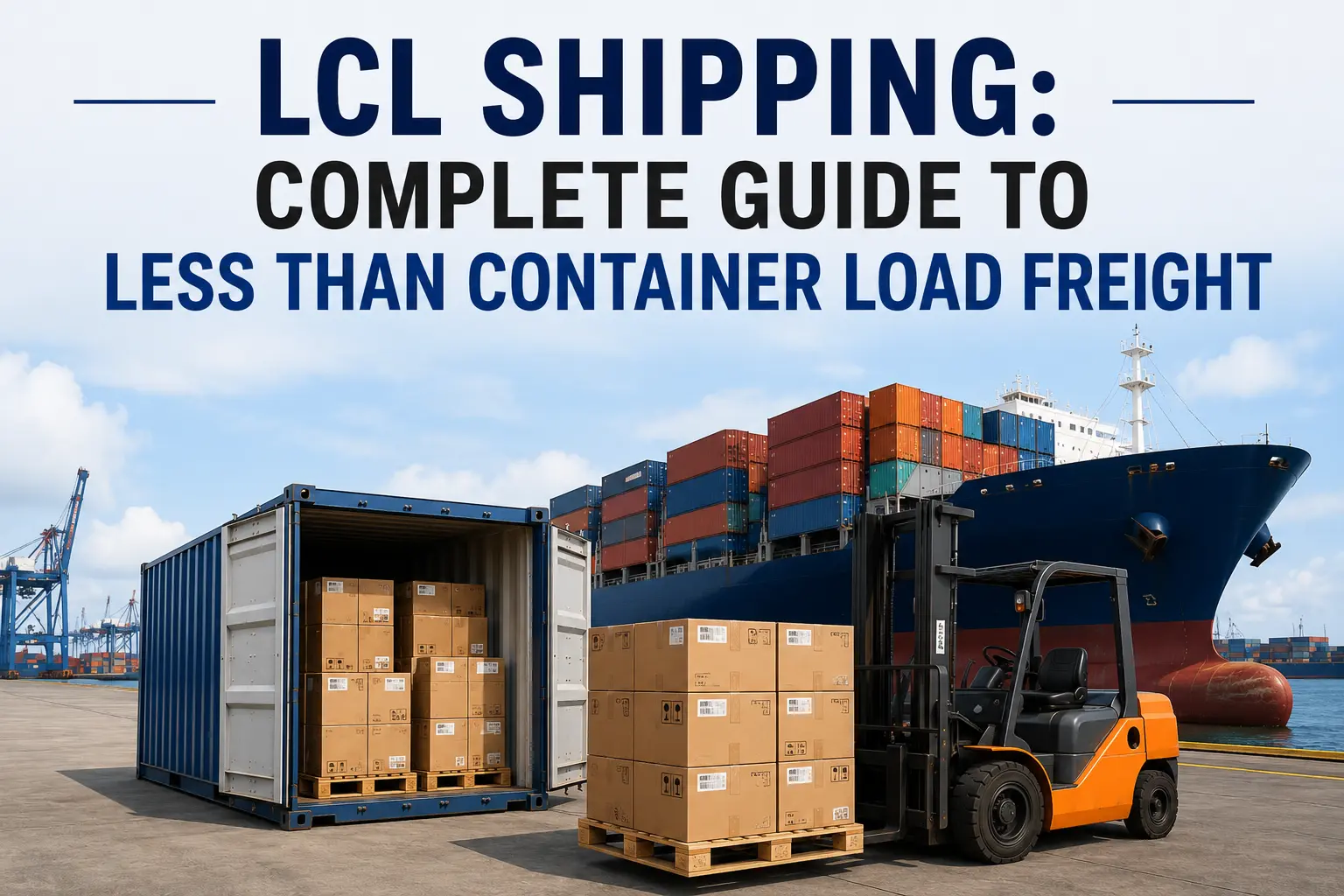
LCL shipping stands for Less than Container Load. It is an ocean freight method where your cargo shares a shipping container with goods from other importers or exporters. Instead of paying for an entire 20-foot or 40-foot container, you pay only for the volume your shipment actually occupies, measured in cubic meters (CBM).
Think of it this way: booking an FCL (Full Container Load) is like renting an entire truck, whether you fill it or not. LCL is like buying a seat on a shared bus. You pay for your seat, the bus still travels the same route, and everyone splits the cost.
This makes LCL one of the most practical shipping options for small and medium-sized businesses, e-commerce sellers, and any importer whose cargo does not justify a dedicated container.
How LCL Shipping Works: The Full Process Step by Step
Understanding each stage of the LCL journey helps you avoid costly mistakes, plan your lead times accurately, and know exactly what you are paying for.
Step 1: Booking the Shipment
You or your freight forwarder submits a booking with the key cargo details: dimensions, gross weight, number of pieces or pallets, commodity type, and origin and destination. This information determines your CBM, which directly drives the cost quote you receive.
Step 2: Cargo Preparation and Packaging
Because your goods will be handled multiple times and share space with other shippers’ cargo, proper packaging is not optional. It is the single biggest factor under your control that protects your shipment. Use export-grade packaging, palletize where possible, apply stretch wrap, and clearly label each piece with the shipper name, destination, and gross weight. For fragile items, add “Fragile” and “This Side Up” markings.
Under-packaged goods in an LCL container are far more vulnerable than in an FCL, where nothing else is moving around them.
Step 3: Delivery to Origin CFS
Your cargo is transported to the origin Container Freight Station (CFS). A CFS is essentially a bonded warehouse at or near the port where multiple shippers’ goods are received, inspected, logged, and staged for loading. You must deliver your goods before the cargo cutoff date, which is typically three to five days before the vessel’s sailing date. Missing the cutoff means your shipment waits for the next available sailing.
Step 4: Consolidation
The consolidator (your freight forwarder or an NVOCC) groups all LCL cargo for the same destination into a single container. Cargo is arranged strategically to maximize space and minimize movement risk during transit. The packed container is then sealed and “drayed,” meaning trucked, to the port of export.
Step 5: Ocean Transit
The container sails to the destination port. Transit time at sea is the same as for FCL on the same route. The difference in total transit time comes from consolidation and deconsolidation, not the sailing itself.
Step 6: Arrival and Deconsolidation
On arrival at the destination port, the container is trucked to the destination CFS, where it is opened and each shipper’s cargo is separated out and held for pickup. This process takes two to five days depending on the port, volume, and any customs inspections required. This step is unique to LCL and is one reason why door-to-door LCL transit times are five to fifteen days longer than comparable FCL shipments.
Step 7: Customs Clearance and Final Delivery
After deconsolidation, your cargo must clear customs before it can be released. Your freight forwarder or customs broker handles this. Once cleared, the cargo can be picked up at the destination CFS or trucked to your door if you have arranged last-mile delivery.
For anyone new to the clearance process, our customs clearance guide explains exactly what documents are needed and how the process works at major ports.
LCL Shipping Costs: What You Actually Pay
This is where most guides fall short. They quote a per-CBM rate and stop there. In practice, your total landed cost has multiple components, and ignoring them leads to invoice shock.
The W/M Billing Rule
Every LCL shipment is billed on a W/M (Weight/Measurement) basis. This means the carrier takes the higher of two values: your actual gross weight in metric tonnes, or your shipment volume in CBM. The formula is:
Chargeable W/M = max(weight in tonnes, volume in CBM)
Example: if your cargo is 2 CBM but weighs 2,500 kg (2.5 tonnes), you are billed for 2.5 W/M, not 2 CBM. Dense cargo like machinery or auto parts is frequently heavier than its volume suggests, which can significantly change your cost versus the initial estimate.
Full Cost Breakdown
| Cost Component | Typical Range | Notes |
|---|---|---|
| Ocean Freight (base rate) | $40 – $180 per CBM | Varies by trade lane and season |
| Origin CFS Handling | $15 – $40 per CBM | Charged at origin CFS |
| Destination CFS Handling | $15 – $40 per CBM | Charged at destination CFS |
| Documentation Fee | $50 – $100 per shipment | B/L preparation, manifest |
| Customs Clearance | $150 – $250 per shipment | Varies by country and broker |
| Destination Drayage | $200 – $400 per shipment | Trucking from destination CFS |
| BAF / Fuel Surcharge | $15 – $30 per CBM | Fluctuates with bunker prices |
| Peak Season Surcharge | $10 – $30 per CBM | Applies Sep–Dec typically |
A realistic all-in cost for a 2 CBM shipment from China to the US West Coast in 2026 is $500 to $900 total, even though the base ocean rate might quote at $120 per CBM. Always ask your freight forwarder for an all-in quote that includes origin and destination CFS fees, documentation, and drayage.
Current Market Rates (2026)
Early 2026 LCL rates have normalized to the $85–$165 per CBM range for China to US West Coast shipments, with trade policy changes and port labor agreements continuing to create rate volatility. Environmental compliance costs tied to IMO2030 fuel regulations are beginning to appear as green surcharges, expected to add $5–$10 per CBM by late 2026.
How to Calculate Your LCL Cost
- Measure each piece of cargo: length × width × height in meters
- Add all volumes to get total CBM
- Weigh all cargo and convert to metric tonnes
- Apply the W/M rule: take whichever is higher
- Multiply by the per-CBM ocean rate
- Add CFS fees (origin and destination), documentation, customs clearance, and drayage
For international shipping cost estimates across different modes, our international shipping cost guide provides useful benchmarks.
LCL vs FCL: How to Choose the Right Option
This is the decision that matters most for your bottom line. The choice is not about preference; it is about volume and math.
The 15 CBM Rule
LCL beats FCL under approximately 15 CBM. Above 15 CBM, a dedicated 20-foot container with roughly 28 CBM of capacity is almost always cheaper per cubic meter than consolidated freight.
However, the breakeven point shifts depending on the trade lane, current FCL rates, and your specific cargo. Always request both an LCL quote and an FCL quote for any shipment in the 10 to 18 CBM range and compare total landed costs, not just the base rates.
Detailed Comparison Table
| Factor | LCL | FCL |
|---|---|---|
| Ideal volume | 1 – 15 CBM | 15+ CBM |
| Pricing | Per CBM used | Flat rate per container |
| Transit time | 5–15 days longer (consolidation/deconsolidation) | Faster, no CFS delays |
| Cargo handling | Multiple touchpoints | Loaded once, delivered once |
| Damage risk | Slightly higher | Lower |
| Customs inspection risk | Higher (shared container) | Lower |
| Cash flow | Better (ship smaller batches) | Requires larger inventory commitment |
| Schedule flexibility | High (ship anytime cargo is ready) | Must wait to fill container |
| Best for | SMEs, e-commerce, new market testing | High-volume regular importers |
When LCL Is the Smarter Choice
LCL makes sense when your cargo volume is under 15 CBM, when you need to ship immediately rather than wait to accumulate enough goods for a full container, when you are testing a new market or product line and do not want to commit to large inventory, or when your business operates on lean inventory principles and needs frequent smaller shipments to keep stock flowing.
When FCL Is the Better Option
FCL is worth considering when your volume consistently hits 15 CBM or more per shipment, when your cargo is fragile or high-value and extra handling creates unacceptable risk, when your delivery deadline is tight and you cannot absorb the additional days LCL adds, or when you are shipping hazardous materials, as many CFS operators restrict or refuse dangerous goods in shared containers.
Our dedicated article on FCL vs LCL shipping breaks down the cost comparison with worked examples if you want to dig deeper into the numbers.
Required Documents for LCL Shipping
Getting documentation right is not a formality. Errors in any of these documents can hold your entire shipment at the destination CFS, trigger customs exams, and generate demurrage charges that accumulate daily.
Bill of Lading (B/L): The primary transport document. It serves as a contract between you and the carrier, proof of ownership, and receipt of goods. For LCL shipments, you typically receive a House Bill of Lading (HBL) issued by the freight forwarder, not the ocean carrier directly.
Commercial Invoice: Must state the accurate value, description, and quantity of goods. Undervaluing goods to reduce import duties is a customs offence in virtually every jurisdiction.
Packing List: A detailed breakdown of every piece, its dimensions, weight, and contents. Discrepancies between the packing list and the actual cargo are a common trigger for customs holds.
Certificate of Origin: Required for most international shipments and often necessary to apply preferential tariff rates under trade agreements.
ISF Filing (for US imports): The Importer Security Filing must be submitted to US Customs at least 24 hours before loading at the origin port. Late or missing ISF filings result in fines. Our ISF filing guide for importers covers exactly what you need to file and when.
Destination Country Documents: Depending on where the cargo is going, you may need phytosanitary certificates, fumigation certificates, or specific product conformity documentation. Check with your customs broker before booking.
LCL Shipping Risks and How to Manage Them
Risk 1: Damage from Extra Handling
LCL cargo is handled more than FCL at loading and unloading at the CFS, which slightly increases the damage risk. For fragile goods, the recommended approach is to use export-grade packaging, palletize the cargo, apply “Fragile” and “No Stack” labels, and always purchase cargo insurance. Suaid Global
Cargo insurance for LCL shipments is not expensive relative to the protection it provides. Most freight forwarders can arrange it as part of the booking. Do not skip it.
Risk 2: Customs Delays Affecting Your Entire Co-load
This is a risk most guides do not explain clearly. When a shared container arrives at the destination port and customs selects it for inspection, the entire container is held, not just the cargo belonging to the shipper under scrutiny. If another company’s goods in your container trigger an inspection, your shipment is delayed too, and you have no control over this. Building a buffer of five to seven extra days into your planning for LCL shipments is simply good practice.
Risk 3: Missing the Cargo Cutoff
LCL consolidation runs on tight schedules. If your cargo arrives at the CFS even a few hours after the cutoff, it misses that week’s sailing and waits for the next departure on that route, which could be three to ten days later depending on the trade lane and service frequency. Confirm the exact cutoff date and time with your freight forwarder before trucking the cargo to the CFS.
Risk 4: CFS Storage Charges
Once your cargo is deconsolidated at the destination CFS, it usually receives a limited number of free days, typically two to five. After that, daily storage charges apply. These can add up quickly if customs clearance is delayed or your customs broker is slow to act. Make sure your clearance documentation is ready and your broker is briefed before the vessel arrives.
LCL Shipping and Incoterms: Who Pays for What
Your choice of Incoterms determines exactly which costs and risks transfer between buyer and seller at each stage of the shipment. This matters a lot in LCL because there are many distinct handoff points, from the origin CFS to the destination CFS to final delivery.
Under FOB (Free on Board), the seller covers costs and risk up to loading at the origin port. The buyer takes on from there, including ocean freight, destination CFS, customs, and drayage. Under CIF (Cost, Insurance, Freight), the seller covers the ocean freight and insurance to the destination port, but the buyer still handles destination CFS, customs, and last-mile trucking.
For new importers working with overseas suppliers, it is worth agreeing on Incoterms explicitly in your purchase contract to avoid disputes about who owes what on the freight invoice.
LCL Shipping Best Practices for Importers and Exporters
Getting the most out of LCL shipping comes down to a few habits that experienced shippers develop over time.
Measure your cargo accurately before booking. CBM errors are the most common cause of invoice disputes. Measure each carton at its outermost dimensions and use actual gross weight on the packing list.
Book early, especially around peak season. LCL consolidation space on major routes like China to US or China to Europe fills up fast between September and December. Rates spike and space becomes scarce. Booking three to four weeks ahead gives you better rates and guaranteed space.
Ask for the all-in quote. Never compare quotes based on the ocean rate alone. Always ask for origin CFS, destination CFS, documentation, and a rough estimate of destination charges so you are comparing total landed costs.
Choose a freight forwarder with owned or trusted CFS agents at destination. An experienced ocean freight forwarder with strong relationships at the destination CFS can speed up deconsolidation and reduce the risk of delays or misdirected cargo.
Transition to FCL when volume justifies it. Once you are regularly shipping more than 15 CBM per booking, doing the math on a 20-foot container is worth the five minutes it takes.
LCL Shipping for E-Commerce and Small Businesses
LCL was built for exactly the kind of shipping that e-commerce businesses do. Small order quantities, frequent replenishment cycles, multiple SKUs from different suppliers, and the need to move goods without tying up working capital in large inventory are all scenarios where LCL fits naturally.
For sellers on platforms like Amazon who use FBA fulfillment, LCL is a common way to move inventory from overseas manufacturers to prep facilities or Amazon warehouses. The key is aligning your LCL shipment schedule with your FBA inventory planning, since deconsolidation and customs clearance add time that you must account for in your reorder calculations.
LCL Shipping Glossary
CFS (Container Freight Station): A facility where LCL cargo is consolidated before loading and deconsolidated after arrival. Both origin and destination charges apply.
CBM (Cubic Meter): The standard unit of volume measurement for LCL cargo. Length × width × height in meters.
W/M (Weight/Measurement): The billing method for LCL, where you pay on whichever is greater: your weight in tonnes or your volume in CBM.
Consolidator: The company (usually a freight forwarder or NVOCC) that groups multiple LCL shipments into one container.
Deconsolidation: The process of unpacking a shared container at the destination CFS and separating each shipper’s cargo.
HBL (House Bill of Lading): The transport document issued by a freight forwarder to an LCL shipper, as opposed to the Master Bill of Lading issued by the ocean carrier to the consolidator.
NVOCC (Non-Vessel Operating Common Carrier): A carrier that issues bills of lading and sells ocean freight capacity without operating its own vessels. Many LCL consolidators operate as NVOCCs.
Free Time: The number of days cargo can remain at the destination CFS without incurring storage charges after deconsolidation.
Frequently Asked Questions About LCL Shipping
What is the minimum shipment size for LCL? There is no formal minimum, though most freight forwarders find shipments below 0.5 CBM are more economical via air freight or express courier. LCL typically makes practical sense from around 1 CBM upward.
How long does LCL shipping take? Door-to-door transit time depends heavily on the route. As a general benchmark, China to US West Coast via LCL takes 28 to 40 days door-to-door. That includes three to five days at the origin CFS, 14 to 18 days sailing, and two to five days at the destination CFS plus customs clearance time. FCL on the same route is typically ten to fifteen days faster.
Is LCL cheaper than air freight? Yes, significantly. Even with all the additional CFS fees, LCL ocean freight typically costs five to ten times less per kilogram than air freight. The tradeoff is transit time. For non-urgent cargo, LCL is almost always the better value.
Can I track my LCL shipment? Yes. Most freight forwarders provide tracking through their portals using the House Bill of Lading number. Visibility at the container level is available through the ocean carrier using the container number, though individual LCL cargo tracking is generally provided by your forwarder rather than the carrier directly.
What happens if my LCL cargo is damaged? If you have cargo insurance, you file a claim with the insurer. Without insurance, recovery depends on proving carrier liability, which requires establishing fault at a specific handling point. This is difficult in LCL because cargo passes through multiple hands. This is one more reason cargo insurance is strongly recommended for any LCL shipment.
Are there goods that cannot be shipped via LCL? Some hazardous goods classes can ship LCL, but restrictions are much stricter than with FCL, and many CFS operators refuse dangerous goods cargo entirely. Perishables requiring temperature control are generally not suitable for standard LCL. Oversized cargo that cannot be palleted or stacked may also not fit standard CFS operations. Always confirm commodity acceptance with your freight forwarder before booking.
Regulatory Reference
For importers bringing goods into the United States, the authoritative guidance on customs requirements including ISF obligations, cargo examination procedures, and import bond requirements comes from US Customs and Border Protection (CBP), the federal agency that governs all US import activity.
Final Thoughts
LCL shipping is one of the most flexible and cost-effective tools available in international trade, particularly for businesses that do not have the volume to justify a dedicated container on every shipment. The key to using it well is understanding exactly how costs are calculated (always use the W/M rule, not just CBM), building the right lead times into your planning (door-to-door is longer than the sailing time suggests), packaging your cargo properly, and working with a freight forwarder who knows the destination CFS operations on your trade lane.
For most importers shipping less than 15 CBM per booking, LCL will consistently outperform FCL on cost. Once you cross that threshold regularly, the comparison deserves a second look. Either way, understanding how LCL works gives you the knowledge to negotiate better rates, catch billing errors, and make smarter decisions about how your goods move across the world.
For a broader look at how ocean freight fits into your overall logistics strategy, our ocean freight guide covers the full picture from carrier selection to route optimization.