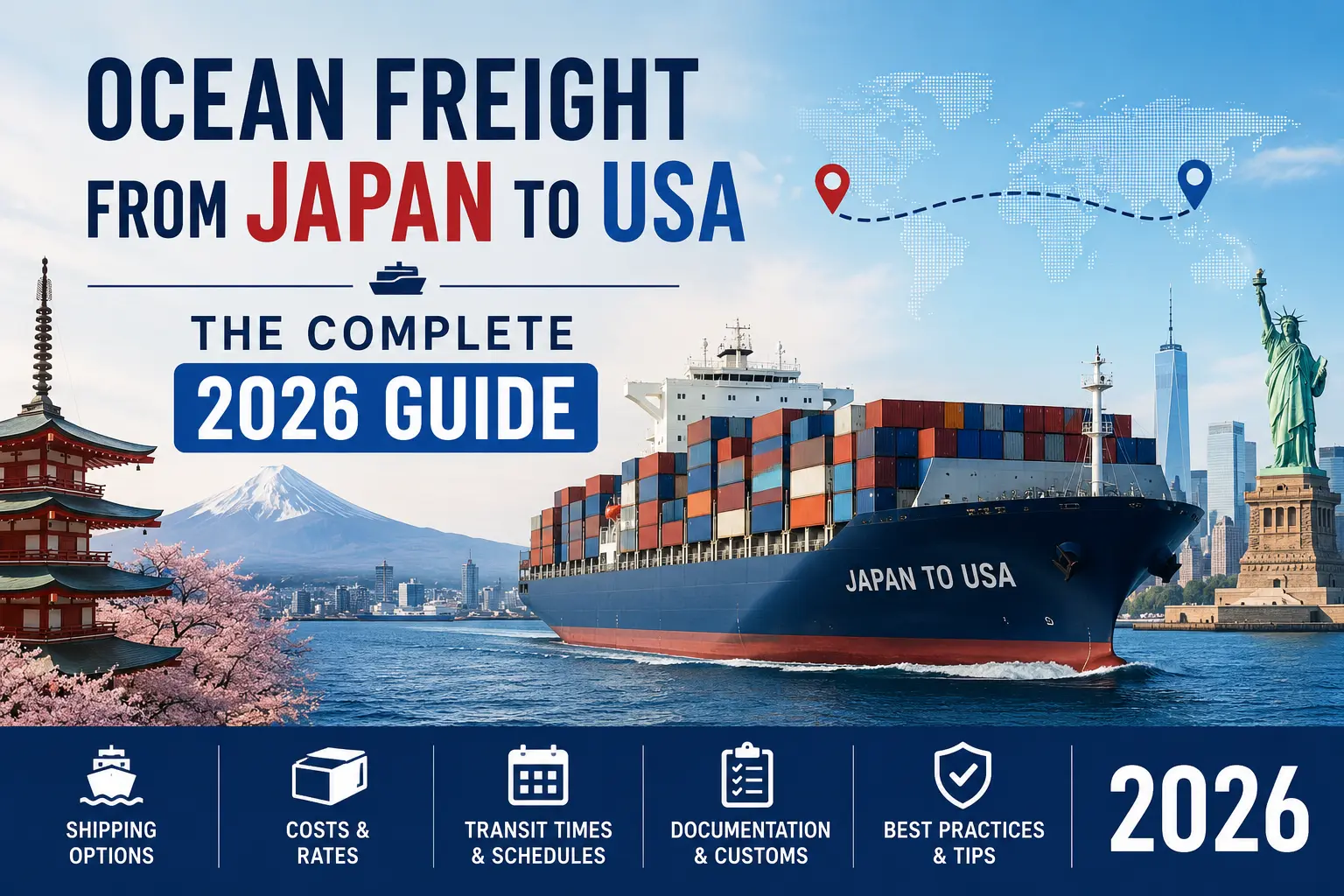
Shipping goods internationally requires careful planning, and ocean freight from Japan to USA remains one of the most reliable and cost-effective solutions for businesses moving cargo across the Pacific. Whether you are importing automotive parts, electronics, industrial machinery, or consumer goods, ocean freight continues to serve as the backbone of this major trade corridor. However, understanding the shipping process, costs, container options, customs requirements, and potential delays is essential for a smooth and successful shipment.
This guide covers everything from choosing the right port and container type to navigating U.S. customs, calculating total landed costs, and making informed shipping decisions in today’s freight environment.
Why Japan to USA Ocean Freight Matters in 2026
Japan is one of America’s most significant trading partners. According to the U.S. Trade Representative, bilateral goods and services trade between the two countries totaled approximately $319.2 billion in 2024, with the U.S. importing everything from finished vehicles and machine parts to semiconductors and precision instruments.
Ocean freight handles the overwhelming majority of this volume. Ships can carry cargo in volumes that no other transport mode can match, and the cost per unit shipped by sea is a fraction of air freight, especially for heavy or bulky goods. For most commercial importers, ocean freight is not just a preference — it is the only viable option at scale.
What has changed in 2026 is the complexity surrounding this route. Shifting tariff structures, port congestion patterns, carrier capacity decisions, and tighter customs compliance requirements have made it harder to plan a shipment without understanding the full picture upfront.
Japan’s Main Export Ports
Your shipment’s journey begins at one of Japan’s major seaports. Japan has over 300 ports along its coastline, but five handle the bulk of international container traffic.
Port of Nagoya is Japan’s busiest port by cargo volume and the primary gateway for automotive exports. Toyota, based nearby in Aichi Prefecture, routes a significant share of its finished vehicles and parts through Nagoya. If you are shipping automotive components or heavy manufacturing goods from the central Honshu region, this is typically your most efficient departure point.
Port of Tokyo handles approximately 4.5 to 5 million TEU annually, making it one of Asia’s largest container terminals. It serves the greater Kanto region and is connected to the country’s main road and rail networks. Tokyo is served by all major global carriers including Maersk, MSC, ONE, CMA CGM, and Hapag-Lloyd.
Port of Yokohama, just south of Tokyo in Kanagawa Prefecture, processed around 3 million TEU in recent years and is Japan’s second-largest container port. It handles a wide range of cargo including industrial equipment, chemicals, and consumer goods.
Port of Osaka serves the Kansai manufacturing region and handles significant volumes of manufactured goods and consumer products destined for Asia and North America.
Port of Kobe is one of Japan’s oldest international trading ports, with deep-water facilities capable of accommodating large modern vessels. It supports trade throughout the Kansai region alongside Osaka.
When choosing your origin port, think beyond just proximity to your supplier. Port-specific surcharges, vessel schedule frequency, and consolidation cycles for LCL cargo can all affect your total lead time and cost.
FCL vs LCL: Which One Do You Actually Need?
This is the first real decision you will make for any ocean freight shipment, and it has a bigger impact on cost, transit time, and cargo risk than most shippers realize.
Full Container Load (FCL)
With FCL, you book an entire container for your exclusive use. Your goods are loaded at origin, sealed, and do not open again until they reach the U.S. destination. The standard options are 20-foot containers (roughly 25-28 CBM usable space) and 40-foot containers (roughly 55-60 CBM usable space), with 40-foot high-cube variants offering additional vertical clearance.
FCL is generally faster than LCL because there is no consolidation or deconsolidation step. It also carries lower risk of cargo damage because your goods are not handled alongside other shippers’ freight. For Japan-USA shipments, FCL becomes the cost-effective choice once your cargo volume approaches or exceeds approximately 15 cubic meters.
Less than Container Load (LCL)
With LCL, your cargo shares container space with other shippers’ goods. A freight forwarder or consolidator groups multiple smaller shipments heading in the same direction into a single container. You only pay for the space your cargo occupies, measured in cubic meters (CBM).
LCL is the practical choice for smaller or irregular shipments where you cannot fill a full container. However, it comes with tradeoffs. Your cargo passes through a Container Freight Station (CFS) at origin for consolidation, and again at the destination CFS for deconsolidation. Each of those steps adds two to five days to your timeline, and they introduce additional handling that raises the risk of minor damage or misplacement. Understanding what happens at a Container Freight Station can help you plan your LCL shipments more accurately.
For Japan-USA LCL, expect to add seven to ten days over and above the base ocean transit time to account for CFS processing at both ends.
The LCL-to-FCL Tipping Point
A useful rule of thumb: if your shipment exceeds around 15 CBM, run a comparative quote for a 20-foot FCL container. Many shippers find that FCL is actually cheaper per CBM at that threshold, and the savings in time, handling risk, and administrative complexity make it an easy choice. For a deeper look at the cost math, the FCL vs LCL comparison covers the breakeven analysis in detail.
| Factor | FCL | LCL |
|---|---|---|
| Minimum volume | Full container (20ft or 40ft) | As small as 1 CBM |
| Cost per CBM | Lower above ~15 CBM | Lower for small volumes |
| Transit time | Faster (no CFS stops) | Slower by 7-10 days |
| Cargo handling | Minimal, sealed | Multiple touch points |
| Damage risk | Lower | Slightly higher |
| Documentation complexity | Moderate | Higher (multiple parties) |
| Best for | Regular shippers, high volume | Startups, samples, small orders |
Ocean Freight Transit Times: Japan to USA in 2026
Transit time is one of the most common questions shippers ask, and also one of the most misunderstood. The numbers below represent port-to-port ocean transit. They do not include inland transport in Japan before loading, CFS processing time for LCL, U.S. customs clearance, or final-mile delivery after the port.
Japan West Coast USA Routes
The most common and fastest routes on this trade lane run from Japan’s major ports to the U.S. West Coast:
- Yokohama / Tokyo to Los Angeles / Long Beach: approximately 12 to 17 days
- Osaka / Kobe to Seattle / Tacoma: approximately 10 to 15 days
- Nagoya to Oakland: approximately 12 to 16 days
West Coast ports, particularly Los Angeles and Long Beach, handle the largest share of trans-Pacific container volume. If your final destination is in California, the Pacific Northwest, or nearby western states, routing through a West Coast port typically gives you the shortest total lead time.
Japan to East Coast and Gulf USA Routes
If your destination is in the Midwest, South, or on the East Coast, you have two main options: transship through the Panama Canal to an East Coast port, or land at a West Coast port and move your cargo by rail or truck.
- Yokohama / Tokyo to New York / New Jersey via Panama Canal: approximately 25 to 35 days
- Any Japan port to Savannah, GA or Charleston, SC via Panama: similar range, 25 to 38 days
The all-water route to the East Coast adds transit time but can reduce inland transportation costs if your final destination is in the Midwest or eastern half of the country. Many importers moving goods to Chicago, Atlanta, or the Northeast find that the all-water option delivers better total cost even though the ocean leg is longer.
What Actually Delays Shipments
Published transit times assume everything goes smoothly. In practice, several factors commonly extend actual delivery timelines:
Port congestion is the biggest unpredictable variable. Los Angeles and Long Beach have historically experienced severe congestion during peak import seasons (July through October, ahead of the U.S. retail holiday surge). When anchor queues form outside the port, vessels can wait days before berthing, and that delay cascades through your entire schedule.
Blank sailings occur when carriers cancel scheduled departures to manage capacity and protect freight rates. In a market where demand softens suddenly, blank sailings can leave your booking rolled to the next available vessel, adding a week or more to your timeline.
Chassis availability is a frequently overlooked problem on the U.S. side. After a container is discharged, it needs a chassis to be moved by truck. Chassis shortages at busy ports like Los Angeles can hold cargo at the terminal even after customs clears it, creating demurrage charges you did not budget for.
Incomplete customs documentation is the other major delay trigger, and the one you have the most control over. More on that below.
Ocean Freight Costs: What to Budget in 2026
Cost is where most guides fall short. They quote a headline freight rate without explaining that the actual number on your invoice will be meaningfully higher. Here is how ocean freight pricing actually works on this trade lane.
Base Ocean Freight Rate
The base rate covers the cost of moving a container from origin port to destination port. For Japan to USA West Coast in 2026:
- 20-foot FCL container: roughly $1,200 to $2,500
- 40-foot FCL container: roughly $1,800 to $3,500
- LCL: approximately $35 to $80 per CBM for the ocean leg alone
These are indicative ranges. Actual rates shift with market conditions, carrier allocation, and booking lead time. Booking 2 to 4 weeks in advance during peak season and staying flexible on vessel choice generally delivers better rates than last-minute booking.
Surcharges That Add to the Base Rate
Surcharges are where the gap between a quoted rate and your actual invoice lives. Common surcharges on this lane include:
Bunker Adjustment Factor (BAF): Covers fuel cost fluctuations. This can add $100 to $400 per container depending on current fuel prices.
Peak Season Surcharge (PSS): Applied by carriers from roughly June through October to capture demand during the U.S. retail import surge. Can add $200 to $600 per container.
Port Congestion Surcharge (PCS): Carriers impose this when destination ports are congested. Variable and unpredictable.
Terminal Handling Charges (THC): Applied at both origin and destination terminals. Typically $150 to $400 per container, per terminal.
Documentation Fee: Covers bill of lading issuance and related paperwork. Usually $50 to $150.
Carrier Security Fee (CSF): A fixed security-related charge, typically $25 to $50.
Additional Costs to Include in Your Landed Cost Calculation
Customs bond: If you are importing commercially, a customs bond is mandatory. A single-entry bond typically costs $100 to $200 per shipment. If you import regularly, an annual continuous bond at $400 to $600 covers all shipments for the year and usually saves money once you exceed three to four shipments annually.
ISF filing fee: Your customs broker or freight forwarder will charge to file the Importer Security Filing. Typically $25 to $75 per shipment.
Customs brokerage fee: The licensed broker who handles your U.S. customs entry charges $150 to $400 depending on shipment complexity.
Harbor Maintenance Fee (HMF): 0.125% of the declared cargo value, collected at U.S. ports.
Merchandise Processing Fee (MPF): 0.3464% of cargo value, with a minimum of $31.67 and maximum of $614.35 per entry.
U.S. import duties: Depend entirely on your product’s Harmonized Tariff Schedule (HTS) classification. Standard rates run from 0% to 37.5%. As of mid-2026, Japanese imports carry a baseline tariff rate; confirm the current applicable rate with your customs broker before booking, as tariff structures have been actively shifting. The U.S. Customs and Border Protection maintains official tariff information through the USITC Harmonized Tariff Schedule.
Inland delivery: Port-to-door trucking on the U.S. side. Budget $500 to $1,500 depending on distance and whether specialized equipment like a liftgate is needed.
Full Landed Cost Example
To make this real, here is a representative scenario for a standard commercial shipment:
A 40-foot FCL container moving from Yokohama to Los Angeles, containing manufacturing equipment, cargo value $80,000:
| Cost Component | Estimated Amount |
|---|---|
| Base ocean freight | $2,200 |
| BAF + PSS surcharges | $450 |
| Terminal handling (both ends) | $550 |
| Documentation fee | $100 |
| ISF filing | $50 |
| Customs bond (single entry) | $175 |
| Customs brokerage | $275 |
| HMF + MPF | $388 |
| Import duty (varies by HTS) | Depends on classification |
| Inland trucking to warehouse | $750 |
| Total (excl. duties) | ~$4,938 |
The import duty line is intentionally left variable because it can range from zero on certain industrial equipment to several thousand dollars on consumer goods or tariff-affected categories. Getting your HTS classification right before you book is not optional — it affects your budget, your pricing, and your compliance.
U.S. Customs Requirements: What You Must Get Right
U.S. Customs and Border Protection (CBP) requirements for ocean freight are more rigorous than most new importers expect. Missing a deadline or submitting inaccurate information does not just cause a delay — it can result in significant financial penalties.
Importer Security Filing (ISF 10+2)
The ISF, also called the 10+2 filing, is a mandatory pre-shipment security filing required for all ocean cargo entering the United States. It was introduced after 9/11 under the SAFE Port Act and requires importers to submit 10 specific data elements to CBP at least 24 hours before cargo is loaded onto the vessel in Japan — not before it arrives in the U.S., but before it is loaded at the origin port.
The 10 data elements the importer must provide include: seller, buyer, importer of record number, consignee number, manufacturer, ship-to party, country of origin, HTS classification, container stuffing location, and consolidator. The carrier provides two additional elements (vessel stow plan and container status messages), which is why the filing is called 10+2.
Failing to file on time or submitting inaccurate information can result in penalties of up to $5,000 per violation, and CBP has the authority to hold or deny loading of your container. For detailed guidance on ISF deadlines and data requirements, the ISF filing guide for importers covers the full process step by step.
Required Documentation for U.S. Customs Entry
Beyond the ISF, clearing U.S. customs requires the following standard documents:
Commercial Invoice: Must clearly state the full description of goods, quantity, unit value, total value, country of origin (Japan), and HTS code. Undervaluing goods on the commercial invoice is a common and costly mistake — CBP has authority to assess penalties and seize goods where it suspects fraud.
Packing List: Line-by-line detail of the shipment contents, dimensions, weights, and packaging type. Should match the commercial invoice exactly.
Bill of Lading (B/L): The contract between shipper and carrier. The original B/L or its electronic equivalent (electronic bill of lading, eBL) is required to take delivery of your cargo at the U.S. port.
Arrival Notice: Issued by the carrier or their agent when the vessel approaches the U.S. port. You typically have 15 days from cargo arrival to file your customs entry before storage fees begin.
Customs Bond: As noted above, mandatory for formal entries (shipments valued at $2,500 or more).
For a comprehensive overview of how to prepare each document and avoid common mistakes, the customs clearance guide walks through the full process.
Japan Export Procedures
Before cargo leaves Japan, the exporter must comply with Japan Customs export declaration requirements. This involves submitting an export declaration through Japan’s NACCS (Nippon Automated Cargo and Port Consolidated System), obtaining customs clearance, and ensuring any applicable export licenses are in place for controlled goods such as certain electronics, military-use equipment, or dual-use technology. The complete guide to export procedures from Japan covers what Japanese exporters need to prepare before cargo can be loaded.
Understanding Incoterms on This Route
Incoterms define the responsibilities, costs, and risks between buyer and seller at each stage of the shipment. Choosing the wrong Incoterm is one of the most common and expensive mistakes in international trade, because it determines who arranges and pays for ocean freight, insurance, customs clearance, and last-mile delivery.
FOB (Free on Board) — Yokohama / Nagoya / Kobe: The Japanese seller is responsible for delivering the cargo to the named port and loading it onto the vessel. From that moment, risk and responsibility transfer to the U.S. buyer. This is the most common term used by U.S. importers because it gives the buyer control over the ocean freight leg and the ability to negotiate their own rates.
CIF (Cost, Insurance, and Freight): The Japanese seller arranges and pays for ocean freight and insurance to the named U.S. destination port. Risk transfers to the buyer once the goods are on board the vessel in Japan. CIF looks simpler but often results in the buyer paying a higher effective freight rate embedded in the seller’s invoice, without visibility into what was actually charged.
EXW (Ex Works): The buyer takes responsibility from the seller’s factory door in Japan. This gives maximum control to the buyer but requires them to manage all of Japan’s domestic transport, export clearance, and port loading — which is complex without local expertise.
DDP (Delivered Duty Paid): The seller delivers to the buyer’s door in the U.S., fully cleared and with all duties paid. The buyer has minimal involvement but also minimal visibility and control over costs. For Incoterms 2020 details and a full breakdown of which term works best for different shipment scenarios, the Incoterms 2020 guide explains each option clearly.
Carrier Options and Shipping Alliances
The major carriers operating on the Japan-USA trans-Pacific lane include ONE (Ocean Network Express, a Japanese-owned line formed from the merger of MOL, NYK, and K Line), Evergreen, Yang Ming, Hapag-Lloyd, CMA CGM, and Maersk. These carriers operate within shipping alliances that coordinate vessel deployments on key trade lanes.
In practice, you will rarely book directly with a carrier as a small to medium importer. You book through a licensed freight forwarder or Non-Vessel Operating Common Carrier (NVOCC) who has contracted rates with multiple carriers and can shop across options. The value of a good forwarder on this lane is not just competitive pricing — it is knowing which carrier has space available, which service has the most reliable on-time performance at a given U.S. port, and how to rebook quickly when a blank sailing disrupts your plan.
For an introduction to what ocean freight forwarders do and how to evaluate them, the ocean freight forwarder guide covers the selection criteria that matter most.
Special Cargo Considerations
Automotive Parts and Vehicles
Japan is the world’s largest exporter of finished vehicles and automotive components to the U.S. Automotive parts generally ship as break-bulk or in standard FCL containers, depending on whether they are palletized or loose. Finished vehicles ship via Roll-on/Roll-off (RoRo) vessels or in purpose-built car carriers rather than standard container ships. Understanding the specific logistics of automotive shipments, including compliance with NHTSA import regulations for vehicles, is covered in depth in the automotive logistics guide.
Hazardous Materials (DG Cargo)
Shipments containing lithium batteries, certain chemicals, flammable liquids, or other dangerous goods require IMO Dangerous Goods Declaration and must comply with the IMDG Code. Not every vessel or carrier accepts all DG classifications, and misdeclaring hazardous cargo is a serious violation with significant legal consequences. Disclose DG cargo to your forwarder before booking.
Oversized and Out-of-Gauge Cargo
Heavy machinery, industrial equipment, or other cargo that does not fit in a standard container requires flat-rack or open-top containers, or breakbulk shipping. These shipments need specialized handling at both origin and destination ports and should be quoted separately.
How to Choose the Right Freight Forwarder
Your freight forwarder is the most important partner you will have on this trade lane. A good forwarder does not just move boxes — they advise on container type, manage carrier relationships, file ISF on your behalf, coordinate customs brokerage, and handle problems when they arise.
When evaluating a forwarder for Japan-USA ocean freight, ask:
- Do they have a physical presence or established partners in both Japan and the U.S.?
- Can they file ISF and handle U.S. customs brokerage in-house, or do they outsource it?
- Do they offer real-time shipment tracking?
- What is their process when a vessel is rolled or a blank sailing hits your booking?
- Are their quotes fully itemized, showing ocean freight, surcharges, and all destination charges separately?
Transparency on charges is a reliable indicator of how a forwarder operates generally. A forwarder who gives you a single bundled number without breaking it down is one who may be building in margin you cannot see. For a structured comparison of how to evaluate freight forwarding companies, the guide to freight forwarding companies in Japan provides useful benchmarks.
Frequently Asked Questions
How long does ocean freight from Japan to USA take? Port-to-port, expect 12 to 17 days to the U.S. West Coast and 25 to 38 days to East Coast ports via the Panama Canal. Add 7 to 10 days for LCL consolidation/deconsolidation, plus customs clearance and inland delivery time.
How much does ocean freight from Japan to USA cost? A 20-foot FCL container costs roughly $1,200 to $2,500 for base ocean freight, before surcharges and destination charges. A 40-foot container runs $1,800 to $3,500 at base. LCL starts at around $35 to $80 per CBM. Your total landed cost will be 40 to 70% higher than the base freight rate once all surcharges, duties, customs fees, and inland delivery are included.
What is ISF and when does it need to be filed? ISF (Importer Security Filing) must be submitted to U.S. Customs and Border Protection at least 24 hours before your cargo is loaded onto the vessel in Japan. Missing this deadline can result in a $5,000 penalty per violation.
Do I need a customs broker? You are not legally required to use a licensed customs broker, but it is strongly advisable. The consequences of misclassification, incorrect valuation, or missing documentation are costly, and an experienced broker pays for themselves many times over on even a single shipment.
What import duties apply to Japanese goods in 2026? The applicable duty rate depends on your product’s HTS classification. As of 2026, a general tariff applies to Japanese imports; the exact rate varies by product category and has been subject to policy changes. Always verify the current rate with your customs broker or through the USITC HTS database before finalizing your landed cost calculations.
What is the cheapest way to ship from Japan to USA? For cargo above approximately 15 CBM, FCL ocean freight is typically the most cost-effective mode. For smaller volumes, LCL ocean freight beats air freight significantly on cost, though transit time is longer. For urgent or high-value, low-weight shipments, air freight may be justified despite the cost premium.
Can I ship personal effects or household goods from Japan to USA by ocean freight? Yes. LCL is commonly used for personal effects and partial household moves. Dedicated moving container services also offer FCL options for full household relocations. Note that U.S. Customs treats personal effects differently from commercial cargo, and documentation requirements differ.
Key Takeaways
Ocean freight from Japan to the USA is a mature, well-served trade lane with competitive carrier options and reliable transit times. Getting it right comes down to a few fundamentals: knowing whether FCL or LCL suits your volume, understanding your total landed cost before you commit to pricing or supplier contracts, filing ISF and preparing documentation accurately and on time, and working with a forwarder who has genuine expertise on this specific corridor.
The shippers who run into problems on this lane almost always do so for the same reasons: underestimating total landed cost, missing ISF deadlines, using the wrong Incoterm, or choosing a carrier based solely on the cheapest headline rate without accounting for reliability and service frequency. Address those four things and you will be ahead of most importers on this route.